Check the body and liner separately
Empty the basket and find its material description and care instructions. Check the rim, base and weave for splits or loose pieces before cleaning. For fragile plant-fibre basketry, the Canadian Conservation Institute recommends supporting the base with both hands; do not rely on a weakened handle.
Remove the liner only if it is designed to come out. Undo its intended ties or fastenings without pulling against the weave. A sewn-in lining is not a removable bag, and cutting stitches is outside this cleaning routine.
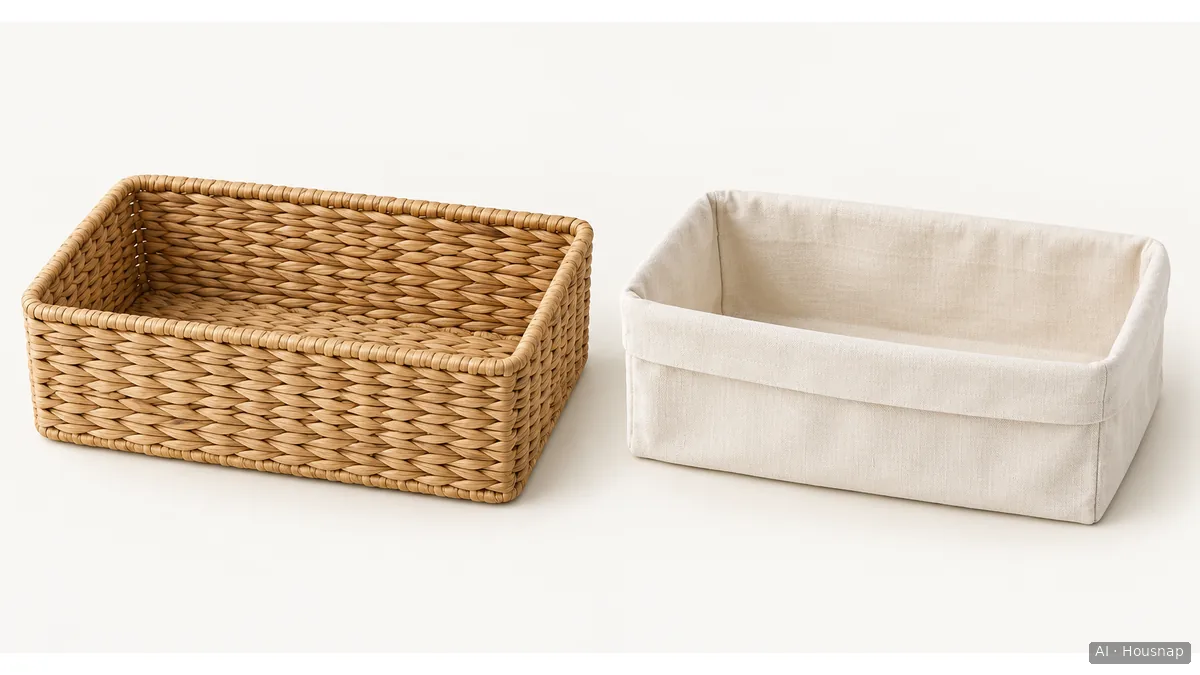
The illustration separates two parts that need separate care decisions. It does not identify their fibres or show that either part can be washed.
For a natural plant-fibre basket, avoid improvising a soak: CCI explains that these materials swell and shrink with moisture and that dyes can bleed. That guidance concerns heritage collections. Here it supports a conservative starting point for an unfamiliar basket, not a universal rule for every modern synthetic weave. Follow the exact product's instructions when available.
Lift loose dust without pulling the weave
For sound plant-fibre basketry, use a clean, very soft artist's brush or cosmetic brush you already own. If you need one, look for those specific brush types rather than a stiff scrubbing brush. CCI's method uses the brush to lift dust toward a vacuum nozzle, with repeated light passes instead of sustained rubbing at one spot.
- Support the basket. Place it on a clean, stable surface so you can work without gripping the rim.
- Control suction. If using a vacuum, reduce suction and secure fine mesh over the nozzle opening to catch loose fragments. Keep the nozzle away from the weave; suction must not lift any part of the basket.
- Work lightly. Move the brush across accessible areas, lifting dust rather than forcing bristles into gaps. Stop if fibres move, catch or detach.
These precautions come from CCI's basketry cleaning guidance. If your vacuum cannot provide gentle, controlled suction, skip it rather than modifying the machine or pressing its nozzle against the basket. There is no reason to buy a vacuum just for this job.
If your basket's own instructions call for cloth wiping instead, follow that method. When you lack a suitable cloth, the microfiber and cotton cleaning-cloth guide helps with that narrower choice; it does not establish compatibility with your basket's finish.
Decide whether the liner can be washed
Removable and washable are separate checks. IKEA describes the liner of this BRANÄS rattan laundry basket as both removable and washable. That is an example for the named product, not permission for every fabric-lined basket.
- Removal and washing are both permitted. Take out the liner and follow its stated hand- or machine-washing method, temperature limit and drying instructions. Check restrictions on bleach and tumble drying before choosing settings.
- The liner comes out, but washing instructions are missing. Ask the maker using the product reference and a photo of any label. Do not infer a wash cycle from the fabric's appearance.
- The liner is fixed or designated for another cleaning method. Keep it attached and use the specified method. Do not immerse the whole basket to wash its lining.
The product description confirms washability but does not, by itself, supply every wash setting. Use the liner label or complete product care instructions to finish that decision.
Stop at damage, then decide what can go back
Dust removal is enough when loose dust has gone. A remaining dark patch is not a reason to press harder or wet the whole basket. CCI advises stopping when the plant surface is disturbed or decoration loosens.
For an ordinary household basket with broken strands or loose joints, stop cleaning and ask the maker about continued use. For an antique or culturally significant basket, consult a conservator before further cleaning or repair; CCI specifically refers damaged collection basketry for professional assessment.
As a practical reassembly check, let a washed liner dry completely by its permitted method before putting it back. Refit it without stretching it against the rim. If it no longer fits freely, or the basket has become distorted, leave it apart and seek product-specific advice rather than forcing it into place.
How this guide was built
This article was written by AI for Housnap, using an IKEA product description and Canadian Conservation Institute guidance. It distinguishes a named liner's washability from conservative dust-removal advice for plant-fibre basketry; the household decision steps are editorial guidance, not original product testing.