Skip to content
Housnap AI
Electronics / Roof Cargo Carriers

Roof Rack or Cargo Box, Which Rooftop Carrier Should You Buy First

You have more stuff to strap to your car's roof than fits inside it, so you search roof rack vs cargo box and the results split into two shapes that barely resemble each other. One is a sealed, teardrop-shaped shell that clicks onto your crossbars and locks. The other is an open metal tray with a grid of tie-down loops. Both promise to solve the same overloaded-trunk problem, and the spec sheets do not make the choice obvious. Here is the shortcut. The decision almost always comes down to what you are hauling and how much it needs to stay dry, then how much weight your specific vehicle and rack system can actually carry, since that number is lower than most buyers expect and it trips up almost everyone on their first purchase. Neither shape is objectively better. A cargo box is the stronger pick if you are packing soft, moisture-sensitive gear, luggage, sleeping bags, ski gear, and want it locked out of sight. A basket earns its keep when the load is bulky, wet, dirty, or an odd shape that a fixed box shell could never fit. This guide walks through that first fork, the capacity and weight-limit math that confuses almost every first-time buyer, a use-case framework for deciding which one to buy, the fuel economy hit that rarely makes it onto the spec sheet, and a short checklist before you order either one.

Roof Rack or Cargo Box, Which Rooftop Carrier Should You Buy First — AI illustration

Current products to compare

These products come from Housnap search results for this topic.

Roof Rack or Cargo Box: What's the Real Difference

A rooftop cargo box, often just called a roof box, is a hard-shell, lockable enclosure that clips onto your crossbars and closes completely around whatever you put inside. Everything stays dry, secured, and out of sight, which is why GearJunkie's rooftop cargo carrier comparison and REI's cargo box buying guide both point to it as the default pick for moisture-sensitive gear: sleeping bags, tents, and a week of folded clothes for a family road trip.

A "roof rack" in the sense most first-time buyers mean it, a roof rack basket or cargo basket, is built the opposite way. It is an open-sided metal tray with raised edges and a grid of tie-down points, designed to strap down whatever does not fit inside a fixed shell, firewood, a cooler, a muddy mountain bike wheel, a stack of lumber from the hardware store. RoofBoxHub's basket-versus-box comparison frames the two around exactly that split, weatherproof and lockable versus open and flexible, and it is the fork every first-time buyer eventually has to pick a side on.

Neither is a strictly better rooftop carrier. A box wins on security, since it locks, on keeping gear dry in bad weather, and on wind noise at highway speed. A basket wins on price and on how easily you can throw something oddly shaped on top and cinch it down without worrying whether it fits. Omni Garage's roof box versus cargo rack comparison calls this exact trade-off, weatherproofing and security against price and flexibility, the one decision buyers should settle before they even start comparing brands or sizes.

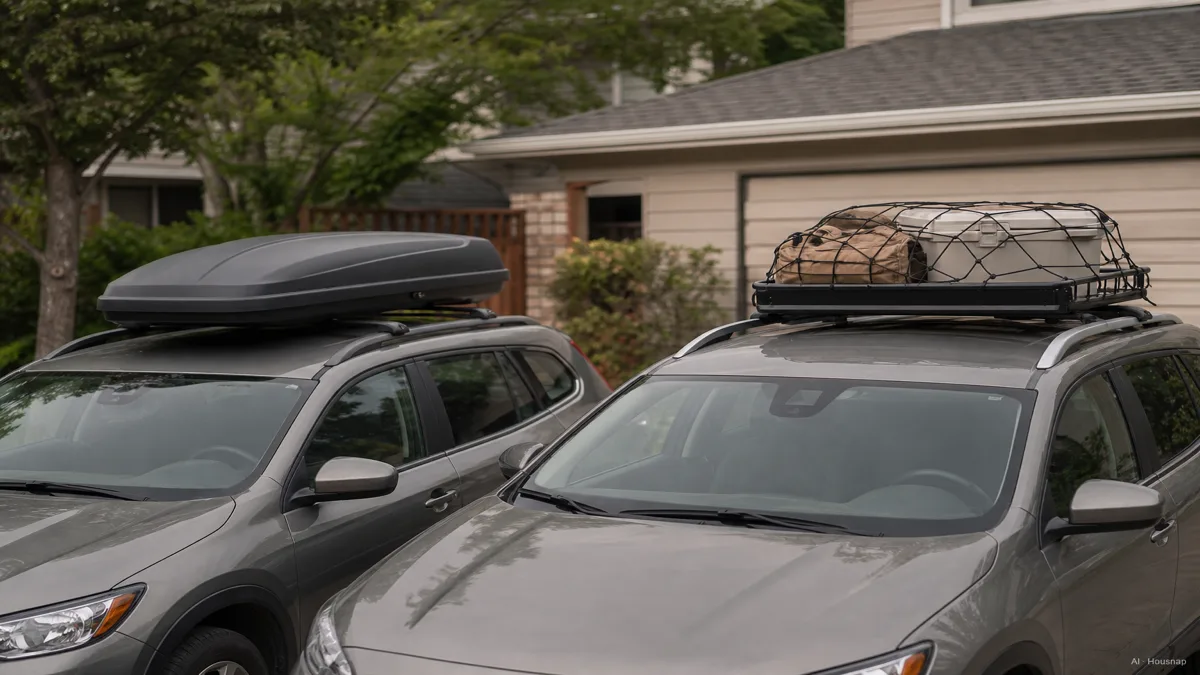
Image: a rooftop cargo box and an open roof rack basket mounted side by side on two similar cars in a driveway, the box closed and locked, the basket loaded with a cooler and a duffel bag strapped down with cargo netting — AI illustration

Cargo Capacity and Weight Limits Explained (Static vs Dynamic Load)

This is the part where most first-time buyers get lost, mixing up two or three different numbers that all get called "capacity."

Roof boxes are usually sized in cubic feet, and most fall in an 11 to 16 cubic foot range across small, medium, and large tiers, according to REI's sizing guide; even boxes built specifically for skis and snowboards tend to land in that same window. Baskets are usually rated by weight instead of volume, and a full-size basket commonly carries a stated capacity of around 140 to 165 lbs, per RoofBoxHub.

But the number printed on the box or basket is not the number that actually limits you. Most aftermarket crossbar systems carry a dynamic load rating, the weight allowed while the car is moving, of around 165 lbs, according to both Thule's own weight capacity guidance and Rack Attack's Thule-versus-Yakima guide. That is far lower than the static load rating, the weight allowed while the car is parked, which is the figure used for something like a rooftop tent. Load more than the dynamic rating and drive off, and you are outside the tested limits of your rack system, regardless of what the box or basket itself claims to hold.

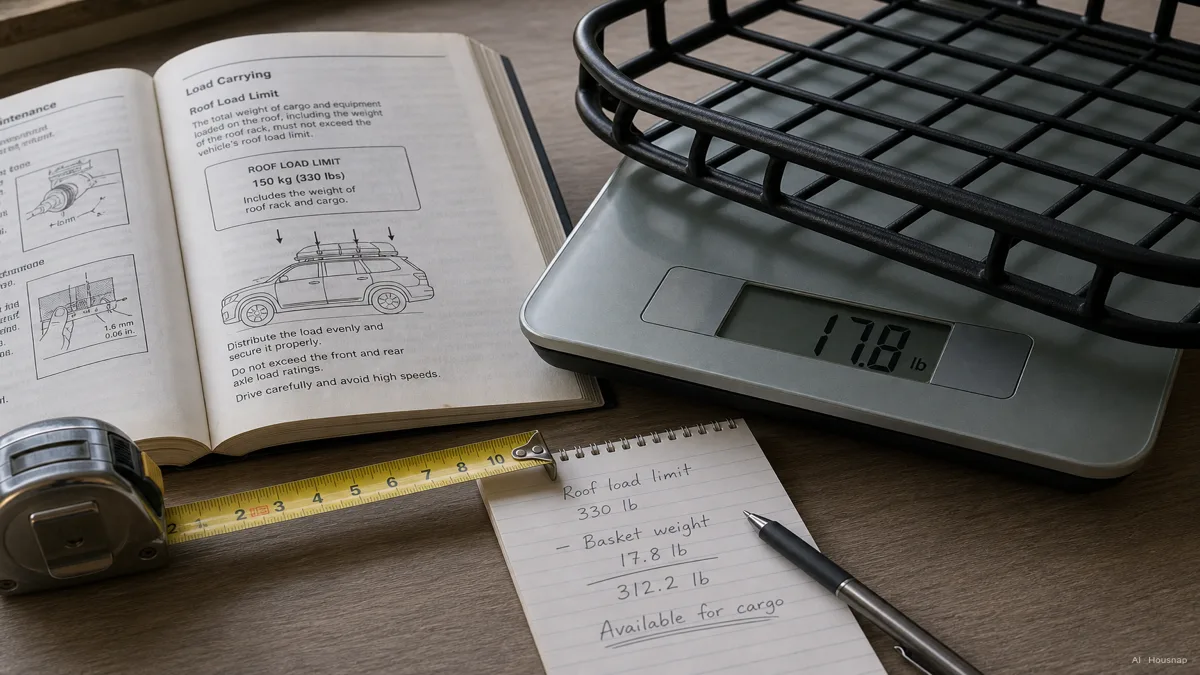
Yakima's own support documentation lays out the actual math for real usable capacity: start with your vehicle's maximum dynamic roof weight limit, found in the owner's manual, not the rack's marketing spec, subtract the weight of the crossbar and tower system, then subtract the weight of the empty box or basket itself. Whatever is left over is what you actually have for cargo, and it is almost always a smaller number than either figure printed on the carrier.

Box capacity also varies more by tier than buyers expect. An entry-level box like the Thule Sidekick holds as little as 75 lbs, while a larger box like the Yakima Carbonite is rated near 165 lbs, per Rack Attack's brand comparison, so "a roof box" is not one spec, it is a range worth checking model by model.

Image: a close-up of a vehicle owner's manual open to the roof load rating page next to a bathroom scale weighing an empty roof basket, a tape measure and a notepad with subtraction math nearby — AI illustration

Which One Should You Buy First? A Decision Framework by Use Case

Once the box-versus-basket shape is clear, most first purchases sort themselves by what is actually going on the roof.

Family road trips and air travel gear. Luggage, duffel bags, and folded clothing are exactly what a box protects best, locked, dry, and invisible to anyone glancing into a parked car at a rest stop.

Ski and snowboard trips. Skis and boards are long, narrow, and hate getting wet or salted on the drive up. A box built for winter sports gear keeps them dry and locked, which most basket setups cannot match without extra straps and a tarp.

Camping and overlanding gear. Firewood, a cooler, muddy boots, and camp chairs are bulky and dirty in ways that do not care about a fixed shell shape. A basket handles that mess and lets you hose it down afterward.

Moving, hardware runs, and irregular loads. Lumber, a mattress topper, boxes that do not stack evenly, a basket's open tie-down grid adapts to whatever you are actually carrying that week, which a rigid box cannot.

If your trips genuinely mix both, weatherproof gear on some trips and bulky odd loads on others, most roof rack systems let you swap a box and a basket on and off the same set of crossbars, so the first purchase does not have to be the last one.

The Fuel Economy Trade-off You Shouldn't Ignore

Whichever shape you pick, expect a real hit at the pump, and it is bigger than most spec sheets let on.

Consumer Reports' rooftop carrier testing found that an empty roof rack alone barely moved the needle, cutting a Toyota RAV4's highway mileage by about 2 percent, from 41 to 40 mpg. Adding a loaded rooftop cargo box changed that completely, dropping the same RAV4 down to 35 mpg, a 13 percent loss. A Nissan Altima in the same test lost close to 19 percent, about 9 mpg, once a loaded carrier went on top, compared to roughly 11 percent from the empty rack by itself.

That gap between an empty rack and a loaded carrier is the real story. Aggregated estimates from EPA, Consumer Reports, and WhatCar testing put loaded rooftop carriers at a 15 to 35 percent highway mpg loss depending on shape and load, against roughly 2 percent for an empty, aerodynamic crossbar-only setup. A box's fixed shape and larger frontal area push it toward the higher end of that range compared to a lower, open basket, though a fully loaded basket with an irregular shape can drag just as much.

If most of your hauling could just as easily go behind the car instead of on top of it, a hitch-mounted cargo carrier is worth comparing before you commit to a rooftop setup. It sits in the vehicle's existing wake instead of punching a new hole in the air, which tends to cost noticeably less at the pump, and it is usually easier to load than reaching over a roofline.

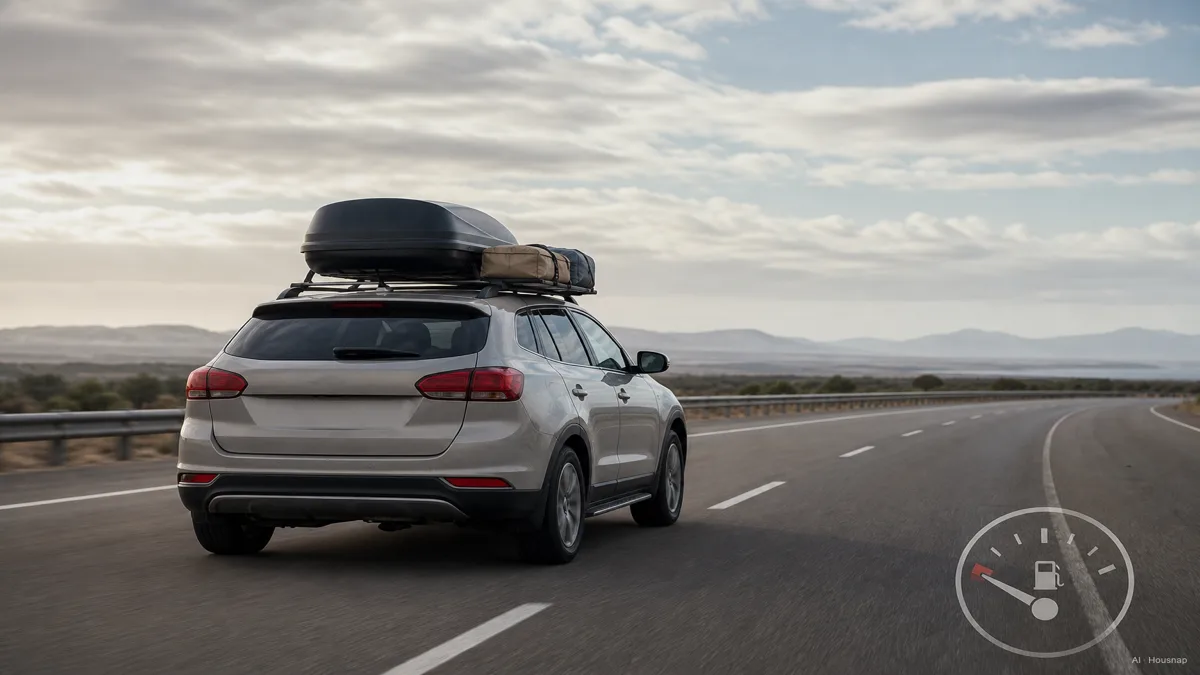
Image: a loaded car driving on a highway seen from a slight rear angle, a rooftop cargo box creating a visible wind-drag silhouette against the sky, a fuel gauge icon subtly overlaid to suggest the mileage cost — AI illustration

Buying Checklist: Vehicle Fit, Crossbars, and Budget

Before you order either one, run through these five checks.

Crossbars first. A box or basket only works with compatible crossbars already mounted to your roof or rails. Check your vehicle's fit before you shop for the carrier itself, since crossbars are frequently sold separately.

Your dynamic load number. Find your vehicle's dynamic roof weight limit in the owner's manual, then subtract your crossbar system's weight and the carrier's own empty weight. That leftover number, not the box or basket's advertised capacity, is your real budget for cargo.

Match size to your actual trips. A small box in the 11 cubic foot range fits weekend bags; a large one closer to 16 handles skis or a family's worth of luggage. Baskets scale by dimensions and a weight rating rather than volume, so measure what you are strapping down before ordering.

Garage and parking clearance. A basket sits lower than a box, which matters if you regularly park in a garage, under a carport, or in a height-restricted lot. A box adds more vertical height to the vehicle and is the one measurement first-time buyers most often forget to check.

Security and weather needs. If what you are hauling is valuable, easily stolen, or hates rain, the box's lock and seal earn their higher price. If it is bulky, dirty, or irregular, a basket's open frame and lower cost make more sense.

Sources

How this guide was built

Edited by the Housnap team · Images are AI-generated illustrations