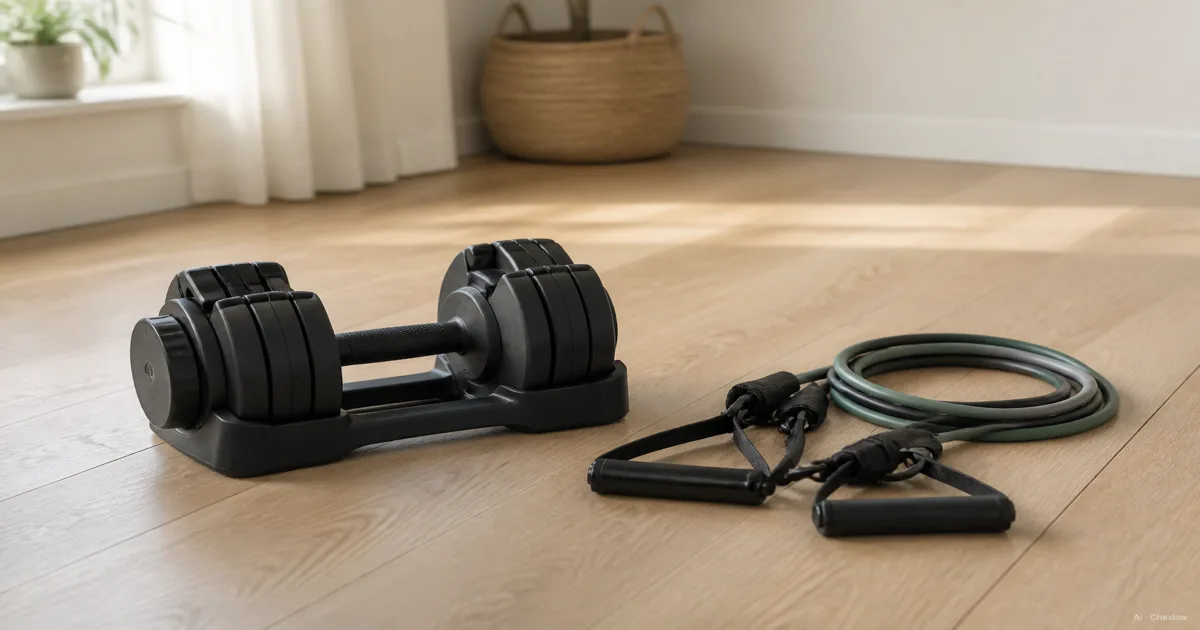
Available now from a single store
These picks currently have one store option each. Price comparison opens up as more stores are tracked.

Choose around your main constraint
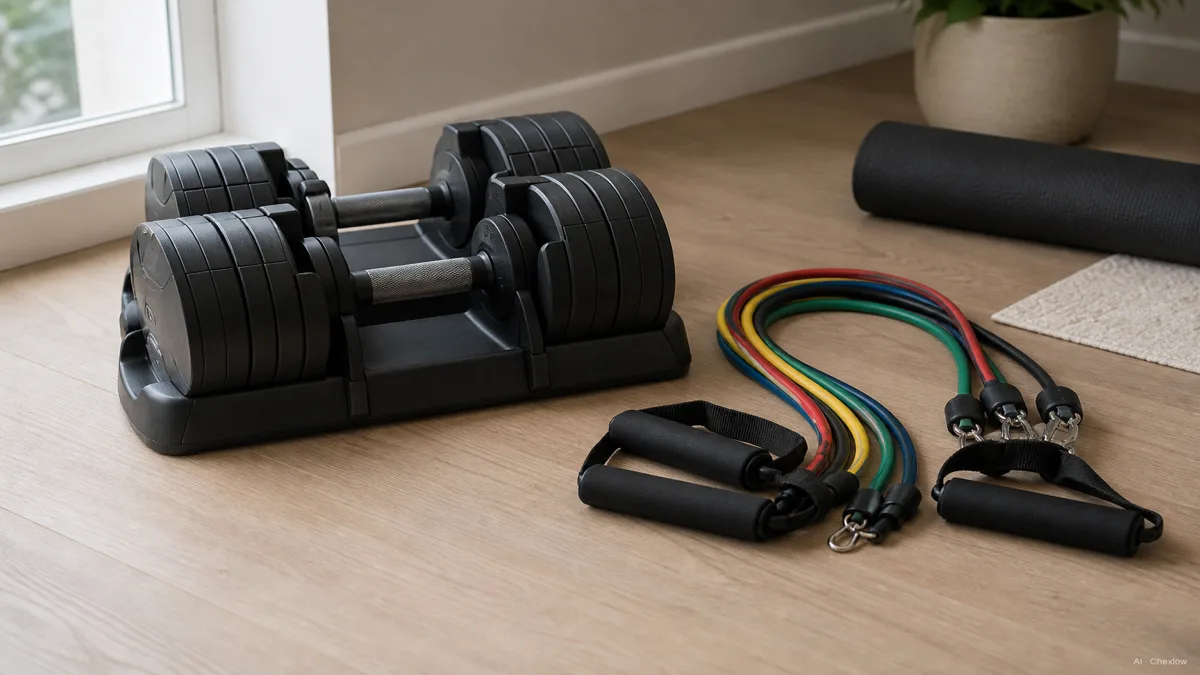
You do not need to buy both to make a sensible start. Use these priorities to narrow the choice:
- You will carry the equipment between places. Put bands first. Their portability is a practical advantage, described in THERABAND’s buying FAQ.
- You want to repeat a load and record the next increase. Put dumbbells first, then compare the available weight steps rather than just the heaviest setting.
- You have limited room. Check the actual storage footprint and exercise clearance. Compare a band kit with the dumbbells you would buy, not automatically with a full rack.
These are buying priorities, not a ranking of muscle-building potential. Pain or rehabilitation needs call for an individual exercise plan, not an assumption that an elastic band is automatically gentle.
Check how your exercises will be set up
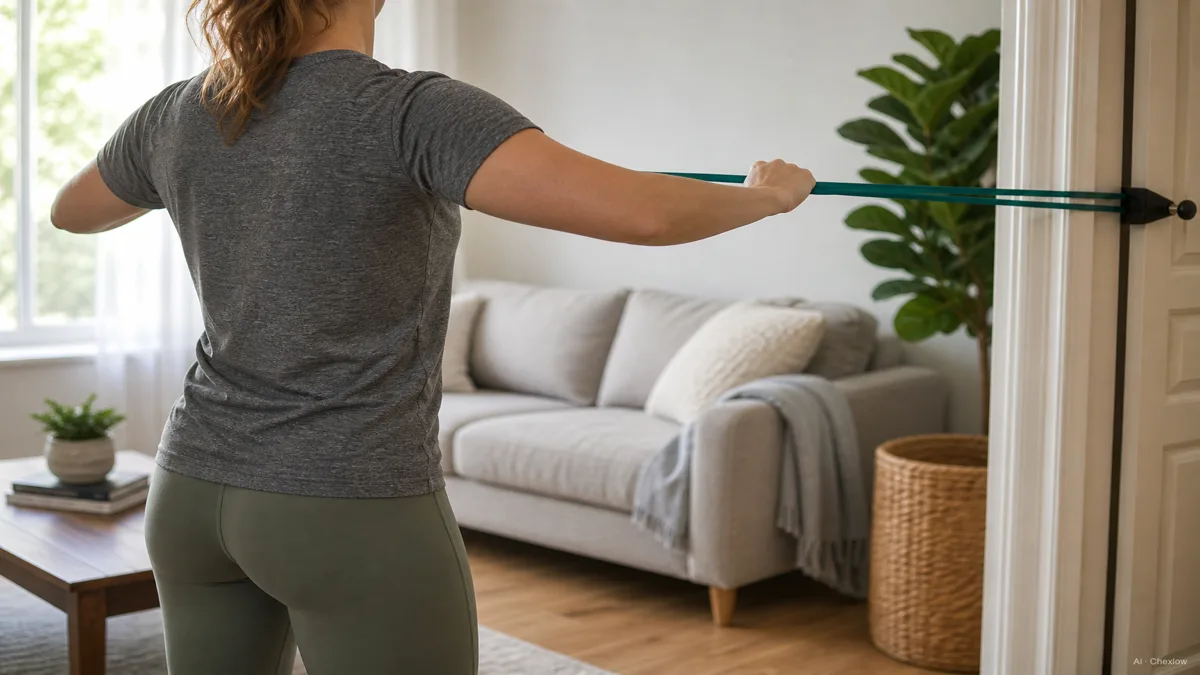
Write down the exercises you intend to follow before choosing a kit. For bands, check the required shape, length and attachment method. ACE distinguishes externally anchored exercises from movements using the hands or feet as the fixed point.
The illustration is a workout scene, not an installation guide. A two-handed pull-apart and an exercise with one end fixed to a door are different setups.
A compatible door anchor is useful only if your chosen exercise needs it. Check whether one is included and whether its instructions suit your band and door. THERABAND’s accessory guidance makes that need conditional on use; do not improvise an attachment from the picture. If you cannot establish the specified setup, choose an exercise that does not need it or reconsider the equipment.
For dumbbells, check the exercise instructions for any bench or support requirement before counting that movement as covered by the purchase.
Plan how you will measure progress
A band’s quoted resistance is not interchangeable with the same number on a dumbbell. THERABAND explains that force increases with elongation. A dumbbell’s mass stays the same, but the turning effect around a joint changes with position, as illustrated in this biomechanics paper. Neither means an identical muscular demand throughout a repetition.
Use a simple record:
- Dumbbells. Record weight per hand, repetitions and sets, keeping the movement and range comparable.
- Bands. Record the specific band, grip position, anchor position and starting distance as well as repetitions and sets. Otherwise a setup change can masquerade as progress.
- Next purchase step. Check that the set offers a manageable increase beyond your starting level. A large maximum is little help if the next step is unusable.
An eight-study meta-analysis found no superiority between elastic and conventional resistance training for strength. It did not establish which builds more muscle. Choosing dumbbells for simpler load records is an editorial buying judgment, not proof that bands cannot build strength.
Inspect the product before committing
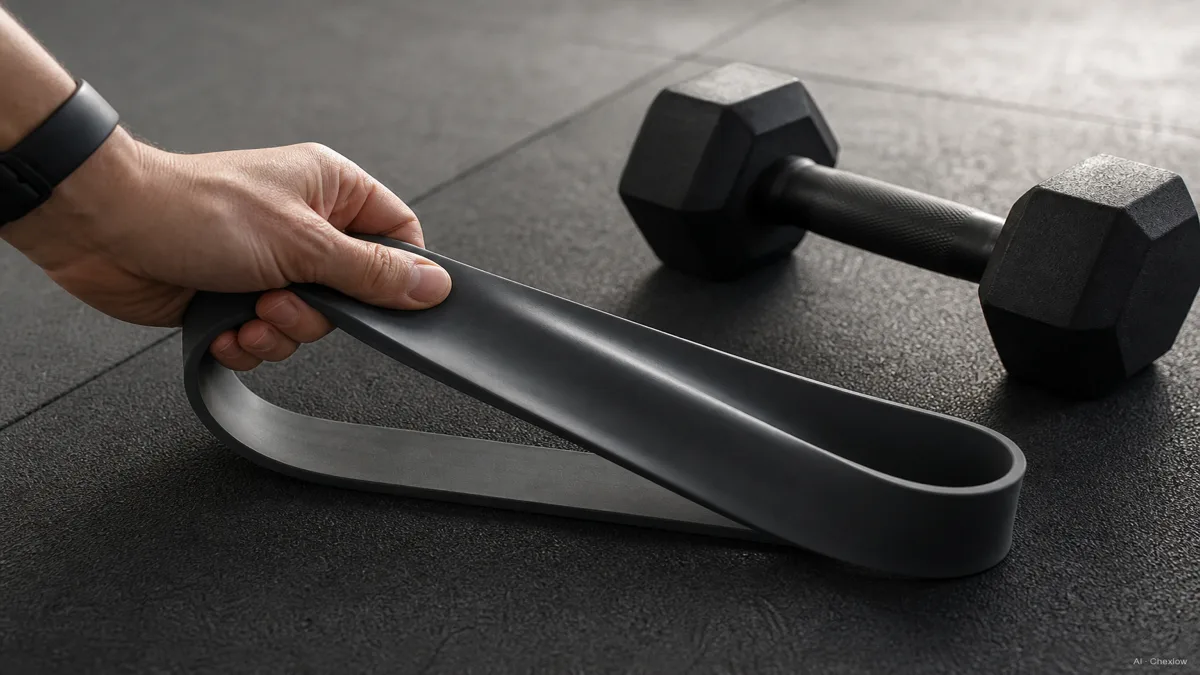
Do not treat a hard test pull as proof of quality. THERABAND advises checking for tears, cracks and wear, especially at connections, and replacing worn bands. Check material information if you have a latex allergy; the manufacturer describes non-latex alternatives.
Read the stretch limit and safety instructions for the exact band. ACE advises never releasing a band under tension. Follow any specified eye-protection and attachment requirements.
With adjustable dumbbells, locate the locking check and handling instructions before buying. For example, the Bowflex BD552 manual requires lock checks and prohibits dropping that model. Its weight steps also vary across the range. This illustrates what to check, not a recommendation of that model or a rule that all mechanisms work alike. Check the exact model’s recall status too, especially when buying used.
Buy one useful starting setup, then reassess
Compare the total cost of the setup your exercises require, including any necessary compatible attachment, rather than the headline kit price. Choose bands if carrying and storing the kit is your main obstacle; choose dumbbells if repeating and logging a known weight is the deciding benefit.
Start gradually. The NHS includes both weights and bands in strength training and recommends working the major muscle groups on at least two days a week. Let your exercise plan determine what resistance you need; there is no single starting weight suitable for every buyer and exercise.
Add the other type only when you can name the gap it would fill. If dumbbell training later raises a separate question about sore palms or difficulty holding the weight during pulling exercises, read whether lifting gloves or straps address your problem before adding accessories.
How this guide was built
This guide was written by AI for Housnap, using resistance-training research, NHS and ACE guidance, and manufacturer documentation. It turns those sources into a first-purchase comparison of setup, progression and inspection needs; it is not a product test or an individual rehabilitation plan.