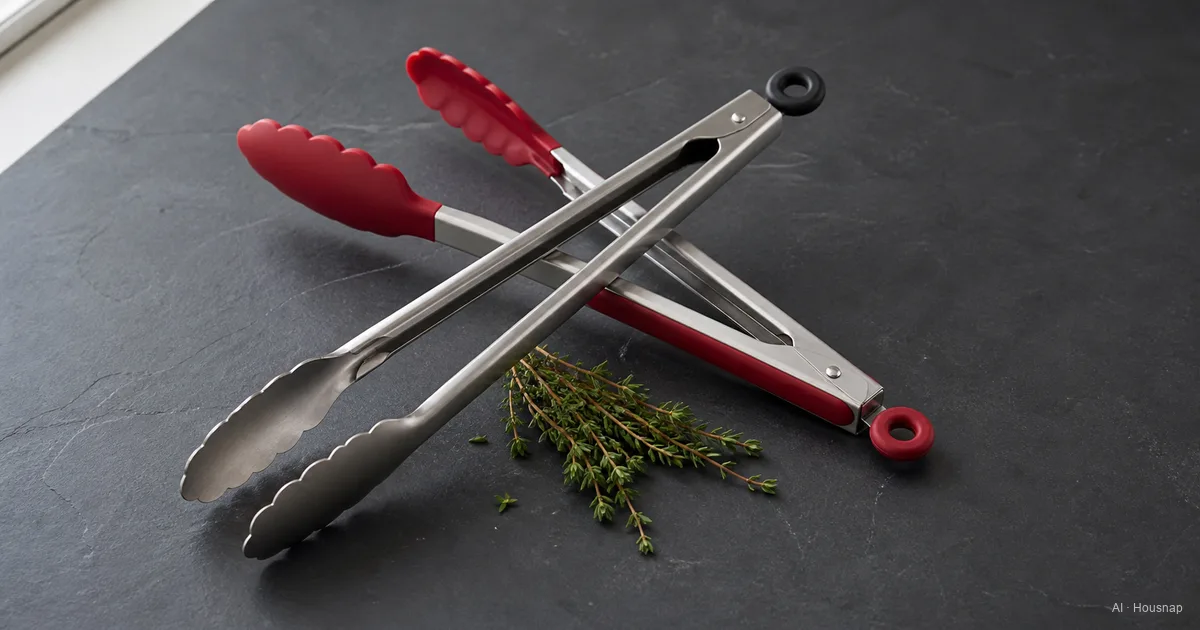
Kitchen Tongs, Locking vs. Silicone-Tip and What Length You Actually Need
Tongs are one of those tools that home cooks keep buying because the pair they have never quite works right. The spring tension is too high, so you cannot pick up a tomato slice without crushing it. Or the tips are too smooth, and a chicken breast slides off before it reaches the plate. Or the lock fails after six months and the tongs rattle open in the drawer. These are not bad luck — they are the result of choosing the wrong pair for your cooking style, or choosing a pair where the details were not checked before purchase. The decisions involved in buying kitchen tongs are more specific than they look. Tip shape, tip material, spring tension, locking mechanism, and length each affect a different aspect of how the tongs perform. A pair that is excellent for grilling will be mediocre at plating pasta. A pair designed for delicate work at the stove will feel flimsy at the barbecue. Understanding the tradeoffs before buying means you end up with a tool you actually reach for.
A pair of tongs does one thing: it transfers grip from your hand to an object that is too hot, too wet, too slippery, or too awkward to handle directly. The gap between tongs that do this well and tongs that do it poorly is not about price as much as it is about the match between the tong's design and the task you use it for.
Scalloped vs. straight tips for different tasks
Tong tips come in two basic forms: scalloped and straight. Scalloped tips have small ridges or teeth cut into the inner surface. Straight tips are smooth and flat.
Scalloped tips grip food actively. The ridges bite into surfaces that would otherwise slip — a chicken breast, a corn cob, a piece of bread. This makes scalloped tips better for most everyday cooking tasks where you need to pick up food and hold it securely. The tradeoff is that scalloped tips can tear delicate surfaces. Pressing scalloped tips into a fragile piece of fish or a ripe tomato will mark or break the surface.
Straight tips are gentler. They grip primarily through pinch pressure rather than surface bite. For delicate fish, soft vegetables, or plating where presentation matters, straight tips are less damaging. The tradeoff is that they provide less hold on irregularly shaped items. A chicken breast turns unpredictably in smooth-tipped tongs in a way that scalloped tongs hold steady.
Some tongs have one scalloped arm and one straight arm, attempting a compromise. In practice, the scalloped side does most of the work and the combination handles most tasks reasonably well. For a first pair, scalloped tips on both sides cover more ground than straight and handle the tasks most home cooks do most often (Kenji López-Alt, Serious Eats Equipment Reviews).
Locking mechanism: ring lock vs. bow lock
Almost all kitchen tongs have some locking mechanism to hold them closed during storage. The two dominant designs are ring lock and bow lock.
A ring lock is a small ring or sleeve that slides along one of the tong arms and locks the tongs closed when slid into position. Ring locks are simple, reliable, and easy to operate one-handed — important when your other hand is managing a pan or a spatula. The main failure mode of ring locks is that the ring can crack or break after extended use, particularly with cheaper plastic rings. Metal ring locks are more durable.
A bow lock is a curved spring that holds the tong arms crossed and locked. To open the tongs, you press the bow outward until it clears the arm and the tongs spring open. Bow locks are robust and rarely break. The tradeoff is that some bow locks require two hands to engage and disengage, particularly when the bow spring is stiff, which defeats some of the convenience of a locking tong.
For everyday kitchen use, a smooth-operating ring lock is generally more convenient than a bow lock. For outdoor or grill use, where you may not care as much about one-handed operation and do care more about durability, bow locks perform well. In both cases, test the lock before buying if possible — a stiff or poorly positioned lock means you will stop using it within a week.
Silicone-tipped vs. all-metal: nonstick safety
All-metal tongs — typically stainless steel throughout — have no coating and no material concerns. They can go in any pot, on any pan, at any temperature. The tradeoff is that bare stainless steel tips will scratch nonstick pans. A single deep scratch on a PTFE nonstick coating is not dangerous in itself, but a pattern of scratching over time accelerates the degradation of the coating and shortens the pan's life.
Silicone-tipped tongs have a silicone layer bonded to the metal tips. Silicone does not scratch nonstick surfaces, which makes silicone-tipped tongs safe for use in nonstick pans. The tradeoff is that silicone has a maximum temperature rating, typically around 200–230°C depending on the formulation. Using silicone-tipped tongs in a very hot pan — cast iron at high heat, or a carbon steel pan above 230°C — can damage or melt the silicone coating over time (Safe Cookware Materials, Serious Eats).
A common failure mode with silicone-tipped tongs is that the silicone sleeve separates from the metal tips after repeated high-heat use or dishwasher cycling. When the silicone pulls away from the metal, it creates a gap where food and bacteria can accumulate — a hygiene problem that cannot be cleaned out. Inspect silicone-tipped tongs periodically for tip separation.
The practical solution for most home cooks is one pair of each: all-metal tongs for cast iron, carbon steel, and outdoor grilling; silicone-tipped tongs for everyday nonstick cooking. If you have only one pair and cook mostly on nonstick, silicone-tipped is the safer default. If you cook on multiple surface types, all-metal with careful technique on nonstick is a reasonable compromise.
Length and heat exposure
Tong length is directly related to how far your hand is from the heat source. A 9-inch tong puts your hand much closer to a hot grill grate or a splashing deep fryer than a 16-inch tong. A 16-inch tong keeps your hand further from the heat but is awkward for fine work in a pan on the stovetop.
The standard lengths available are 9-inch, 12-inch, and 16-inch. Nine-inch tongs are the most controlled and precise — suitable for stovetop work, plating, and tasks where you need to feel what you are doing. They are too short for outdoor grilling, where the heat radiated from charcoal or a gas flame requires hand clearance. Twelve-inch tongs split the difference and work reasonably well for both stovetop and moderate grilling. Sixteen-inch tongs are the choice for charcoal grills and any task where the heat source is intense and your hand needs distance.
A useful approach for a kitchen with multiple cooking surfaces is one 12-inch pair as the everyday tool and one 16-inch pair for outdoor grilling. This covers most situations without requiring hand strength to work an oversized tool on the stovetop or risk burning yourself working with a too-short tool at the grill.
Spring tension: too tight vs. too loose
Spring tension is the force required to squeeze the tong arms together. It sounds trivial, but it determines whether the tongs feel tiring to use after twenty seconds or whether they give you confident control.
Too much spring tension means you are working against the tong every time you grip. After a few minutes of active use — turning chicken pieces, tossing pasta, working at the grill — your hand fatigues and your grip becomes imprecise. Oversized tongs made for commercial kitchen use often have spring tension calibrated for people who use them for hours at a time and have built up hand strength over years of professional cooking. Those same springs can make the tongs exhausting for home cook use.
Too little spring tension means the tongs feel loose and imprecise. The arms wobble slightly with each grip, which makes it difficult to pick up items accurately. Cheap tongs often have insufficient spring tension, which is why they feel flimsy and unreliable even on the first use.
The right spring tension is hard to judge from a box. If possible, handle the tongs in the shop. Open and close them ten times rapidly and note whether your hand is working hard. The tong should spring open on its own with almost no resistance when you release, and should close with moderate pressure — enough to feel secure, not so much that holding them closed requires effort. A spring that does not spring back immediately when released has lost its temper and will only get worse with use and heat.
Dishwasher safety and cleaning
Most all-metal stainless tongs are dishwasher-safe and survive machine washing without issue. Silicone-tipped tongs are usually rated as dishwasher-safe by their manufacturers, but repeated dishwasher cycling accelerates the adhesive failure between the silicone tip and the metal arm, which is the failure mode described above. Hand washing silicone-tipped tongs and drying them promptly extends their useful life considerably.
Any tong with a locking ring made of plastic rather than metal should be hand-washed if you want the lock to last. Dishwasher heat and detergent are hard on plastic locking components, which crack and become brittle over time. If the tong is otherwise metal throughout and only the lock ring is plastic, that alone is worth hand-washing to preserve.
Cleaning tongs is simple: rinse or wipe under warm water after each use. For stuck-on food in the tong pivot, a small brush works better than a sponge because the pivot is too narrow for most sponge corners to reach. Fully disassembled pivots — found on some higher-end tongs — make cleaning easier but add a step when reassembling.
9-inch vs. 12-inch vs. 16-inch use cases
To put the length question concretely: a 9-inch tong is the right size for turning bacon strips in a pan, arranging vegetables on a baking sheet, tossing salad, and plating food where you want precision at close range. It is too short for grilling anything over charcoal or high-heat gas, and marginally short for working in very tall stockpots.
A 12-inch tong covers the widest range of everyday tasks. It works on the stovetop with comfortable hand clearance from a standard gas or electric burner. It works on a gas grill with enough clearance to keep your hand out of the direct heat zone. It handles pasta-tossing, meat-turning at the oven, and most of what a home cook does every day. A single 12-inch pair of quality tongs solves most of the tong problems in a home kitchen.
A 16-inch tong is specifically for outdoor charcoal grilling, deep frying where you need to submerge and retrieve items from very hot oil, and any situation where intense heat requires maximum hand clearance. At this length, precision is reduced — working with 16-inch tongs in a sauté pan feels like trying to write with a ruler. Keep the 16-inch pair at the grill and use a shorter pair for everything else.
If budget requires choosing only one, choose 12 inches. It handles enough of the stovetop tasks to be useful indoors and enough of the outdoor tasks to work at a gas grill. Its limitations only show up at a charcoal grill with radiant heat close to the grate, or at commercial deep fryers, which most home cooks will rarely encounter.
Sources
- Kenji López-Alt, The Best Kitchen Tongs, Serious Eats — side-by-side testing of tip shape, spring tension, and grip performance
- The Best Kitchen Tongs, America's Test Kitchen — structured evaluation of locking mechanisms and real-use durability
- Silicone (material), Wikipedia — heat resistance and material properties of silicone at elevated temperatures
- Nonstick cookware, Wikipedia — PTFE coating characteristics and scratch sensitivity