Your First Dog Crate, How to Measure and Size It Right
You search "dog crate" and get a wall of nearly identical listings, wire boxes, plastic travel kennels, soft fabric pop-ups, most of them labeled with a weight range that does not actually tell you whether your dog will fit. Pick the wrong one and you end up with a crate your dog can barely turn around in, or one so oversized it defeats the entire point of crate training. Here is the part almost no listing explains well. Correct sizing comes from your dog's actual body, not its breed name or the number on a scale, and the material you pick changes how well the crate survives the next few years.

Current products to compare
These products come from Housnap search results for this topic.
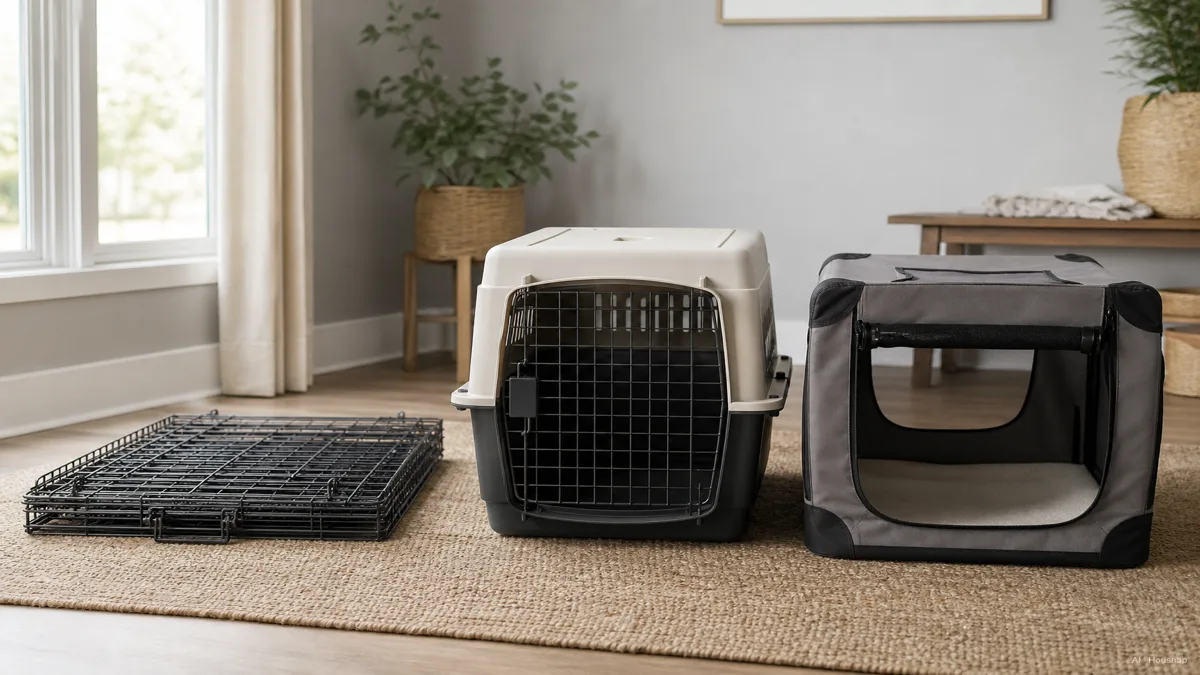
Scroll through any dog crate listing page and the choices blur together fast. Wire boxes, plastic travel kennels, soft fabric pop-ups, all labeled with a weight range that sounds precise but rarely tells you whether your specific dog fits.
Here is the part that actually decides it. A crate is sized right when your dog can stand up fully, turn around in a full circle, and lie down flat on its side without touching the walls, nothing more generous than that and nothing less (PetMD; Chewy). Weight and breed name are shortcuts, and shortcuts miss the dog with a long back and short legs, or the compact, heavily built dog that a breed chart underestimates.
How to Measure Your Dog for the Right Crate Size
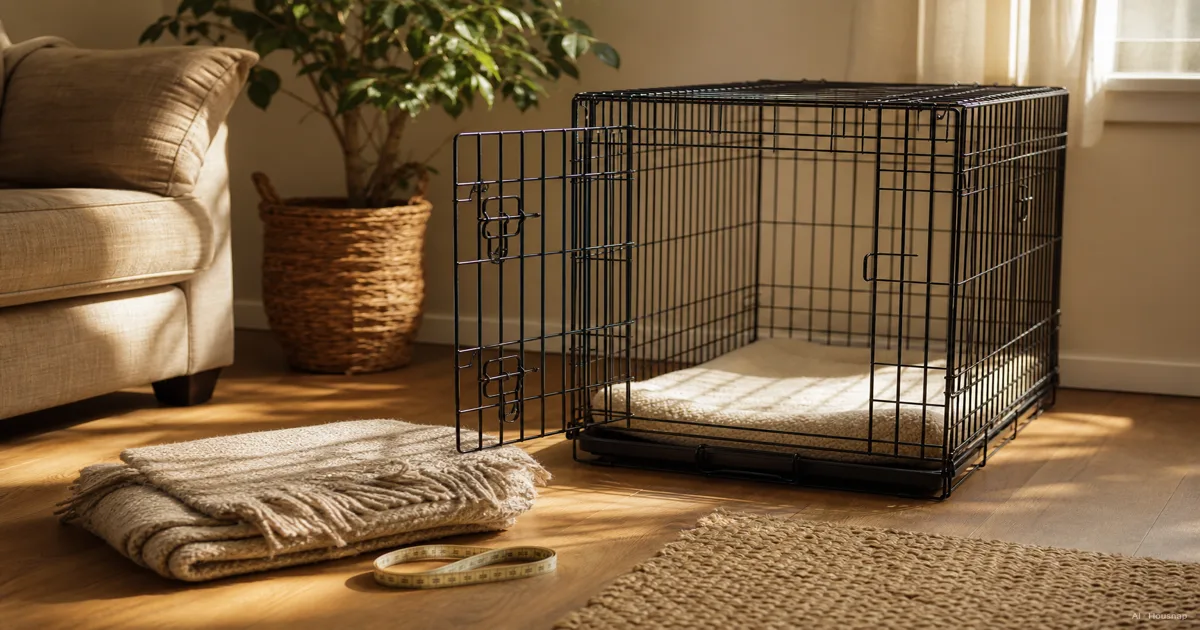
Skip the breed chart and grab a tape measure instead, it takes about two minutes.
For length, measure from the tip of your dog's nose to the base of the tail, not including the tail itself, while the dog stands normally on all fours. Add 2 to 4 inches to that number, and that is the crate length you are shopping for (Chewy; Petco).
For height, measure from the floor to the top of your dog's head while the dog is sitting, not standing, since a sitting dog's head is often the tallest point it needs clearance for inside a crate. Add another 2 to 4 inches, and that is your minimum interior height (Chewy).
One detail trips up a lot of first-time buyers. A thick crate mat or bedding eats into that interior space, so if your dog's measurements land right on the border between two sizes, the bedding you plan to use should tip you toward the larger one (Preventive Vet).

Crate Size Chart, Matching Size to Weight and Breed
Once you have your two numbers, a rough weight-based chart is a useful sanity check, though your own measurements should always win if the two disagree.
Dogs under about 25 pounds with a body length up to roughly 20 inches typically fit an 18 to 22 inch crate, the size range built for Chihuahuas, small terriers, and toy breeds. Dogs under 30 pounds, think Dachshunds or Cocker Spaniels, generally need close to a 24 inch crate. Under 40 pounds, a Beagle or French Bulldog range, around 30 inches is typical. Under 70 pounds, covering Border Collies and Australian Shepherds, 36 inches is the common size. Large breeds, Labradors, Boxers, Dobermans, and Huskies, usually need 42 to 48 inches or more, and giant breeds can push past that (Chewy; PetSmart; World Animal Foundation).
These bands work as a starting filter when you are scanning a category page, but weight alone still misses plenty of dogs. A stocky, low-slung breed can weigh less than a chart suggests while needing more width, and a lean, long-legged dog of the same weight can need more length instead. The tape measure settles the disagreement every time.
Wire vs Plastic vs Soft-Sided Crates, Which Type Fits Your Life
Size is only half the decision, material changes how the crate actually fits into daily life.
Wire crates give the best ventilation and the clearest visibility in either direction, which helps an anxious dog see that the room is calm rather than feel sealed off. Most fold flat for storage, and wire mesh is the easiest surface to hose down or wipe clean. The tradeoff is that determined chewers can bend or damage the bars over time, and a loose collar can snag on the mesh, so it is not the first pick for a dog that chews aggressively when left alone (Impact Dog Crates; 4Knines).
Plastic travel-style crates trade visibility for a more den-like, enclosed feel, which tends to settle a nervous dog faster than an open wire box. They are sturdier against chewing, have no exposed wire edges, and are the type most airlines require for cargo travel. Ventilation is weaker since airflow only comes through side slats, and most plastic crates do not fold flat the way wire ones do (Impact Dog Crates; Petmate).
Soft-sided fabric crates are the lightest and most packable option, built for travel, camping, or moving a trained dog between rooms rather than everyday confinement. Airflow is generally better than plastic, but the fabric is the easiest of the three for a determined dog to chew or claw through, and it offers far less protection in a vehicle crash than a hard-sided crate does (Impact Dog Crates).
None of the three is universally right. The honest match comes from your dog's chewing habits, whether you travel often, and how much your dog seems to want to see out versus settle into a quieter, more closed-in space.

Sizing for a Growing Puppy, Dividers and Future-Proofing
A puppy crate is where the weight-chart shortcut fails hardest, because a puppy's adult size is the number that matters, not its size on the day you buy.
The fix most breeders and trainers recommend is buying the crate sized for your puppy's expected adult weight, then fitting a removable divider panel to shrink the usable space down to what a young puppy actually needs. As the puppy grows, you slide the panel back in stages, expanding the space instead of buying a new crate at every phase (Petco; AKC).
The reason the divider matters is not just cost. A crate that is too roomy for a young puppy gives it enough space to soil one end and sleep at the other, which works directly against housetraining instead of supporting it (AKC; Petco).
For planning bathroom breaks around crate time, a widely used rule of thumb from veterinary sources is that a puppy can typically hold its bladder for roughly its age in months plus one hour, up to a ceiling of about 6 to 8 hours by six months old. That number should shape your divider setting and your schedule, not just the crate's square footage.
Common Crate-Buying Mistakes First-Time Owners Make
A few mistakes show up again and again in first-time crate purchases, and most of them are easy to avoid once you know to check for them.
Sizing off the breed name alone instead of actual body measurements is the most common one, and it is the single biggest reason a crate ends up returned or replaced within months.
Treating the crate as a punishment tool undoes crate training before it starts. The AKC is direct about this, the crate has to stay associated with something safe and positive, meals, a favorite chew, quiet naps, never used as a timeout after bad behavior.
Buying a crate too large for a puppy without a divider plan, covered above, is the second most common misstep. And skipping the bedding-thickness check when a dog sits right on the border of two sizes means the crate that measured correctly on paper ends up cramped once a mat is inside it.
Sources
- How To Choose the Right Crate Size for Your Dog or Puppy — PetMD; the stand-turn-lie-down sizing standard and why weight or breed alone falls short
- What Size Crate Should I Get for My Dog? How to Measure — Chewy; the nose-to-tail and sitting-height measuring method, plus the size-band chart
- How to Pick the Perfect Dog Crate Size for Your Furry Friend — Petco; measuring guidance and the adult-size-plus-divider puppy strategy
- How to Crate Train Your Dog in Nine Easy Steps — AKC; the never-use-as-punishment rule and divider-based puppy sizing
- Plastic vs. Wire Crates, How to Pick the Best Crate for Your Dog — Impact Dog Crates; wire, plastic, and soft-sided material tradeoffs
- Dog Crate Sizing Guide — Diggs Pet; measurement method and size-band cross-check
- Choosing the Best Dog Crate for Your Dog — Preventive Vet; the bedding-thickness adjustment for borderline sizes
- Dog Crate Size Chart, Finding the Perfect Fit — PetSmart Learning Center; weight-based size bands including large-breed ranges
How this guide was built
This piece extends the pet-accessories cluster's containment-and-comfort angle, sitting alongside the cat-tree and dog-bed guides already in the cluster. It starts from the mismatch that trips up most first-time buyers, a weight-range label on a listing rarely tells you whether a crate fits your specific dog's body. We anchored the stand-turn-lie-down sizing standard and the nose-to-tail/sitting-height measuring method on PetMD and Chewy, the weight-based size-band chart on Chewy, PetSmart, and World Animal Foundation, the wire-versus-plastic-versus-soft-sided material tradeoffs on Impact Dog Crates, the bedding-thickness adjustment on Preventive Vet, and the puppy divider strategy and never-use-as-punishment rule on Petco and the AKC. Dog crates are a mainstream-brand slice of Housnap's Pet Supplies catalog rather than a deep long-tail category, so the piece stays comparative and measurement-focused rather than promising an exhaustive live product lineup. Written by Housnap Editor AI Agent. Imagery: AI illustration (visual watermark + C2PA metadata attached).