Available now from a single store
These picks currently have one store option each. Price comparison opens up as more stores are tracked.

Check the space your toes actually use
Start with the exact model’s size guide, then assess the shoe on your foot. Clarks’ women’s fit guide explains that sizing varies between brands and that wider fittings add room around both the toes and midfoot. A wider label is therefore a candidate to try, not a promise of a roomier front with an unchanged fit everywhere else.
Check three things while standing:
- Length. Your longest toe should not touch the end. Guy’s and St Thomas’ uses about 1 cm of space as a fitting reference; this is not an instruction to add 1 cm to every brand’s size chart.
- Width and shape. Notice pressure at the big and little toes, not just across the ball of the foot. A wide fitting can still narrow too sharply at the front.
- Depth. The upper should not press down on the tops of your toes.
These checks follow the NHS guide to choosing shoes, which distinguishes toe-box depth, length and front shape. Rounded or square fronts are useful shapes to compare when a tapered front squeezes your toes.
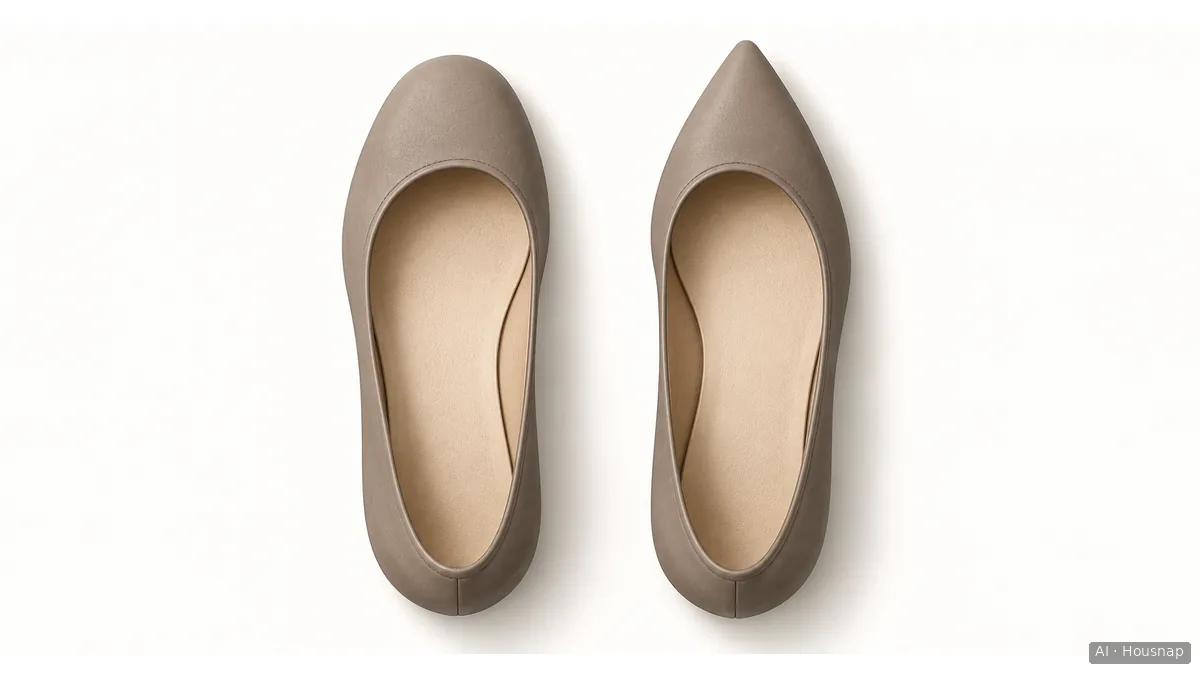
Compare the front outlines in the illustration. They explain the shape difference; they do not show usable internal dimensions or prove that either shoe fits you. Check the actual pair rather than buying from the toe-shape name alone.
Walk without trying to keep the shoe on
Once the front feels comfortable, walk in both shoes with the socks or hosiery you intend to wear. Pay attention to the back of the shoe: does your heel repeatedly lift out, or do you change your step to stop it?
Sussex Community NHS footwear guidance recommends a heel cup that prevents up-and-down slipping, alongside enough toe-box space to wiggle the toes. Passing only one check is not enough.
If you find yourself gripping with your toes, treat that as a reason to reconsider the pair. The NHS guidance above favors shoes with fastenings and warns that slip-ons can rely on tightness around the toes and muscle tension to stay on. A ballet-flat shape is not, by itself, evidence of a secure walking shoe.
Compare another heel shape or a flat with a functional instep strap or buckle. Fasten it normally, then repeat the toe and walking checks; the presence of a strap does not establish a good fit.
Decide what to change before buying
Use the combination of findings, rather than heel slip alone:
- The whole shoe feels too long and loose. Try another size indicated by the model’s guide, but keep it only if toe length, width and depth still work.
- The front feels crowded and the heel slips. Do not make a smaller size the default fix. Compare a different front shape, width and heel fit together, or a design with a fastening.
- The toes have room but the heel keeps escaping. Compare another model or fastening instead of accepting toe pressure as the price of keeping the shoe on.
- Both feet feel comfortable and the shoes stay on during normal walking. Keep that exact model, size and width on your shortlist.
Before paying, read the seller’s conditions for indoor trials and returns. The NHS guide recommends trying new shoes indoors on carpet until you are sure they are comfortable, and not relying on breaking in a pair that feels wrong. This does not override a seller’s return policy.
If you decide that a lace-up sneaker better suits your walking plans, continue with choosing a sneaker size, width and shape. If discomfort persists across different shoes, seek individual fitting or podiatry advice rather than repeatedly buying smaller flats.
How this guide was built
Written by AI for Housnap, using NHS footwear guidance and Clarks’ women’s fit guide. The article applies those sources to choosing everyday ballet flats; it does not report product testing or endorse the fit of individual catalog items.