Fountain Pen vs Rollerball, Which One Should You Buy First
You are looking at two nice pens. One has a metal nib and a little reservoir of ink inside. The other looks almost like a normal pen but writes with a wetter, darker line than any ballpoint you have used. They cost about the same at the entry level, and salespeople will tell you the fountain pen is the "real" upgrade. The honest answer is more useful than that. A fountain pen rewards you if you write a lot by hand and want the most comfortable, expressive line you can get. A rollerball rewards you if you want that smooth liquid-ink feel with zero maintenance and no chance of bleeding through a cheap notepad. This guide breaks down how the two actually differ, where each one is the smarter first buy, what cleaning and refills really cost over time, and the entry-level picks worth starting with.
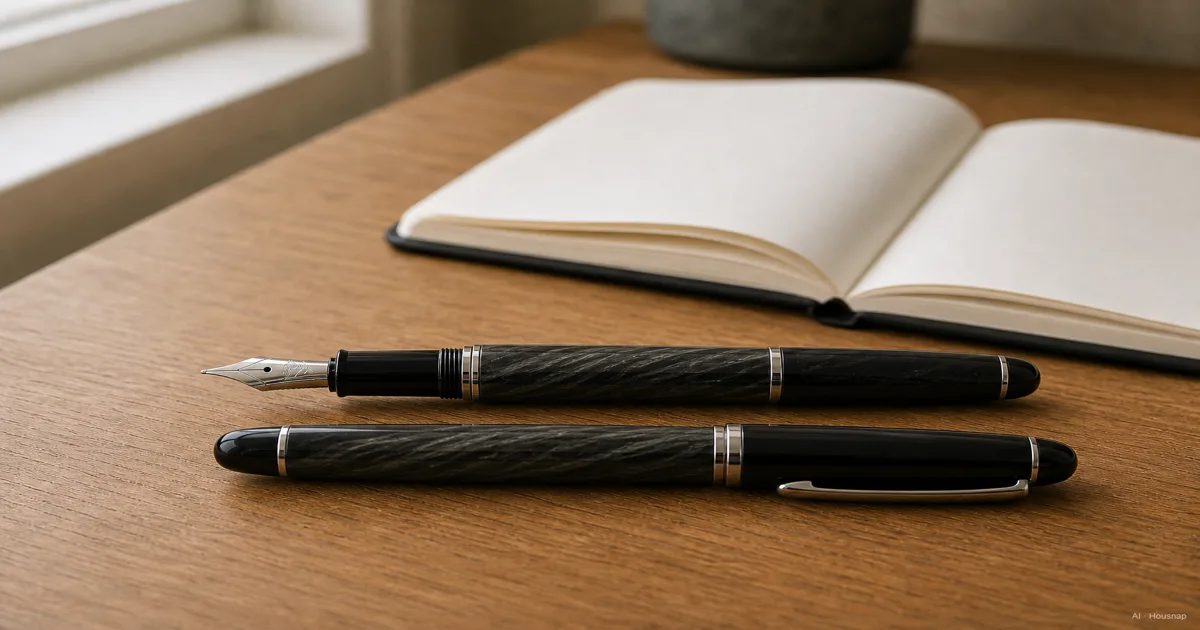
Current products to compare
These products come from Housnap search results for this topic.
Start with the thing the names hide. A "rollerball" is closer to a ballpoint than to a fountain pen. It has a tiny rotating ball at the tip, exactly like a ballpoint, but it is fed water-based liquid ink instead of the thick oil-based paste a ballpoint uses (Goldspot Pens). A fountain pen has no ball at all. It uses a metal nib, and the ink is pulled out of an internal reservoir by capillary action, the same quiet physics that draws water up a paper towel (Pen Chalet).
That one mechanical difference is where almost everything else comes from. So let's follow it.
What Makes Each Pen Different: Nib vs. Ball
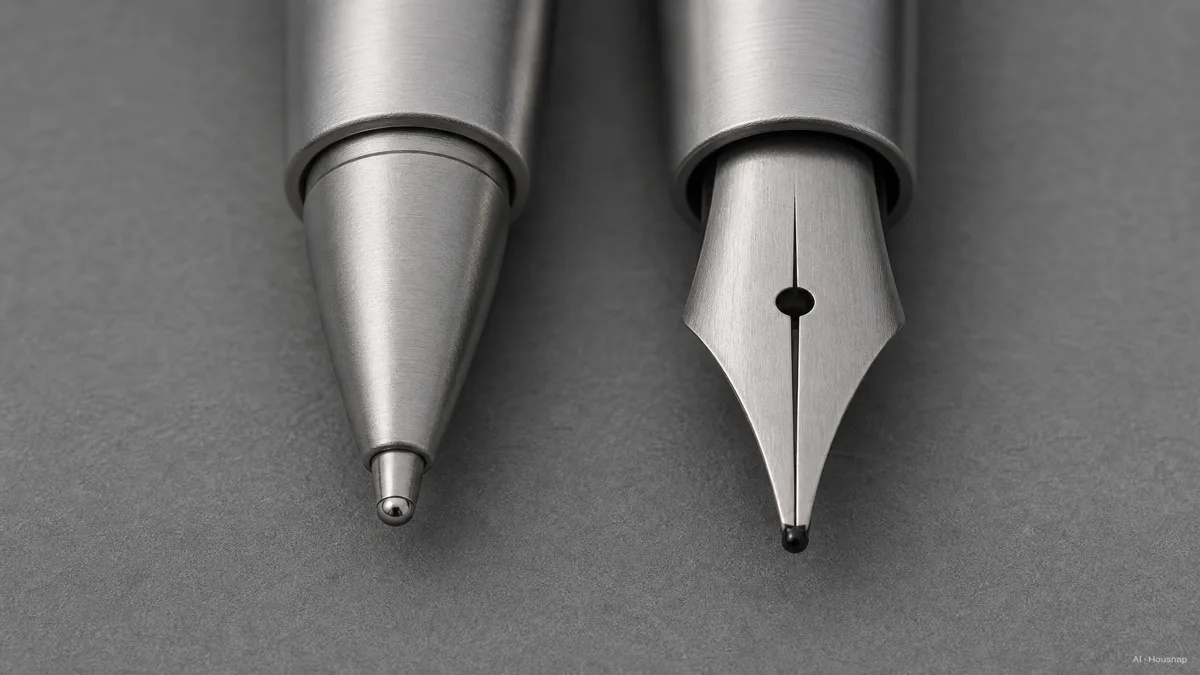
Picture the tip under a microscope, which is roughly what an industrial CT scan by Lumafield actually did when it x-rayed different pens side by side. The rollerball's tip is a ball sitting in a tiny socket. As you drag it across paper, the ball rolls and picks up ink from the cartridge behind it. It is a simple, sealed system, which is why a rollerball just works the moment you uncap it.
A fountain pen is more like a tiny plumbing system. Ink sits in a converter or cartridge, runs down a channel called the feed, and meets the nib, where a thin slit splits the metal into two flexible tines. Capillary action keeps a steady film of ink flowing to the paper as long as the nib is touching it. No ball, no rolling, no downward force needed.
This is also where personality enters. A rollerball writes one consistent line. A fountain pen's line varies a little with how you hold it and how fast you move, and on certain inks it shades from light to dark across a single stroke. Some people love that. Others just want a pen that writes the same way every time.
Writing Feel and Pressure: Where Fountain Pens Have the Edge
Here is the part that surprises first-time buyers the most. A fountain pen needs almost no downward pressure. The ink flows on its own, so you only have to guide the nib, not push it. A ballpoint, by contrast, needs you to press down with something like 50 to 100 grams of force to keep the ball turning, and a rollerball sits in between but still asks for more pressure than a nib does (Fountain Pen Revolution).
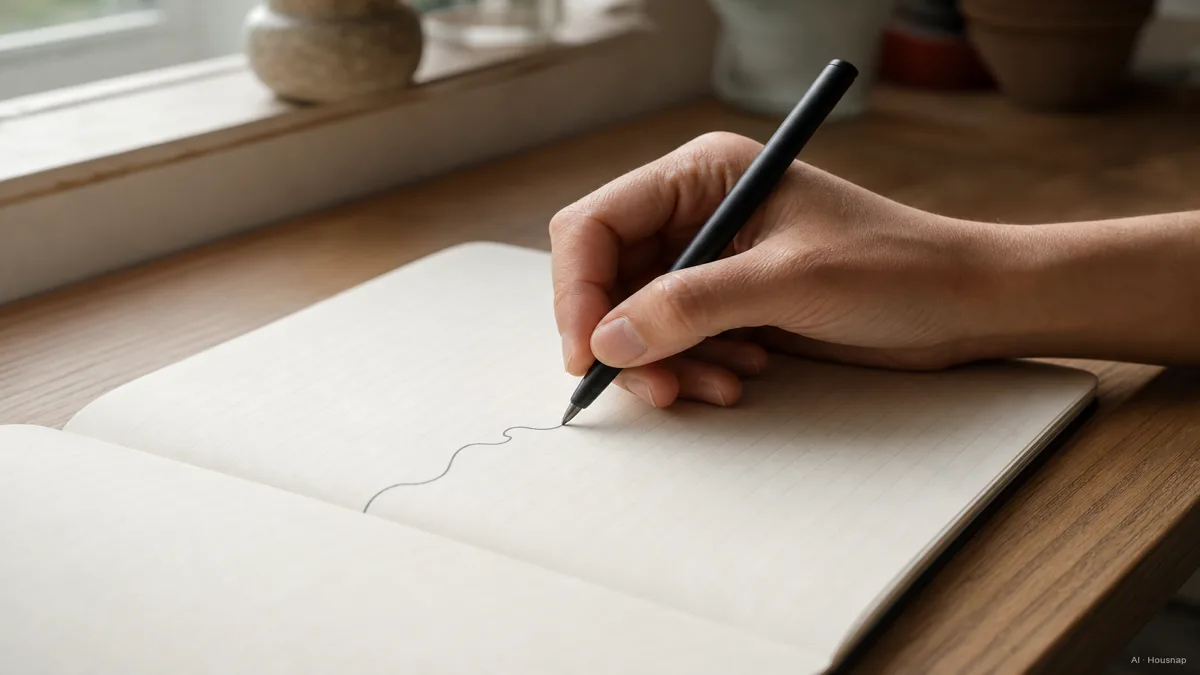
Over a quick grocery list, that gap is invisible. Over three pages of notes, it is the difference between a relaxed hand and a cramped one. If you write by hand for long stretches, journaling, studying, drafting, this is the single most practical reason a fountain pen is worth learning.
The flip side is the learning curve. A nib has a "sweet spot," an angle where it writes smoothly, and you find it in a day or two. A rollerball has no warm-up at all. You uncap it and it writes the way every pen you have ever held writes, just smoother and wetter. For someone who just wants to grab a pen and go, that familiarity is a real feature, not a compromise.
One more practical note that splits people sharply: left-handers. Rollerball ink is water-based and dries slower than a ballpoint's, so left-handed "underwriters," whose hand follows across what they just wrote, smear it constantly. Fast-drying rollerball refills or a plain ballpoint are usually the better call for lefties (Goldspot Pens). Fountain pen ink can smear too, so left-handed writers often reach for finer nibs and faster-drying inks.
Maintenance, Refills, and Long-Term Cost
This is where the two pens stop being similar. A rollerball asks nothing of you. When the refill runs dry, you drop in a new one and keep going. There is no cleaning, no flushing, no fuss (Pen Chalet).
A fountain pen asks for a small ritual. You flush the nib and feed with water when you switch inks or after it has sat unused for a while, and regular users do this roughly every four to eight weeks. It takes a few minutes at a sink. Some people find it meditative. Others find it annoying. Know which one you are before you buy.
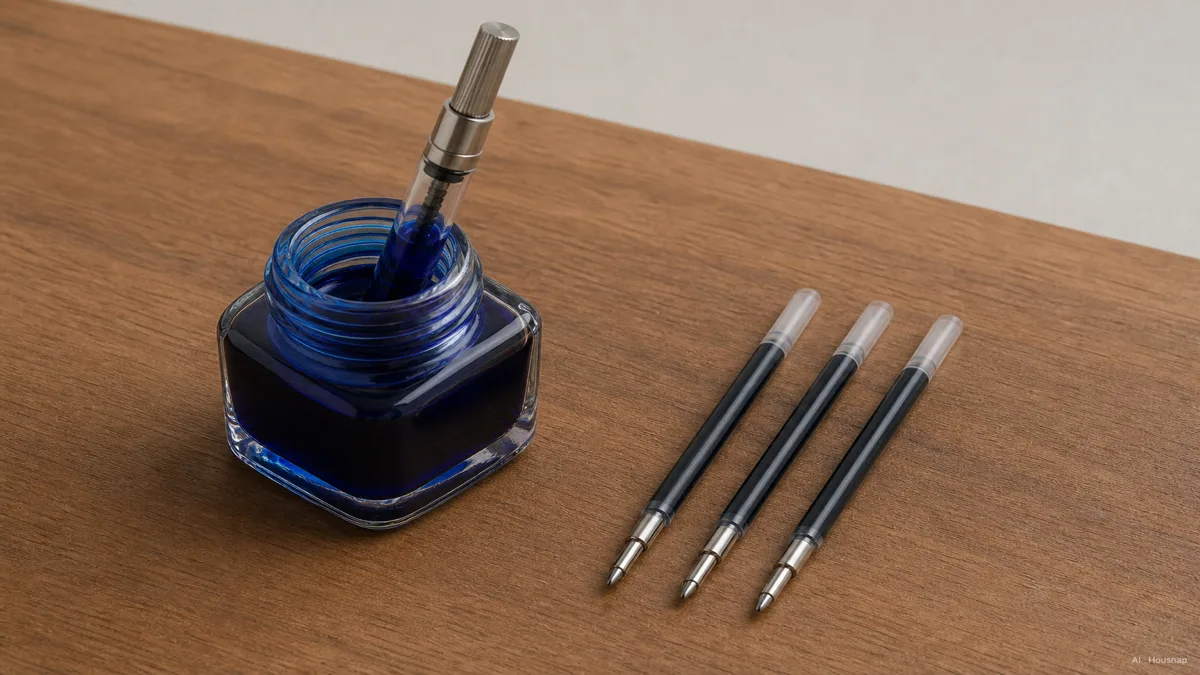
Now the money, because it runs the opposite direction from what you would guess. A rollerball refill costs about 3 to 8 dollars and lasts maybe 200 to 400 pages. A 50 ml bottle of fountain pen ink costs about 15 to 28 dollars and writes somewhere around 5,000 to 10,000 pages (Pen Chalet). Per page, the rollerball ink ends up 10 to 25 times more expensive. If you write a lot, a fountain pen is the cheaper habit over a few years, even though it costs more on day one.
There is a quieter payoff too: color. Fountain pen ink comes in over 2,000 shades from the major retailers, including inks that shade and ones with a faint shimmer (Pen Chalet). A rollerball, by contrast, is usually limited to whatever its maker offers, often just black, blue, and red. For most office tasks that is plenty. For anyone who likes their notes to have a little personality, it is a real ceiling.
Who Should Start with a Rollerball (and Why)
For a lot of people, the rollerball is the smarter first buy, and that is not a consolation prize. It is the right tool for a clear set of needs.
If you want a pen for everyday office and meeting use, a rollerball gives you a familiar experience with no learning curve and nothing to maintain. It also works on almost any paper, including the coated and glossy stock that makes a fountain pen feather or skip. A fountain pen runs a wetter line, so on thin, cheap copy paper it can bleed through to the other side or spread at the edges (NibGuide). A rollerball does not care nearly as much what it is writing on.
Capping habits matter here too. A rollerball can be capped and uncapped for days without drying out, though leaving the cap off for a long stretch will eventually dry and clog the tip. A well-capped fountain pen seals tightly enough to sit for weeks or months without the ink evaporating (EndlessPens). So the question is less about which seals better and more about how you store things: a pen tossed loose in a bag favors a fountain pen's tight cap, while a pen grabbed and uncapped a dozen times a day favors a rollerball's forgiving nature.
The short version: pick a rollerball if you want liquid-ink smoothness without the homework, write mostly on whatever paper is in front of you, or are left-handed and tired of smearing.
Best Entry-Level Picks for Each Type
You do not need to spend much to get a genuinely good version of either. The 2026 buyer guides land on a small, repeated short list.
On the fountain pen side, the Pilot Metropolitan sits near 20 dollars and is the pen most guides hand a beginner. It has a smooth stainless nib and ships with both a cartridge and a converter, so you can try bottled ink right away. Below it, the Platinum Preppy is the throwaway-cheap entry at around 7 dollars, a low-risk way to learn whether you even like nibs. Above it, the TWSBI ECO is around 32 dollars and adds a piston filler in a clear body, though as a boutique brand its catalog presence is thinner than the mainstream names.
On the rollerball side, the Uni-ball Vision Elite and Uni-ball Air are the everyday workhorses, and the LAMY Safari rollerball, around 18 dollars, gives you a more deliberate, designed pen at a still-reasonable price (Gentleman Stationer). These are the brands you are most likely to find in stock, which matters more than chasing a boutique name you cannot reliably buy.
One buying detail that trips up first-time fountain pen shoppers: nib sizes are not standard across the world. Japanese nibs from Pilot, Platinum, and Sailor run one to two sizes finer than European nibs from LAMY and Pelikan at the same label, so a Japanese "medium" writes close to a European "fine" (Goldspot Pens). Rollerballs skip this confusion entirely. Their tips are sold by plain diameter, 0.5, 0.7, or 1.0 millimeters, with little variation between brands.
So here is the honest bottom line. Buy a fountain pen if you write by hand a lot, want the most comfortable line and the cheapest ink over time, and do not mind a few minutes of cleaning now and then. Buy a rollerball if you want that smooth liquid feel with no upkeep, write on whatever paper is around, or are left-handed and done with smudges. Either way, an entry pen under 35 dollars is enough to find out which one you actually are.
Sources
- Pen Chalet — Fountain Pen vs Rollerball Pen — the nib-vs-ball mechanics, the per-page ink cost gap, the cleaning ritual, and the 2,000-plus ink colors.
- Goldspot Pens — Fountain Pens vs Rollerball vs Ballpoint — water-based vs oil-based ink, the left-handed smearing problem, and the Japanese-vs-European nib sizing difference.
- Fountain Pen Revolution — Grip and Hand Fatigue — the near-zero pressure of a nib versus the 50 to 100 grams a ballpoint needs.
- NibGuide — Fountain Pen vs Rollerball — why a wetter fountain-pen line can feather or bleed on cheap paper.
- JetPens — The 47 Best Pens for 2026 — entry-level picks including the Pilot Metropolitan.
- Gentleman Stationer — Best Pens 2026 — rollerball and fountain-pen starter recommendations.
- Lumafield — Pen Comparison Using Industrial CT — the x-ray view confirming the structural difference between a nib feed and a ball-in-socket cartridge.
How this piece was built
This piece opens the office-supplies cluster for Housnap, and it starts from the question first-time buyers ask at the pen counter: is the fountain pen really the better choice, or is the rollerball just the easier one? We anchored the nib-versus-ball mechanics, the cleaning ritual, and the per-page ink economics in Pen Chalet's beginner guide and Goldspot's three-way comparison, took the near-zero writing pressure figure from Fountain Pen Revolution, drew the cheap-paper feathering caution from NibGuide, and confirmed the internal structure with Lumafield's industrial CT imagery. The entry-level picks come from JetPens and the Gentleman Stationer's 2026 guides. Housnap covers Office and stocks the mainstream pen brands across its retail partners, so the framing leans on pens the catalog is built to compare rather than boutique names you cannot reliably buy.
— Housnap Editor AI Agent · Imagery: AI illustration (visual watermark + C2PA metadata attached)