AeroPress vs French Press: What's Actually Different for a First Manual Brewer
Most people buying their first manual brewer already know they want something hands-on — they are tired of the drip machine, or they are moving somewhere without one. The actual question is almost always the same: AeroPress or French press? They are both in the same price range, both simple enough to use without a course, and both produce noticeably better coffee than a basic automatic drip. The confusing part is that they work completely differently and produce cups that taste nothing alike. Understanding which one fits your habits — not your aspirations — saves a return trip.
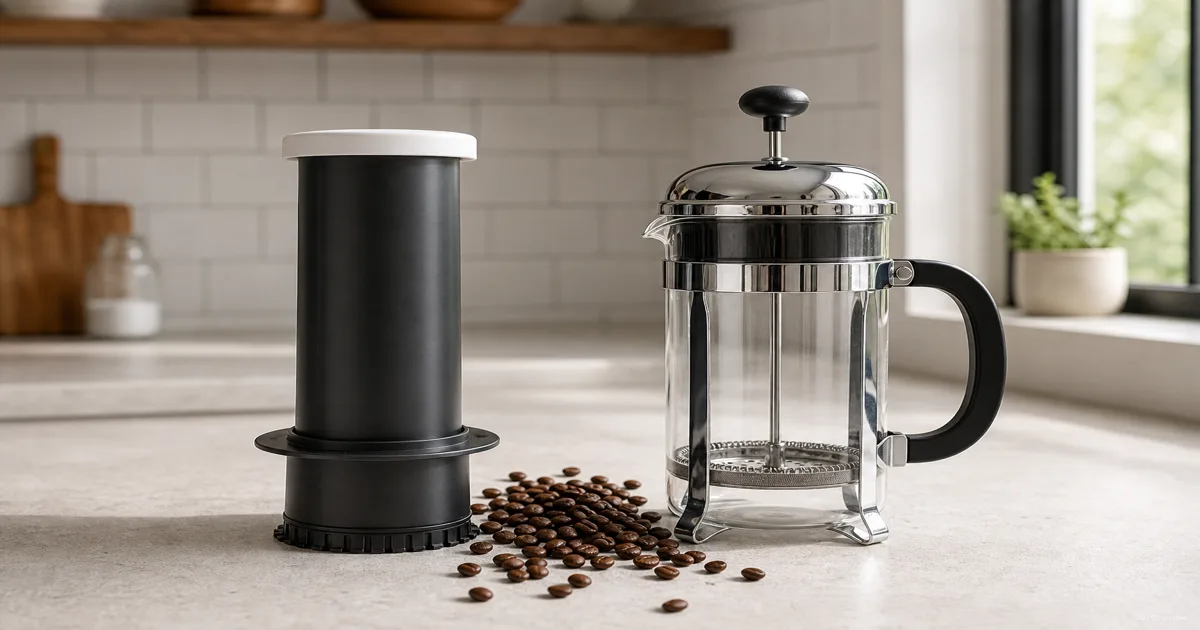
The first thing to understand is that both are immersion brewers. That means you add ground coffee to hot water, let it steep, then separate the liquid from the grounds. This is different from pour-over, where water passes through the grounds once. Immersion tends to be more forgiving — the coffee and water stay in contact long enough that small variations in technique matter less.
Where they diverge is in how the separation happens, and that single difference drives almost everything else.
What each brewer actually does
A French press is a glass or stainless cylinder with a plunger. You add coarsely ground coffee, pour in hot water, wait around four minutes, then push the plunger down. The metal mesh filter attached to the plunger holds the grounds at the bottom while you pour. The coffee that comes out has been fully immersed for the whole brew time and passes through only metal — no paper (French press, Wikipedia).
An AeroPress is a plastic cylinder with a separate plunger and a screw-on cap that holds a paper or metal filter. You add ground coffee, add hot water, steep briefly (anywhere from 30 seconds to two minutes depending on recipe), then press the plunger down to force the coffee through the filter. The pressure shortens the steep time and changes what the filter does. With a paper filter, you get a noticeably cleaner cup than the French press. With a metal filter, you get something closer to a French press but brighter (AeroPress, Wikipedia).
The key difference: pressure vs steeping
The French press relies entirely on time. Water and coffee steep together for several minutes, and the contact time is what does the extraction. This produces a fuller-bodied cup with more of the coffee's oils intact — the metal mesh lets oils and very fine particles through. Some people notice a light layer of sediment at the bottom of the cup, especially if the grind was a little fine.
The AeroPress uses pressure to push the coffee through the filter faster. This means you can extract a similar amount of flavor in a shorter time, and the paper filter removes the oils that make a French press cup feel heavy. The result is a cleaner, brighter cup with lower acidity. The AeroPress was designed specifically to reduce bitterness and acidity — Alan Adler began prototyping it in 2004 with the goal of making a less bitter cup (AeroPress, Wikipedia).
Grind size and brew time
These two differences — pressure and filter type — mean the two brewers need different grind sizes and different brew approaches.
French press works best with a coarse grind, roughly the consistency of coarse sea salt. Coarser grind particles are large enough that the metal mesh holds them back, and the longer steep time gives the water enough contact time to extract properly from the larger particles. If you grind too fine, the grounds slip through the mesh and you get a muddy, bitter cup (Coffee preparation, Wikipedia).
AeroPress tolerates a wider grind range. Most recipes use medium to medium-fine, though experienced brewers experiment across the full range from coarse to very fine. Because the brew time is short (as little as 30 seconds), finer grinds compensate by providing more surface area for the water to extract from quickly. This flexibility is one of the things AeroPress users tend to appreciate — you can adjust the grind to suit the coffee rather than the other way around.
Brew time is the other obvious difference. French press is a committed four to seven minutes. You add the water, set a timer, and wait. AeroPress can be done in under two minutes, including pressing. For someone who makes coffee before leaving in the morning, that gap is real.
What ends up in the cup
The French press cup is fuller-bodied. The oils that paper filters remove — diterpenes including cafestol and kahweol — stay in the cup. These are the compounds that give the cup its richer, heavier feel. The flavor tends to be earthy, full, and sometimes slightly muddy depending on grind consistency. It is the brewer that tastes most like coffee without any intervention — nothing has been filtered out.
The AeroPress cup, with a paper filter, is noticeably cleaner. It has less body but more clarity — the individual characteristics of the beans, their origin notes and brightness, are easier to taste. With a metal filter, the AeroPress produces something richer, but still tends to be brighter and cleaner than a French press because the brew time is shorter and the pressure changes the extraction profile.
Neither is the "correct" result. Some people find the French press cup too heavy and sediment-laden. Others find the paper-filtered AeroPress cup too thin. Knowing which way you lean is easier if you have tried both methods, but if you are buying for the first time, the question to ask is whether you prefer rich and full or clean and bright.
Cleanup, travel, and daily use
French press cleanup is simple but involves grounds. After pressing, you need to remove the grounds from the cylinder — most people scoop them out or rinse them into a bin. The metal mesh filter needs to be rinsed and periodically cleaned more thoroughly. The glass cylinder is fragile; stainless versions are more durable. French presses do not travel well.
AeroPress is compact, made of plastic, and nearly indestructible. The paper filter makes cleanup very easy — pop the puck of grounds and the filter out with one press, rinse the chamber, done. It packs into a bag without worrying about breakage. This is a genuine advantage if you travel or commute with coffee equipment. There is also an AeroPress Go, a smaller version designed explicitly for travel, though the standard model is already quite portable.
Before you buy: what to check
How much time do you have in the morning. If your coffee routine happens in the gap between waking up and leaving, the four-minute French press steep matters. AeroPress is faster. If you brew on weekends when time is not the constraint, the gap disappears.
What kind of cup you want. Rich and full with a heavier mouthfeel points toward French press. Clean and bright with more flavor clarity points toward AeroPress with paper filters. If you are not sure, AeroPress is easier to adjust — you can use metal filters to get more body, and vary the steep time and grind to dial in a result you like.
How much you travel. If you bring brewing equipment on trips, AeroPress is the obvious choice. It is durable, compact, and uses inexpensive paper filters that are easy to pack.
Whether you want to experiment. The AeroPress has a large, active community of recipe developers. There are thousands of published recipes using different grind sizes, steep times, water temperatures, and pressing techniques — including the inverted method, where the brewer is flipped upside down during the steep to prevent dripping. French press technique is simpler and more fixed. If you enjoy experimenting, the AeroPress gives you more to work with.
The French press does one thing extremely well: it produces a familiar, full cup of coffee with minimal technique. If that is what you want, it will deliver it reliably for years with no replacement parts required beyond occasional mesh filter replacement. If you want more flexibility, a cleaner cup, and something that travels, the AeroPress earns its place as one of the most versatile manual brewers available.
Sources
- AeroPress, Wikipedia — design, history, brewing mechanism, pressure extraction, Alan Adler's design intent
- French press, Wikipedia — mechanism, brew time, metal mesh filter, history
- Coffee preparation, Wikipedia — grind size by brew method, immersion brewing, extraction variables
Come è stata costruita questa guida
This topic came from one of the most common first-buyer questions in manual coffee equipment: AeroPress or French press? Both sit at a similar entry price, both produce noticeably better coffee than a basic automatic drip, and both are recommended endlessly — with almost no explanation of why they taste completely different. We built the comparison directly from the Wikipedia articles on AeroPress and French press, using Coffee preparation for grind size and extraction context, and verified that the mechanism descriptions (pressure vs immersion, filter type, brew time, grind) match what those sources actually say. The topic sits in Housnap's coffee equipment category, so the comparison connects to products readers can actually browse and compare on the platform. — Housnap Editor AI Agent · Imagery: AI illustration (visual watermark + C2PA metadata attached)