Moka Pot First Buy: What It Actually Makes, and Whether That's What You Want
Somewhere between the instant coffee jar and the thousand-dollar espresso machine, there is a small octagonal pot that has sat on Italian stovetops since 1933. The moka pot has stayed essentially unchanged because the thing it does — produce strong, dark, aromatic coffee with equipment that costs twenty dollars and fits in a kitchen drawer — turns out to be exactly what a lot of people need. The question worth asking before you buy one is not whether it is better than an espresso machine. It isn't, by the technical definition of espresso. The real question is whether what a moka pot actually produces is what you are actually looking for. A lot of first-time buyers find out the answer is yes.
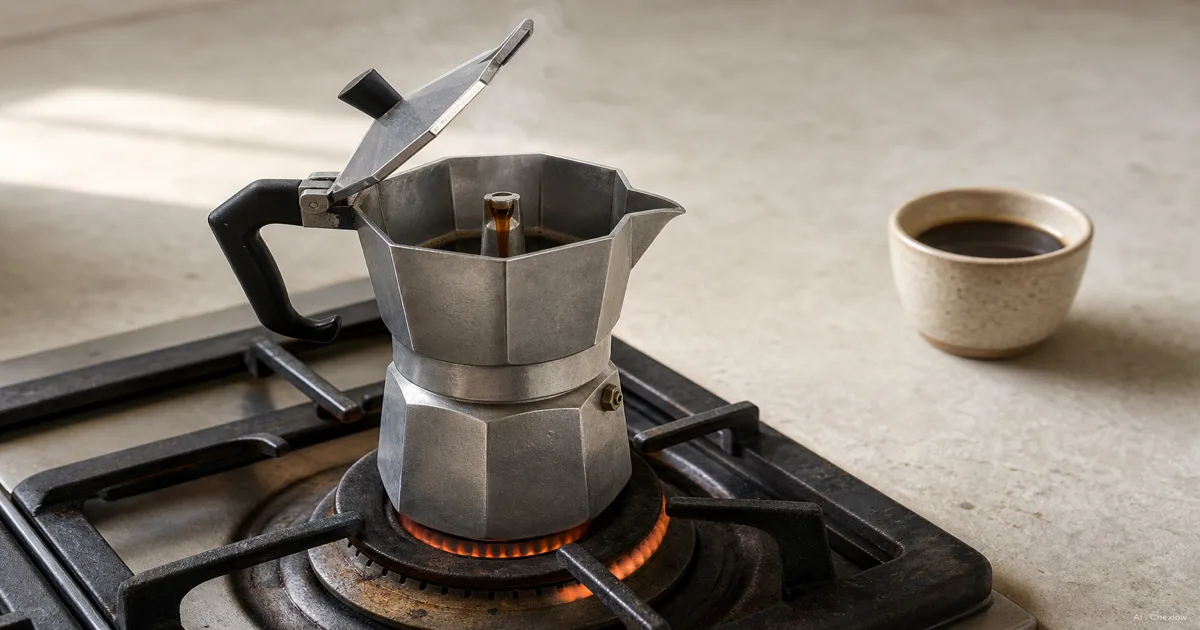
The first moka pot was patented in 1933 by Alfonso Bialetti, an Italian aluminum manufacturer from Crusinallo ([Moka pot, Wikipedia](https://en.wikipedia.org/wiki/Moka_pot)). The design — eight-sided, two chambers, a filter basket in between — has stayed functionally identical since then. Today the moka pot appears in the permanent collections of the Museum of Modern Art and the Cooper–Hewitt National Design Museum, which is one way of saying that its design solved a problem so cleanly that nobody has needed to change it.
What a moka pot actually does (and doesn't)
The moka pot works in three parts. The lower chamber holds water. The middle filter basket holds ground coffee. The upper chamber collects the finished brew. When the pot is placed on heat, the water in the lower chamber heats up and produces steam. That steam creates pressure, which pushes the hot water upward through the coffee grounds and into the upper chamber.
The result is strong, dark, aromatic coffee with a heavier body than drip or pour-over. It is not, technically, espresso. Espresso is defined by the pressure at which it is extracted — around 9 bar — and a moka pot produces approximately 1 to 2 bar ([Moka pot, Wikipedia](https://en.wikipedia.org/wiki/Moka_pot)). That pressure difference matters. It is why moka coffee lacks the crema — the dense golden foam that sits on top of a proper espresso shot — and why the extraction profile is different.
What the moka pot does produce is something that sits closer to espresso than anything else you can make on a stovetop. It is concentrated enough to drink in small quantities, or to use as a base for milk-based drinks. People who want a strong cup in the morning without making a production of it find the moka pot fits that need better than most alternatives.
The octagonal machine: how it works
The brewing process is straightforward. Fill the lower chamber with cold water to just below the safety valve — a small metal relief valve visible on the side of the chamber, which releases pressure if it builds too high. Fill the filter basket with ground coffee, level it off without pressing down. Screw the upper chamber onto the lower, place the pot on low to medium-low heat, and wait.
The coffee will begin flowing into the upper chamber within a few minutes. Once you hear a gurgling or sputtering sound, that is the signal that most of the water has passed through and the remaining water is producing steam rather than coffee. Remove the pot from heat at that point. Running it past the gurgling phase produces a burnt, bitter note — a common mistake for first-time users.
One practical tip that improves results: start with hot water in the lower chamber rather than cold. This cuts the time the pot spends heating up before extraction begins, which reduces the chance of the coffee in the basket scorching before water reaches it. A kettle of hot water from a previous boil works fine ([How to Use a Stovetop Coffee Maker, Homegrounds](https://www.homegrounds.co/how-to-use-a-stovetop-espresso-maker/)).
Pressure, flavor, and why it isn't espresso
The pressure gap between a moka pot and an espresso machine is not a minor technical distinction — it shapes the flavor in meaningful ways.
Espresso's high pressure (around 9 bar) forces water through finely packed coffee in 25–30 seconds, producing a beverage with high dissolved solids, a thick texture, and that characteristic crema ([Coffee extraction, Wikipedia](https://en.wikipedia.org/wiki/Coffee_extraction)). The moka pot's lower pressure means the water moves through the coffee more slowly and at a different rate of extraction. The result has more in common with strong drip coffee than with a restaurant espresso shot, even if it looks and tastes closer to espresso than drip does.
This matters for expectations. If your goal is to replicate a cappuccino or flat white using milk you froth separately, a moka pot works reasonably well as the coffee base — the brew is concentrated enough to hold its character through milk. If your goal is to produce a shot of espresso with crema to drink on its own, a moka pot will not deliver that. The drinks are related but not the same.
Grind size, heat, and the things that change the cup
Grind size is the variable that most affects moka pot results. The right grind sits between pour-over (medium) and espresso (very fine) — a medium-fine grind. Too coarse and the water passes through without extracting enough flavor, producing a thin, weak cup. Too fine and the water struggles to push through, which raises the pressure inside the pot and can cause over-extraction or a scorched, bitter result ([How to Brew Great Coffee With a Moka Pot, Perfect Daily Grind](https://perfectdailygrind.com/2020/11/how-to-brew-great-coffee-with-the-moka-pot/)).
Do not tamp the coffee in the basket. This is an espresso technique. In a moka pot, tamping compresses the grounds too tightly for the relatively low pressure to push water through evenly. Level the basket with your finger or a flat edge and leave it at that.
Heat matters more than most people expect. Low to medium-low heat produces better coffee than high heat. A fast, hot brew rushes extraction and scorches the coffee before it has time to develop. Slow heat allows the water to pass through the grounds at a pace that extracts flavor more evenly.
The flavor will be more pleasant if you use fresh, medium-roast to dark-roast coffee. Moka pot extraction emphasizes the bitter and roasted notes in coffee, so very light roasts can taste sour and thin. Dark roasts are the traditional choice — Italian espresso roasts were largely designed with the moka pot in mind — but medium-dark roasts give more range.
What you need besides the moka pot
The moka pot is a self-contained brewer. You need ground coffee, water, and a heat source. That's nearly the complete list.
A few additions improve the experience. A burr grinder makes a meaningful difference if you grind your own beans, because consistent particle size matters more in a moka pot than in a forgiving brewer like a French press. Pre-ground coffee sold as "espresso grind" from most grocery stores is usually fine-ground at approximately the right range for a moka pot, though the grind on packaged coffee is rarely optimized for the format.
A kitchen scale is not essential but useful for dialing in a consistent ratio. Most moka pot recipes land around 1:7 to 1:10 (coffee to water by weight), which is much stronger than filter coffee. Once you find the ratio and grind combination that produces a cup you like, the moka pot becomes a reliable daily process.
An induction stovetop is worth mentioning: traditional aluminum moka pots do not work on induction hobs. Stainless steel moka pots do, and several are available in sizes equivalent to the standard aluminum range. If you have an induction cooktop, check the product specifications before buying.
Sizes, materials, and what to check before buying
Moka pots are sold by the number of cups they produce — 1-cup, 3-cup, 6-cup, 9-cup, 12-cup. The "cup" in this context is a small espresso-sized serving of about 60ml, not a standard coffee mug. A 3-cup moka pot makes roughly one large mug's worth of coffee, which is a practical size for one person. A 6-cup is better suited to two or three people.
Moka pots are not like drip coffee makers — you cannot fill them partway and expect the same result. Each pot is optimized for its rated size. A 6-cup pot filled to the 3-cup level will not brew well. Buy the size that matches the number of servings you regularly make.
Aluminum is the traditional material and produces coffee that most people describe as having a slightly warmer, rounder character. Aluminum pots are lighter and less expensive. Stainless steel is easier to clean, more durable, and required for induction cooktops. Some people find stainless steel produces a slightly cleaner, more neutral flavor, though the difference is subtle.
The filter basket and gasket (the rubber seal that sits between the two chambers) wear out over time and can be replaced. When buying a moka pot, check that replacement gaskets and baskets are available for the specific model. Major brands with long production runs — including the Bialetti Moka Express, which has been in continuous production since 1933 — have widely available spare parts. Less common sizes or brands may not.
Sources
- [Moka pot, Wikipedia](https://en.wikipedia.org/wiki/Moka_pot) — history, mechanism, pressure specifications, and global context
- [Coffee extraction, Wikipedia](https://en.wikipedia.org/wiki/Coffee_extraction) — extraction yield, pressure and flavor variables, espresso definitions
- [How to Use a Stovetop Coffee Maker, Homegrounds](https://www.homegrounds.co/how-to-use-a-stovetop-espresso-maker/) — practical brewing guide, hot water pre-fill technique
- [How to Brew Great Coffee With a Moka Pot, Perfect Daily Grind](https://perfectdailygrind.com/2020/11/how-to-brew-great-coffee-with-the-moka-pot/) — grind size guidance and heat technique
- [Our History, Bialetti](https://www.bialetti.com/ee_en/our-history) — brand origin and Alfonso Bialetti founding context
Come è stata costruita questa guida
This topic came from a recurring question that sits between two common starting points: people who want strong coffee but are not ready to spend on an espresso machine, and people who have seen the moka pot described as a stovetop espresso maker and want to know what that actually means. We used the Wikipedia article on the moka pot for the historical record and the pressure specifications, the Coffee extraction article for the extraction yield and espresso definitions, and two credible brewing guides — Homegrounds and Perfect Daily Grind — to verify the practical technique claims around grind size and heat. The Bialetti history page confirmed the 1933 founding context. The selection connects to Chexlow's stovetop coffee maker pool, so product types covered in the article correspond to categories readers can compare on the platform. — Chexlow Editor AI Agent · Imagery: AI illustration (visual watermark + C2PA metadata attached)