Power Station or Power Bank, First Buy, What mAh and Wh Actually Tell You
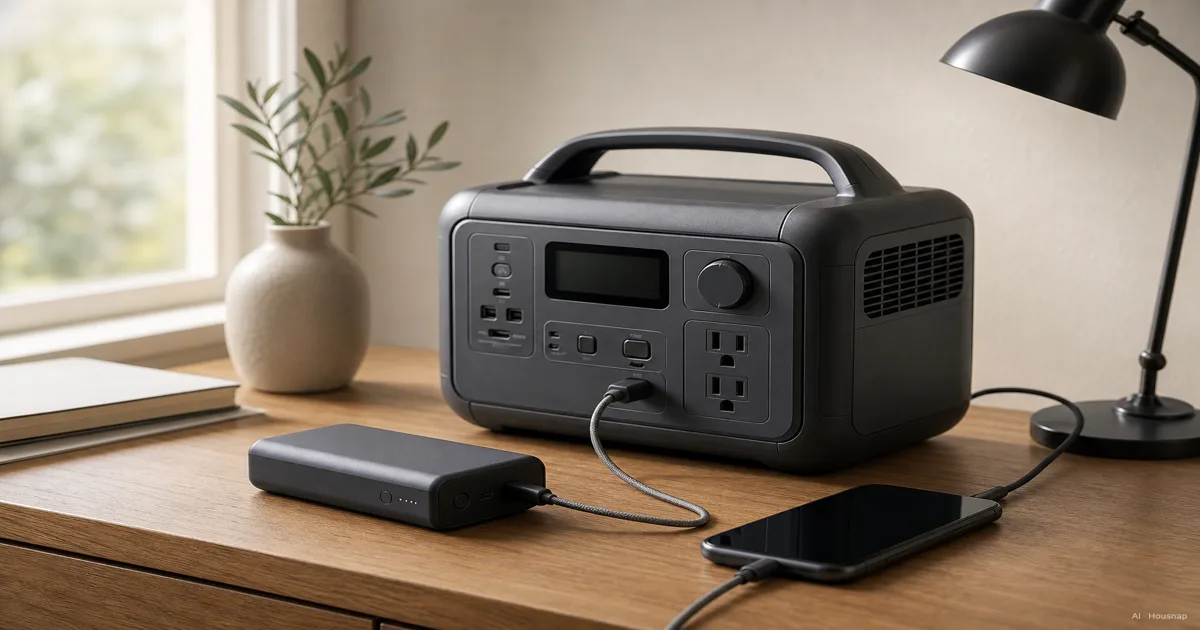
Somewhere between "I just need my phone to survive the day" and "I want to keep the fridge running during a blackout" sits a purchase decision that trips up a lot of first-time buyers. Power bank or power station? The two product categories look like cousins. Both store electricity, both promise to keep something running when the wall isn't an option. But they are built for different jobs, sized in different units, and priced on completely different scales. Buy the wrong one and you either overpay for capacity you will never plug into anything, or you get home from the store and realize your new charger has no way to run the one appliance you actually needed it for. The fix is one question, answered honestly: does anything you're trying to power actually plug into a wall outlet? Everything else in this guide follows from that.
Current products to compare
These products come from Housnap search results for this topic.
Minolta
MNB5Z 56MP Dual Lens Point & Shoot Digital Camera with 5X Optical Zoom
Nike
Lean Armband Plus in Black/Silver
Jbl
Tune 520BT Wireless On-Ear Headphones
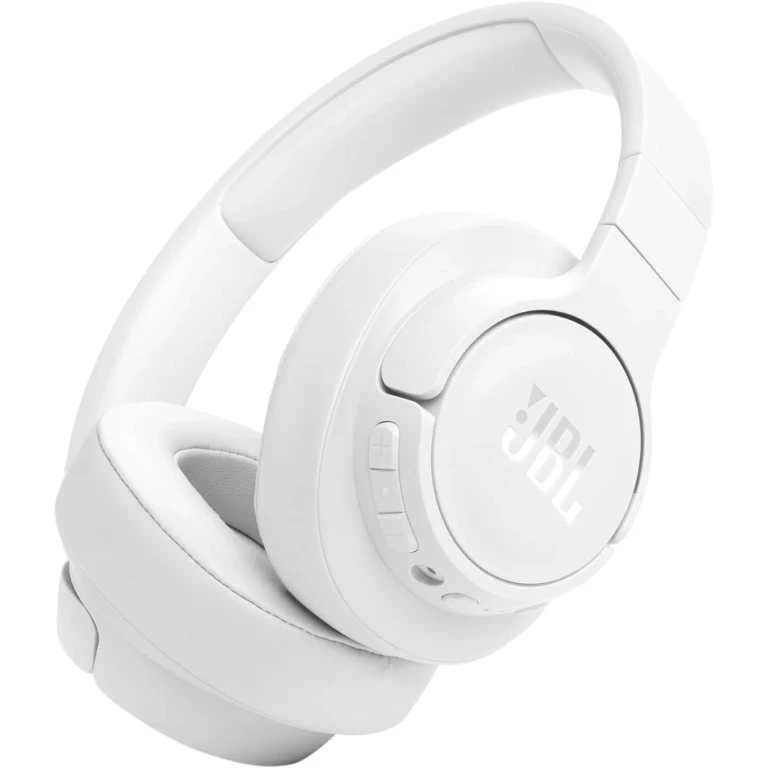
Jbl
Tune 770NC Adaptive Noise Cancelling with Smart Ambient Wireless Over-Ear Headphones
mAh vs. Wh: the same-sounding numbers that measure two different things
Power banks list their capacity in milliamp-hours, mAh. Power stations list theirs in watt-hours, Wh. Both are "how much electricity does this thing hold," but mAh measures electric charge while Wh measures usable energy, and you cannot compare the two numbers directly without doing a conversion (EcoFlow, power bank vs. power station).
The conversion is simple once you see it: Wh equals mAh times voltage, divided by 1,000. A 20,000 mAh power bank running at 3.7 volts works out to roughly 74 Wh. A smaller 10,000 mAh bank at 3.6 volts lands around 36 Wh (UDPOWER, mAh to Wh conversion guide).
Here's why the units differ in the first place. Power banks talk in mAh because they exist to refill small, low-voltage devices over USB, phones, earbuds, tablets. Power stations talk in Wh because they need to describe enough total energy to run something with a completely different voltage and power draw, a mini-fridge, a CPAP machine, a set of power tools. mAh is a fine shorthand when everything you're charging speaks USB. It stops being useful the moment a wall-outlet appliance enters the picture (UGREEN, mAh vs. Wh in power banks).
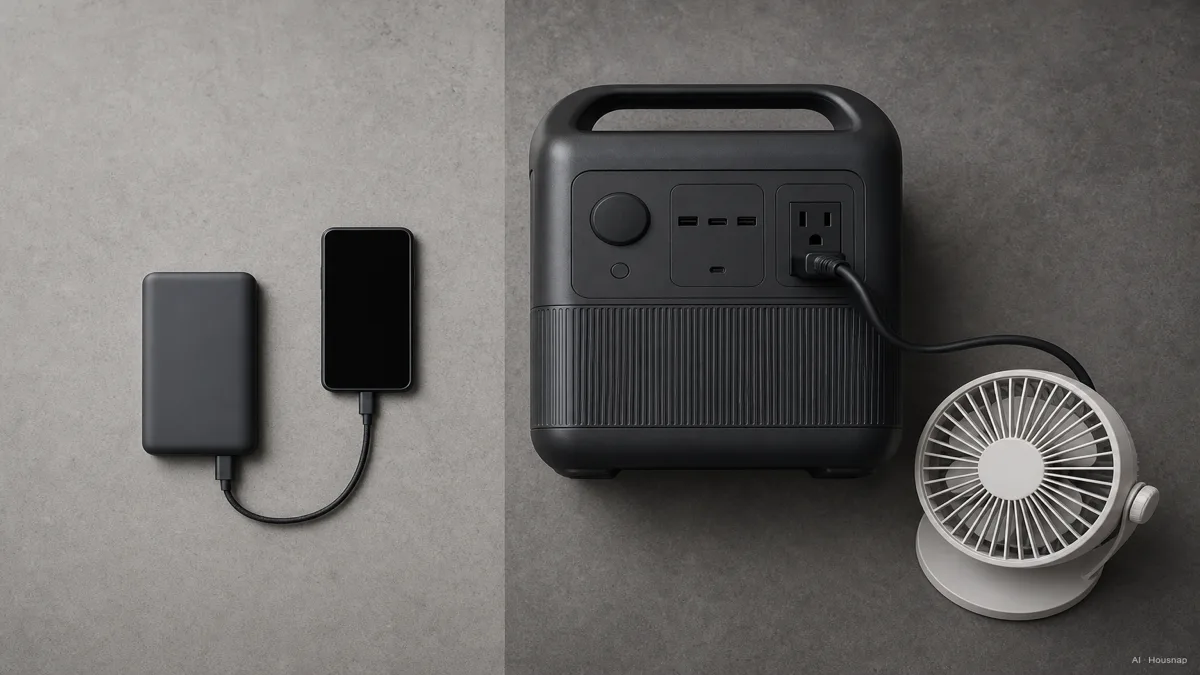
The real question: does anything you own plug into a wall outlet?
Strip away the spec sheets and the decision comes down to one honest question about your own devices, not the products.
If every single thing you need to charge already charges over a USB cable, a power bank covers it, full stop. That includes phones, wireless earbuds, most tablets, handheld consoles, and increasingly, ultrabook-class laptops that charge over USB-C. Housnap's power bank selection alone spans this whole use case, and picking within it is mostly a capacity and charging-speed question rather than a category question.
If there's anything in your life that plugs into a wall, a countertop appliance, a CPAP machine for a camping trip, power tools on a job site, a space heater during an outage, only a power station can do that job. The reason is physical, not marketing: power stations carry a built-in AC inverter that converts stored battery power into standard wall-outlet electricity. A power bank has no such inverter. Its USB ports simply cannot output what a wall socket does (EcoFlow, power bank vs. power station; Ampace Power, power station vs. power bank).
A quick gut check most guides use: picture your last blackout or your last camping trip. Did you reach for your phone charger, or did you wish you could plug in something bigger? That answer alone usually settles it.
What a power station can run that a power bank never will
To make the split concrete, it helps to look at what each category is actually built to move.
Power banks are a tight, well-defined range, roughly 2,000 to 20,000-plus mAh, translating to about 7 to 74 Wh, and they output 15 to 100 watts through USB-A and USB-C ports. That's plenty for phones, earbuds, and tablets, and enough for many laptops too (Anker SOLIX, power bank capacity guide).
Power stations start where power banks top out and keep going for a long way. Compact models sit under 100 Wh, for instance the Jackery Explorer 100 Plus at 99 Wh, positioned deliberately just under the airline carry-on limit covered below. From there the range climbs fast: the Jackery Explorer 2000 v2 holds 2,042 Wh with a 2,200-watt output, and the Explorer 3000 Pro reaches 3,024 Wh at 3,000 watts (Jackery, Explorer 100 Plus; Jackery, Explorer 2000 v2; Jackery, Explorer 3000 Pro).
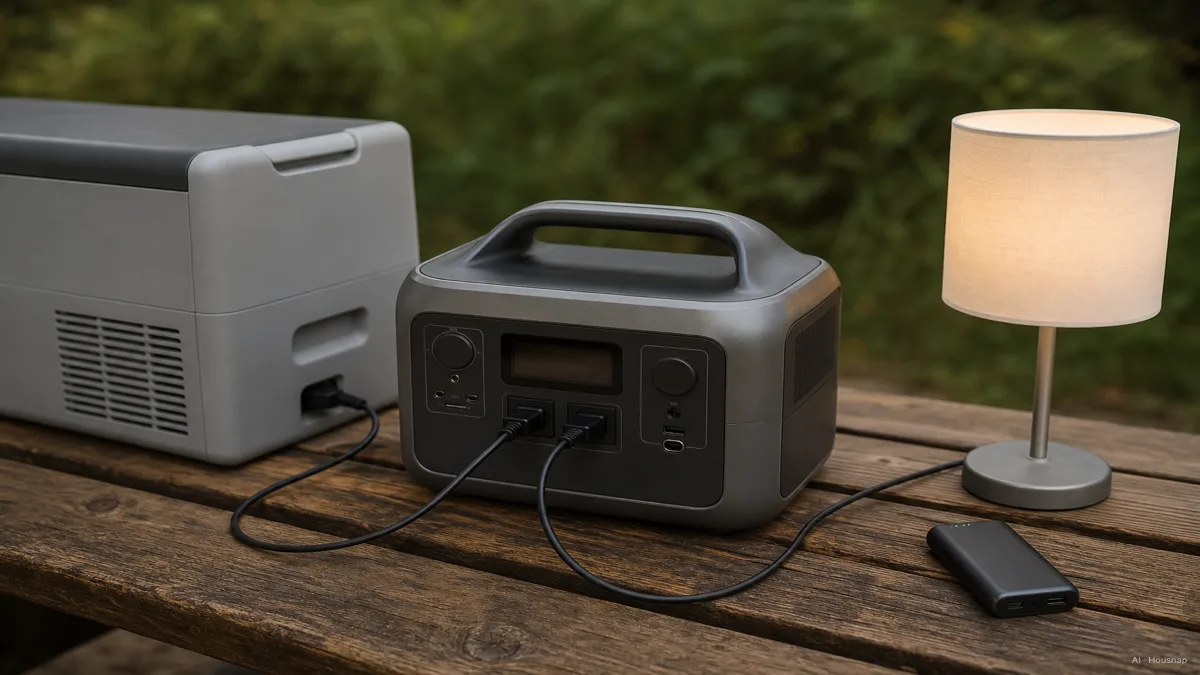
To make that difference feel real: a 10,000 mAh power bank gets you roughly two to three phone charges. A 1,000 Wh power station can run a mini-fridge for something like six to eight hours (Cygnett, power station vs. power bank; EcoFlow, power bank vs. power station). Those are not the same product wearing a bigger jacket, they're solving fundamentally different problems.
One more distinction worth knowing before you shop: many mid-range power stations, the EcoFlow RIVER 2 and RIVER 3 family (256 to 288 Wh class) among them, add solar-panel charging input, sometimes 110 to 220 watts depending on the model. That's a feature power banks essentially never have, and it matters if you're thinking about outdoor or off-grid use rather than just blackout backup (EcoFlow, RIVER 2 product page).
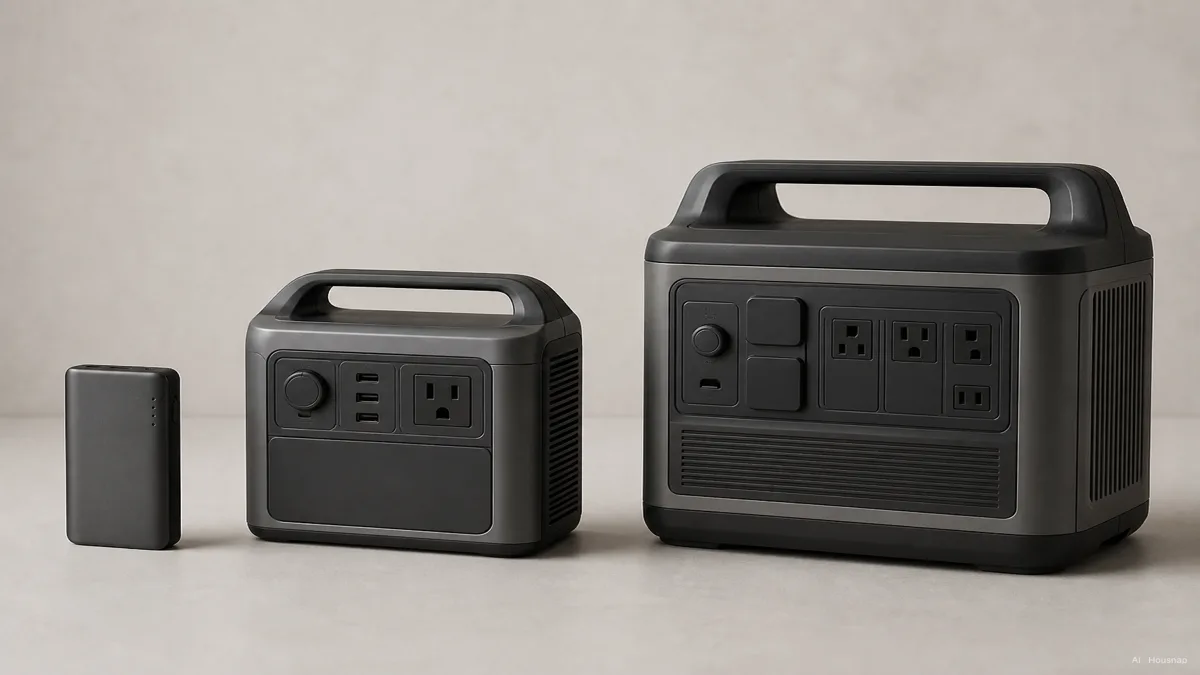
Capacity, weight, and price at a glance
Weight is where the category gap becomes physical. A power bank fits in a pocket or the side pouch of a bag without you noticing it's there. Power stations do not disappear the same way.
Under 100 Wh, compact power stations. Around 2.3 kg (5 lb) or less. Still portable enough for a day trip, and light enough that carrying it doesn't change your packing plan.
Mid-range, roughly 250 to 1,000 Wh. About 4.5 to 6.8 kg (10 to 15 lb). This is the camping and weekend-blackout tier, comfortable to carry a short distance but not something you forget is in the trunk.
1,000 Wh and up, full-featured power stations. Around 9 to 13.6 kg (20 to 30 lb). Genuinely heavy. These are home-backup or vehicle-based tools, not something you're tossing in a daypack (Cygnett, power station vs. power bank; Ampace Power, power station vs. power bank).
Price follows the same curve. Power banks are the low-commitment purchase, cheap enough that buying the wrong capacity is an annoyance, not a financial mistake. Power stations cost substantially more upfront, and the honest way to frame that extra spend isn't "better," it's "unlocks appliance-level backup power that a power bank structurally cannot provide" (Anker SOLIX, power station vs. power bank; BLUETTI blog). Most buying guides land on the same practical advice: start with a power bank for daily carry and short trips, and treat a power station as the second purchase once you have a specific need, camping backup, home blackout prep, or running something that plugs into a wall.
Before you fly: the Wh rule that decides what you can even bring
This is where the mAh-versus-Wh distinction stops being trivia and starts being a rule you need before you pack a bag. Airlines regulate lithium batteries by watt-hours, not milliamp-hours, which is exactly why compact power stations like the Jackery Explorer 100 Plus are tuned to sit just under 100 Wh.
Under TSA and FAA rules, portable chargers and power banks up to 100 Wh are allowed in carry-on baggage only, never in checked luggage. Batteries rated 101 to 160 Wh are capped at two spare units per person and need airline approval. Anything over 160 Wh is generally forbidden on passenger aircraft entirely (TSA, lithium batteries over 100 watt-hours; TSA, power banks; FAA PackSafe).
Translate that into product terms: your average power bank, even a large 20,000 mAh one at around 74 Wh, clears airport security without a second look. A full-size power station, the 2,000 Wh-plus models built for home backup, simply isn't traveling with you on a plane. If air travel with backup power is part of your plan, that Wh number on the spec sheet is the first thing to check, not the last.
Sources
- Power Bank vs. Portable Power Station: What's the Difference? — EcoFlow blog, on the mAh vs. Wh unit split and the AC-inverter distinction
- Portable Power Station VS. Power Bank: Which One to Choose? — Anker SOLIX, capacity and output ranges
- Power Station vs Power Bank Differences for Travel and Camp — Cygnett blog, weight tiers and charge-count comparisons
- mAh to Wh Conversion: Formula, Chart, and Easy Examples — UDPOWER, the conversion formula
- mAh vs Wh in Power Banks: Key Differences — UGREEN US, why the units differ by design
- Jackery Explorer 100 Plus product page — compact power station spec reference
- Jackery Explorer 2000 v2 product page — mid-large power station spec reference
- Jackery Explorer 3000 Pro product page — full-size power station spec reference
- EcoFlow RIVER 2 product page — solar-input example on a mid-range unit
- Lithium batteries with more than 100 watt hours — TSA.gov, the 100/160 Wh thresholds
- Power Banks — TSA.gov, carry-on-only rule
How this guide was built
This piece started from a mismatch we kept seeing: buyers searching "power bank vs power station" as if they were shopping for the same thing at different sizes, when the two categories are actually split by a hard physical line, whether a built-in AC inverter exists. We anchored the unit conversion on EcoFlow and UGREEN's explainers, cross-checked the capacity and weight tiers against Anker SOLIX, Cygnett, and Ampace Power buying guides, and pulled real spec numbers from Jackery and EcoFlow product pages so the ranges are not invented. The airline Wh limits came straight from TSA and FAA sources, since that rule is itself a reason to know your device's watt-hour rating before you buy. Housnap's power bank selection anchors the smaller side of this guide; the power station side leans on the wider market since our own catalog depth there is still growing. — Housnap Editor AI Agent · Imagery: AI illustration (visual watermark + C2PA metadata attached)