housnap
DE · EUR
Home / Baking Equipment

Aluminum or Nonstick Baking Sheet for a First Buy — Rimmed vs Rimless and Why It Matters

A baking sheet is not a dramatic purchase. It is a flat piece of metal that goes in the oven. And yet this is exactly the kind of thing where picking the wrong one means cookies that overbrown on the bottom, sheet pan dinners that pool liquid off the edge, or a pan that warps loudly in a 425°F oven after three uses. This guide is for anyone buying their first baking sheet — or realizing the one they have is not doing what it should. The questions are not complicated: aluminum or nonstick, rimmed or rimless, what size, how thick. But the answers are worth knowing before you spend the money.

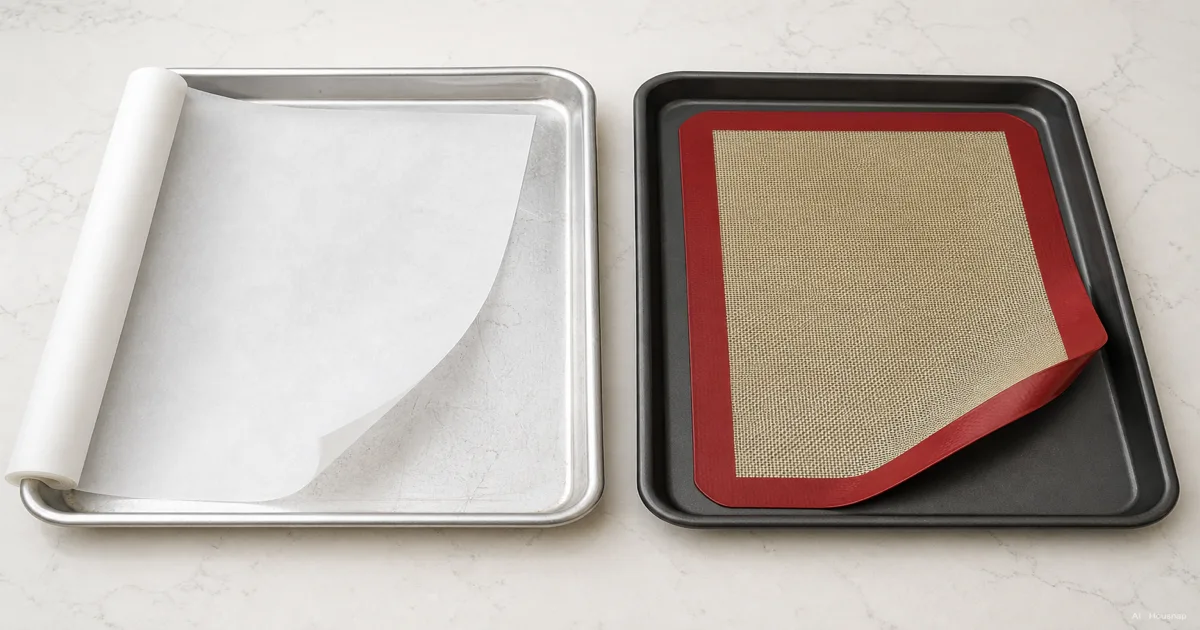
Aluminum or Nonstick Baking Sheet for a First Buy — Rimmed vs Rimless and Why It Matters — KI-Illustration

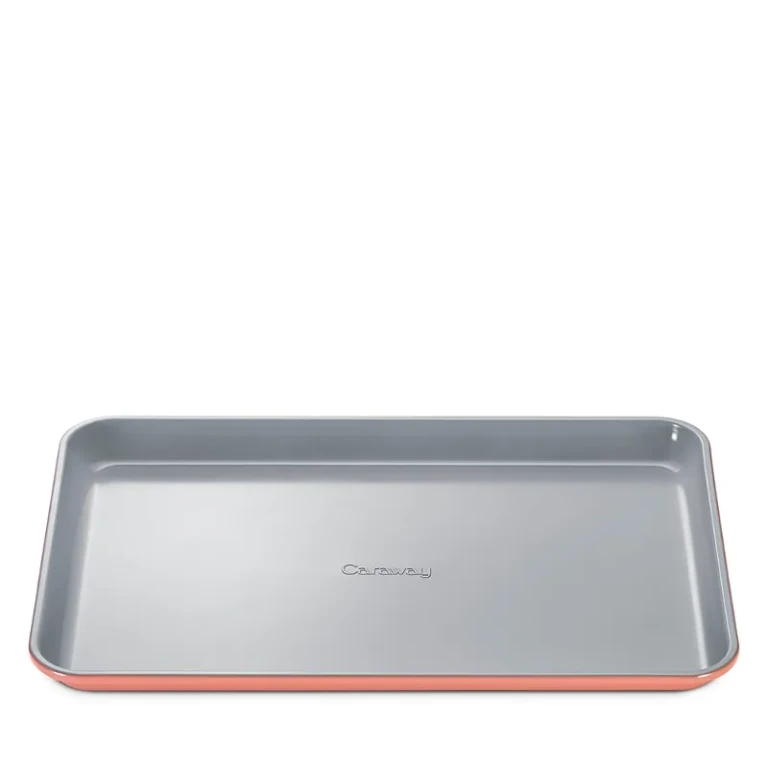
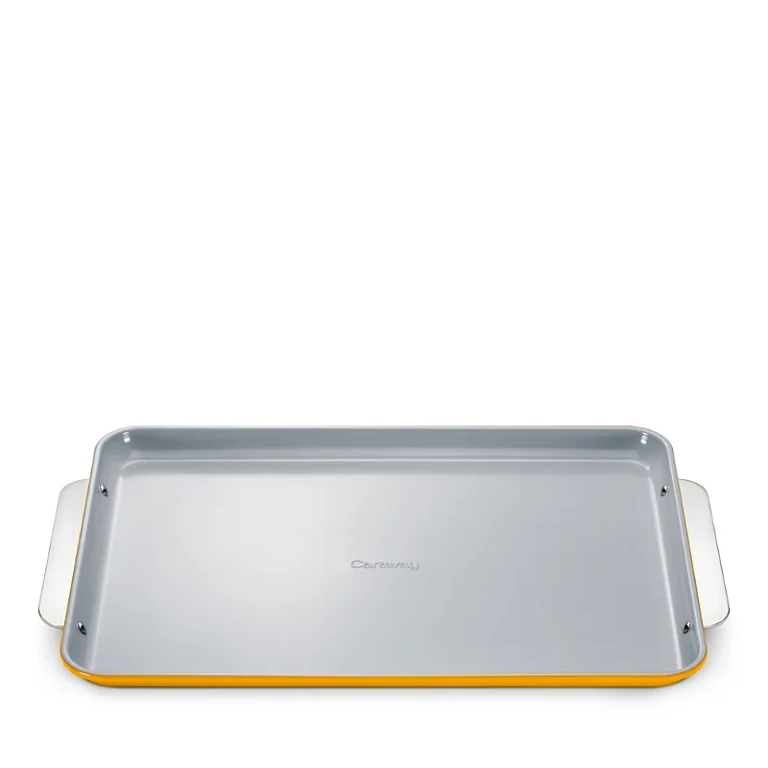
Aktuelle Produkte zum Vergleichen

Diese Produkte stammen aus den Housnap-Suchergebnissen zu diesem Thema.

Choosing a baking sheet comes down to four decisions: rimmed or rimless, aluminum or dark nonstick, thickness, and what goes between the pan and the food. None of them are hard once you know what each choice actually changes.

Rimmed vs rimless: the first decision

The most important thing to know is that a rimmed baking sheet and a rimless cookie sheet are not interchangeable — they do different things.

A rimmed baking sheet (also called a half sheet pan in professional kitchens) has a 1-inch raised edge around all four sides. That edge keeps liquid in, which means you can roast vegetables, make sheet pan dinners, catch juices from roasting chicken, or bake a sheet cake without anything spilling. The raised edges do redirect hot air upward, which means a rimmed pan bakes slightly slower than a rimless one — roughly two to three minutes longer for cookies, according to tests by [America's Test Kitchen](https://www.americastestkitchen.com/how_tos/5778-cookie-sheet-bake-off).

A rimless cookie sheet has no raised edges on at least two sides, sometimes all four. Hot air can flow directly across the surface, so cookies bake a little faster and can slide off easily. The tradeoff: you cannot use it for anything with liquid, and batters or sauces will run straight off the edge.

For most home cooks, the rimmed half sheet pan is the right first purchase. It handles almost everything — roasting, baking, sheet pan dinners, cookies, bread rolls — and the minor speed difference for cookies is not worth losing the versatility. A rimless cookie sheet makes sense as a second purchase once you have the half sheet covered.

Aluminum vs dark nonstick: how they change what you bake

This is the decision that affects browning most directly, and the difference is more meaningful than most people expect.

Aluminum reflects heat. A natural (uncoated, silver-colored) aluminum pan distributes heat evenly and produces lighter, more controlled browning. Professional bakers — and most serious home bakers — prefer aluminum for exactly this reason. Cookies come out with golden-brown edges and a pale bottom. Roasted vegetables get a proper caramelized exterior without the risk of burning. [Food Network](https://www.foodnetwork.com/how-to/packages/shopping/product-reviews/best-sheet-pans) and professional testing consistently rate plain aluminum as the most reliable choice for everyday baking.

Dark nonstick absorbs more heat. The dark surface pulls in radiant heat from the oven and transfers it more aggressively to whatever is sitting on the pan. This means faster browning on the bottom — which can be a problem with cookies (burnt undersides before the center is set), muffins, or anything sensitive to bottom heat. Dark nonstick can work well for savory roasting where you actually want aggressive browning, but for baking it requires lower oven temperatures or closer monitoring.

There is also a durability gap. Nonstick coatings degrade over time — high heat, metal utensils, and abrasive cleaning all accelerate this. Once the coating is scratched or worn, the pan heats unevenly and food sticks. A plain aluminum pan has no coating to degrade. It can discolor over time (dark patches and staining from use), but this is cosmetic and does not affect performance. Most plain aluminum pans last years with basic care; many last decades.

One practical note: plain aluminum is not dishwasher-safe. Dishwasher detergent causes oxidation and can pit the surface. Hand washing with mild soap and hot water is the standard.

Gauge and thickness: why it matters for warping

You will see baking sheets described by gauge — a number that corresponds to metal thickness. Lower gauge numbers mean thicker metal. For aluminum baking sheets, 18-gauge is the standard worth buying.

Thin, cheap baking sheets (often 22- or 24-gauge) warp in high-heat ovens. You have almost certainly heard this: the loud bang from the oven mid-bake as a pan buckles from thermal stress. Thin metal expands unevenly when it heats quickly, especially if part of the pan is hotter than another (near the heating element, for example). Warped pans do not sit flat, which means one corner of your cookie sheet gets more heat than the other.

18-gauge aluminum is thick enough to resist this. Nordic Ware's Natural Aluminum Baker's Half Sheet is the most frequently cited example — it is heavy, feels solid, and does not warp under normal use. At roughly $20–25 for a single pan (or $30–40 for a two-pack), it is not expensive relative to how long it lasts.

A reinforced rim (rolled or encapsulated steel edge) also adds warp resistance. Many professional-grade pans use this — the rim stiffens the pan and keeps it from buckling even when going from a cold fridge to a hot oven.

Avoid very thin pans (anything that flexes when you press the center with your hand) and pans described as "insulated" (double-layer) — insulated sheets resist browning too much and are mostly useful for specific delicate cookies.

Parchment vs silicone mat: what goes between pan and food

Once you have an aluminum pan, you have two main choices for what goes on top of it: parchment paper or a silicone baking mat (the most common brand is Silpat).

Parchment paper is the default for most baking. It is non-stick, disposable, easy to cut to size, and does not significantly affect browning. It handles temperatures up to around 425–450°F and works well for cookies, sheet cakes, roasted vegetables, and bread rolls. The main drawback is waste — each sheet is single use.

Silicone mats are reusable and reduce waste. They are non-stick and clean easily with warm soapy water. But they do change browning: cookies baked on a silicone mat have more even (and slightly less crispy) bottoms compared to parchment. The mat insulates slightly, trapping moisture beneath, which softens cookie edges as they cool. [Handle the Heat](https://handletheheat.com/silpat-vs-parchment-paper/) found that cookies baked on silicone mats spread more and had paler, moister centers than those baked on parchment.

For most home bakers, parchment is the practical starting point — it is inexpensive, widely available, and delivers consistent results. Silicone mats make more sense once you are baking frequently enough that the reusability pays off, and if you prefer the slightly softer texture they produce.

Neither parchment nor silicone mat is necessary with nonstick pans, since the coating itself provides release. But with aluminum, one or the other is standard practice.

Sizes and what each is for

Half sheet (18 × 13 inches / 46 × 33 cm) is the industry standard for home kitchens. It fits in almost every full-size home oven, holds a full batch of cookies (12–16 depending on size), and handles an entire chicken, a full sheet cake, or a large quantity of roasted vegetables. When a recipe says "baking sheet," this is almost always what it means.

Quarter sheet (9 × 13 inches / 23 × 33 cm) is exactly half the area of a half sheet. It fits in toaster ovens and small ovens, is useful for smaller batches, and makes an easy side-dish pan for roasting a portion of vegetables alongside a main. It is worth having as a second pan but is too small as the only sheet pan in a kitchen.

Jelly roll pan is a term used for a rimmed sheet pan that is slightly smaller than a standard half sheet — typically 15.5 × 10.5 inches. It is a different object from a half sheet and is specifically sized for jelly rolls and swiss rolls. For general baking and roasting, a half sheet is more useful.

What to buy first

The practical answer for most home cooks: two half sheet pans in plain aluminum with a roll of parchment paper. This covers 90% of home baking and roasting needs with no compromises.

If you are buying just one pan to start: a single 18-gauge aluminum rimmed half sheet pan. Do not choose a nonstick pan as your first sheet pan — the coating limits oven temperature, degrades over time, and does not improve results for most baking tasks. Do not choose a rimless cookie sheet as your first pan — it is too specialized and cannot handle anything with liquid.

Two aluminum half sheet pans are useful because many recipes require two sheets in rotation — one in the oven while you load the next one. Having two also means you can roast different things at the same time on different oven racks.

The most recommended pan in this category is the Nordic Ware Natural Aluminum Baker's Half Sheet, not because it is the only good option, but because it consistently performs well, does not warp, and lasts for years. Similar pans from other manufacturers at the same gauge specification work equally well.

Sources

  • [America's Test Kitchen — Cookie Sheet Bake-Off](https://www.americastestkitchen.com/how_tos/5778-cookie-sheet-bake-off) — rimmed vs rimless baking performance comparison
  • [Handle the Heat — Silpat vs. Parchment Paper](https://handletheheat.com/silpat-vs-parchment-paper/) — detailed testing of parchment paper vs silicone mat browning differences
  • [Food Network — Best Sheet Pans](https://www.foodnetwork.com/how-to/packages/shopping/product-reviews/best-sheet-pans) — material and construction testing across multiple pan types
  • [Better Baker Club — What Is a Rimmed Baking Sheet](https://betterbakerclub.com/what-is-a-rimmed-baking-sheet/) — overview of rimmed pan uses and size guide
  • [Nordic Ware — Why Does My Baking Sheet Warp](https://www.nordicware.com/why-does-my-baking-sheet-warp/) — explanation of thermal warping causes and gauge selection

Wie dieser Guide entstand

Housnap topic editor · AI-Illustration im Alt-Text ausgewiesen