Bread Knife (Serrated Knife) First Buy: What the Teeth Actually Do and How to Pick One
Here's the thing about bread knives: most people buy one eventually, but almost nobody buys one first. They reach for their chef's knife on a nice sourdough, watch it squash the loaf a little, and figure that's just how bread works. It is not. A serrated blade does something a straight edge physically cannot — it saws rather than presses, which means the crust gives way without the crumb underneath taking the hit. Once you try it, going back feels almost cruel. And it turns out the same logic applies to tomatoes, cakes, and a few things you would not expect.
Aktuell bei einem Shop erhältlich
Diese Produkte sind derzeit jeweils nur bei einem Shop erhältlich. Der Preisvergleich öffnet sich mit weiteren Shops.
Why a straight edge fails at bread
A chef's knife cuts by wedging its edge into the food and splitting it along the blade's path. That works brilliantly for most things — onions, carrots, boneless chicken. It fails at bread because bread has two physically opposite layers: a hard, brittle crust and a soft, airy crumb underneath.
When a straight edge presses down on a hard crust, the crust resists. The knife has to apply enough force to break through, and by the time it does, that same force has already collapsed the crumb. The result is a slice that is compressed at the top and ragged everywhere else. You can manage this somewhat with a very sharp chef's knife and a very careful hand, but it is fighting the geometry, not working with it.
A serrated edge works differently. The pointed teeth grip the surface at multiple small contact points rather than pressing down uniformly. A gentle back-and-forth sawing motion lets each tooth take a tiny slice, and the crust breaks gradually rather than all at once. The force needed at any single point is much lower, so the crumb never gets the full impact. This is why the same knife that glides through a sourdough crust will also glide through a ripe tomato skin — both involve a hard or slippery exterior and a soft interior that would deform under direct pressure ([Serrated knife, Wikipedia](https://en.wikipedia.org/wiki/Serrated_blade)).
How the serrations work
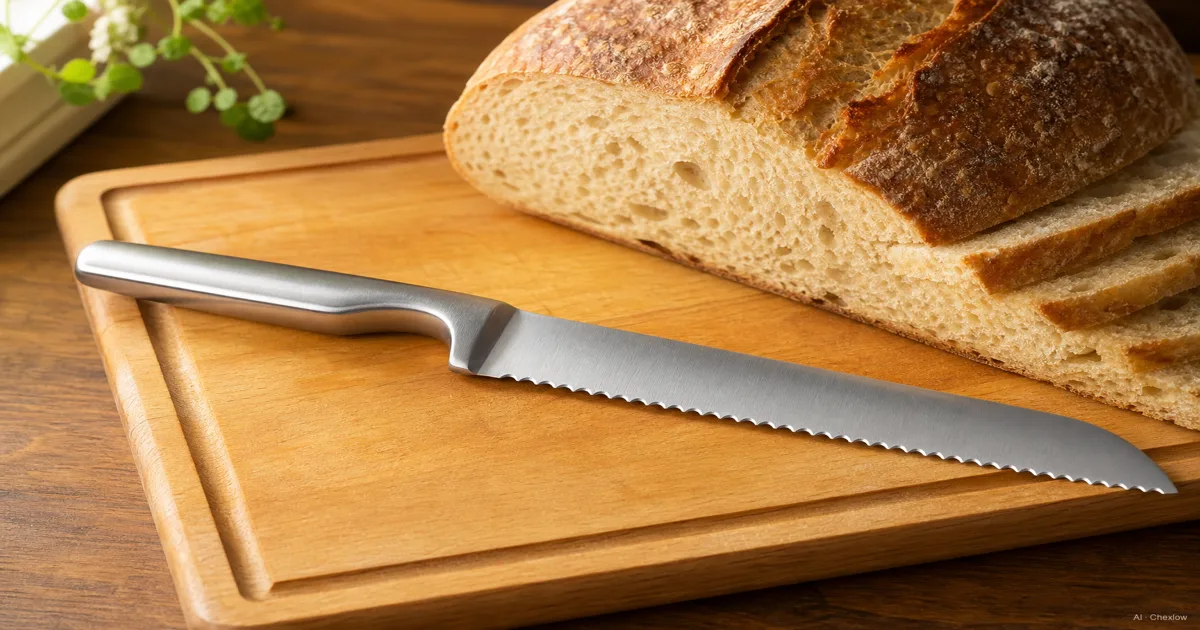
The key variable in serration design is the shape and spacing of the teeth. Pointed, aggressive serrations — the kind that look like saw teeth — bite fast but also tend to tear. They leave a ragged edge on softer foods and create more crumbs on bread. Rounded, gentler serrations grip without tearing. Under a loupe they look more like small scallops than sharp spikes. Most well-regarded bread knives use this scalloped profile.
Spacing matters too. Teeth that are spaced too closely do not have enough gullet depth to clear crumbs and move efficiently through the crust. Too widely spaced, and each individual tooth has to do too much work. The ideal is moderate, even spacing with enough gullet to keep the cut clean.
Some knives combine serrations with small flat sections between them — a "wavy" or "hollow ground" pattern. These tend to be versatile performers across both bread and produce.
Length: 9–10 inches is the answer for almost everyone
The standard recommendation from most serious kitchen testers — including America's Test Kitchen — is at least 9 inches, and 10 inches is better for most home cooks. Here is why length matters:
A long loaf of sourdough or a wide boule can be 20–25 cm across. A blade shorter than 9 inches means you cannot complete a cut in a single stroke — you have to reposition mid-slice, which causes the blade to track off-angle and leaves a crooked cut. A longer blade also helps with cakes, where you want to cut through the full diameter in one motion without the handle hitting the cutting board.
The only case for a shorter knife — say, 8 inches — is if you are primarily slicing baguettes, rolls, or smaller loaves and you want something more maneuverable. For a first bread knife that has to do everything, the longer blade wins.
Offset handle vs. standard handle
An offset bread knife has a step-down between the handle and the blade — the handle sits higher than the cutting edge. When you slice a full loaf resting on a cutting board, an offset handle keeps your knuckles above the board surface throughout the stroke. With a standard handle, your knuckles hit the board on the downstroke, which forces you to either stop short of cutting fully through the bottom, or shift your grip awkwardly.
Honest assessment: an offset handle is a genuine, noticeable improvement that you will feel on every single slice. It is not a gimmick. If two knives are otherwise equal and one has an offset handle, take the offset.
Beyond bread: the other jobs a serrated knife does better
Once you have a bread knife, you will find uses for it that have nothing to do with bread.
**Tomatoes.** A ripe tomato has a skin that is slippery and firm while the interior is soft and full of juice. A chef's knife at less than razor sharpness pushes the skin rather than cutting it — you end up with a squashed tomato and juice on the board. A bread knife grips the skin at the first tooth contact and saws through cleanly, no matter how sharp or dull it currently is.
**Cakes.** Cutting a layer cake with a chef's knife compresses the crumb and drags the frosting. A long serrated knife with a gentle sawing motion cuts through both sponge and frosting cleanly. The same knife levels cake layers — trimming the dome off a baked round — with a single smooth pass. Pastry chefs reach for a serrated knife as a matter of course.
**Soft squash, melons, and pineapple.** Hard-skinned produce that has soft interior flesh behaves exactly like bread — the serrated edge breaks through the skin without the soft inside collapsing.
**Sandwiches and soft rolls.** A submarine sandwich filled with ingredients that shift under pressure cuts cleanly with a serrated knife. No ingredients squeeze out the sides.
Sharpening: the honest downside
Here is the thing nobody tells you upfront: serrated knives are genuinely hard to sharpen at home.
A straight-edged knife can be sharpened on a flat whetstone, a pull-through sharpener, or a honing rod. A serrated knife needs a tapered rod or a ceramic stick, and you have to do each individual gullet separately — which takes time and skill to do without damaging the adjacent tooth. Most home cooks do not have the equipment or patience for this.
The good news is that serrated knives stay sharp for a very long time. Because the edge never touches the cutting board (the points of the teeth do), the flat edge between teeth never gets dull from friction. The teeth themselves dull eventually, but much more slowly than a straight edge in equivalent use.
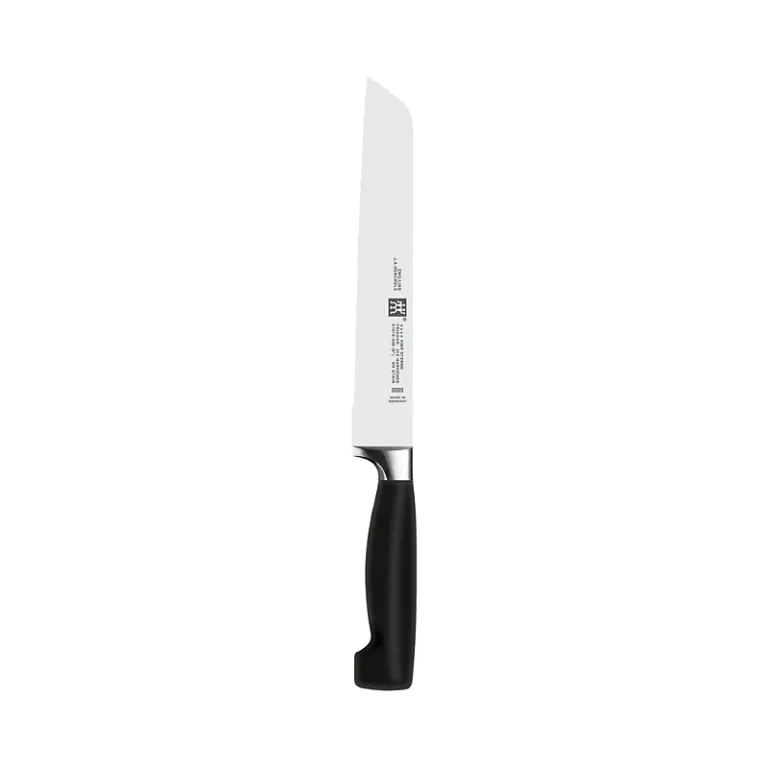
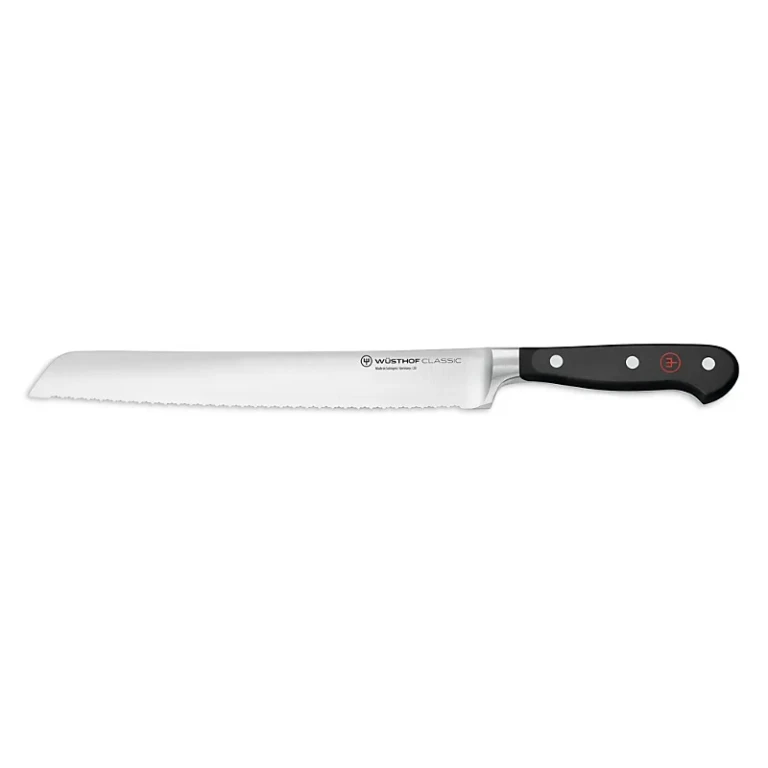
The practical implication: buy a serrated knife that is good enough to last. A $30 knife you resharpen every two years is not worse than a $150 knife you resharpen every ten years if the cut quality is similar. But if the $30 knife is dull in two years because the steel is poor, and you cannot easily resharpen it, you are stuck. Look for high-carbon stainless steel and a reputable brand. The Victorinox Fibrox 10.25" and Mercer Millennia 10" are both widely tested and well regarded at modest prices. At a higher price point, the Wüsthof Classic and Shun Classic are consistent performers with better handle materials.
What to look for at a glance
- **Blade length**: 9–10 inches (25 cm) for a first all-purpose knife
- **Serration shape**: rounded/scalloped, not jagged saw-tooth
- **Handle type**: offset if you can find it; standard is fine if the handle is comfortable
- **Steel**: high-carbon stainless; avoid coatings that can flake
- **Balance**: heavier and more forward-weighted than a chef's knife is normal and comfortable for bread work
- **Budget range**: $40–80 covers excellent options; above that you are paying for handle materials and aesthetics
Sources
- [America's Test Kitchen — Best Serrated Bread Knives](https://www.americastestkitchen.com/equipment_reviews/2497-the-best-serrated-bread-knives) — equipment tests with performance rankings
- [Food Network — Best Bread Knives of 2026](https://www.foodnetwork.com/how-to/packages/shopping/product-reviews/best-bread-knife) — hands-on buyer reviews
- [SharpEdge — Essential Uses of a Serrated Knife](https://sharpedgeshop.com/blogs/knife-types/the-essential-uses-of-a-serrated-knife-a-complete-guide) — use-case coverage beyond bread
- [Misen — Understanding Serrated Knives](https://misen.com/blogs/news/understanding-serrated-knives-from-bread-to-beyond) — serration design and mechanics
- [Serrated blade, Wikipedia](https://en.wikipedia.org/wiki/Serrated_blade) — mechanics of serration cutting