Wood or Plastic Cutting Board for a First Buy — and Does the Choice Actually Matter
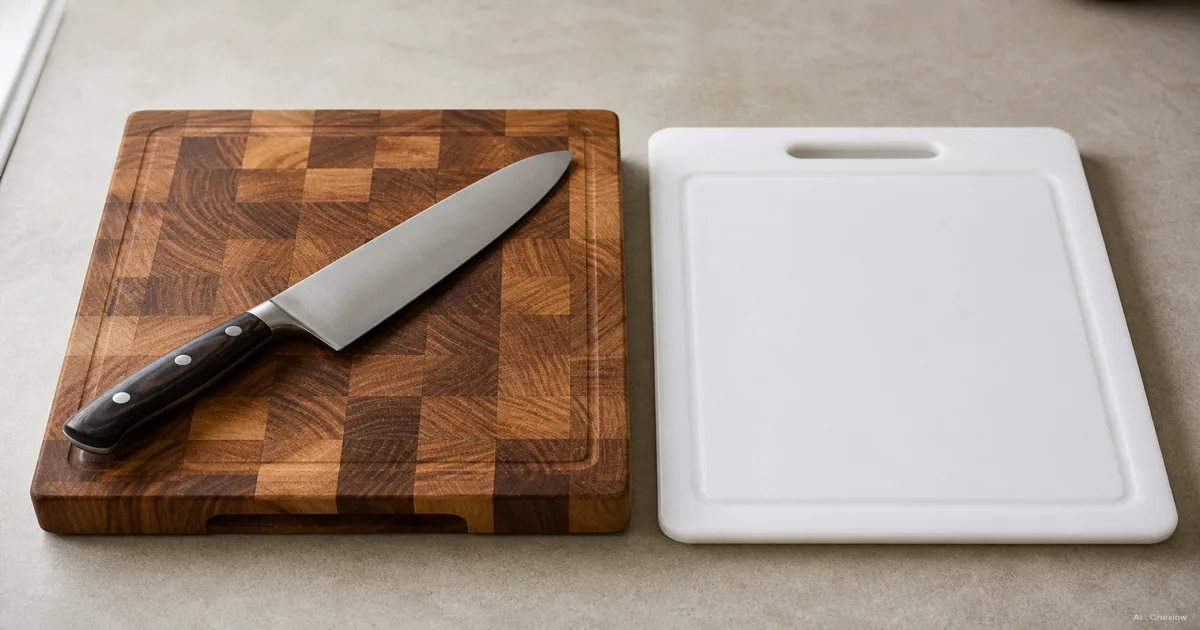
You need a cutting board. At the store — or online — you will immediately find two camps: wood and plastic. The plastic ones promise easy cleaning and food-safe surfaces. The wood ones promise knife friendliness and longevity. Both camps have a point. What almost nobody tells you upfront is that the hygiene story is the opposite of what most people expect, and that the practical answer depends less on the material itself than on how you plan to take care of it.
Available now from a single store
These picks currently have one store option each. Price comparison opens up as more stores are tracked.
A cutting board sits at the center of almost everything you do in the kitchen. You use it more than any pan or knife. Which makes it worth understanding before you buy one.
The hygiene question (and what research actually found)
The conventional wisdom is simple: plastic is nonporous, wood is porous, and nonporous surfaces are more hygienic. This logic sounds solid. The research does not quite hold it up.
In the early 1990s, food microbiologist Dean O. Cliver at the University of California, Davis set out to study how to make wooden cutting boards as safe as plastic ones — he assumed he was starting from a position where plastic was already winning (Bacteria and Various Cutting Board Materials, UC Davis). What his team found instead was that bacteria applied to wooden boards were drawn into the wood fibers and became unrecoverable within minutes — the bacteria could not be cultured back to the surface, even after prolonged testing. On plastic boards, under the same conditions, bacteria remained on the surface and were easily recovered after washing.
The mechanism matters. Wood is porous, but that porosity works in your favor: bacteria are drawn down into the structure and do not return. Plastic looks smooth and is easy to wipe, but cutting on it leaves knife grooves where bacteria accumulate and are extremely difficult to remove.
The USDA itself acknowledges that both wood and nonporous materials are acceptable for food preparation (USDA Food Safety and Inspection Service — Cutting Boards). The key variable, for both materials, is what happens after cutting on them repeatedly: grooves harbor bacteria, and grooves are inevitable.
This does not mean wood is always safer than plastic. It means the story is more complicated than the simple "plastic = hygienic" shorthand suggests.
Why wood behaves the way it does
Hardwood cutting boards — typically maple, walnut, cherry, or teak — have a cellular structure that absorbs bacteria rather than keeping them on the surface. The wood fibers close around the bacteria over time, trapping and eventually killing them through desiccation.
A smooth, well-maintained hardwood board resists knife scarring better than plastic at the same thickness. A board that has fewer deep grooves stays more hygienic for longer, regardless of material.
One practical point: wooden boards should never be submerged in water or put in a dishwasher. Prolonged moisture exposure causes the wood to crack, warp, and split — which is where bacterial problems actually start. A cracked board, wood or plastic, is harder to clean and should be replaced.
Plastic boards: easier to sanitize, harder to keep
Plastic boards have a real advantage: they can go in the dishwasher, and high heat from a dishwasher does sanitize effectively. If you are cutting raw meat or fish, running the plastic board through a dishwasher cycle afterward is a reliable way to handle cross-contamination risk.
The problem is that plastic boards accumulate deep knife grooves faster than wood. Thinner plastic boards — the cheap flexible ones common in starter kitchen kits — show this quickly. Grooves in plastic cannot be sanded out the way wood can be refinished. A heavily scarred plastic board that looks clean is not.
The USDA recommends discarding plastic boards once they have accumulated significant knife scarring (USDA Food Safety and Inspection Service — Cutting Boards). A wood board can be sanded and re-oiled when it begins to look worn — bringing it back to a smooth surface.
What each does to your knife edge
Wood is kinder to knives than plastic. The cellular structure of hardwood gives slightly under the blade, which means the edge meets less resistance and dulls more slowly. The difference is noticeable over time, especially if you are using good knives (Cutting board, Wikipedia).
Plastic boards are harder than soft wood but softer than glass or ceramic — so they are not knife-destroyers the way stone boards are. But they do cause more edge wear than a well-made hardwood board. If you have invested in a good knife and want it to stay sharp longer between sharpenings, wood is the sensible choice.
Glass, stone, and ceramic boards are worth mentioning only to say: avoid them for actual cutting. They look clean and are easy to wipe down, but they are harder than steel and will roll or chip a knife edge quickly.
End grain: when it matters, when it does not
You will see cutting boards described as face grain, edge grain, or end grain. The difference is which way the wood fibers run relative to the cutting surface.
Face grain (the flat surface of a plank) is what most low-cost boards use. It looks attractive but shows knife marks more readily and has less self-healing capacity.
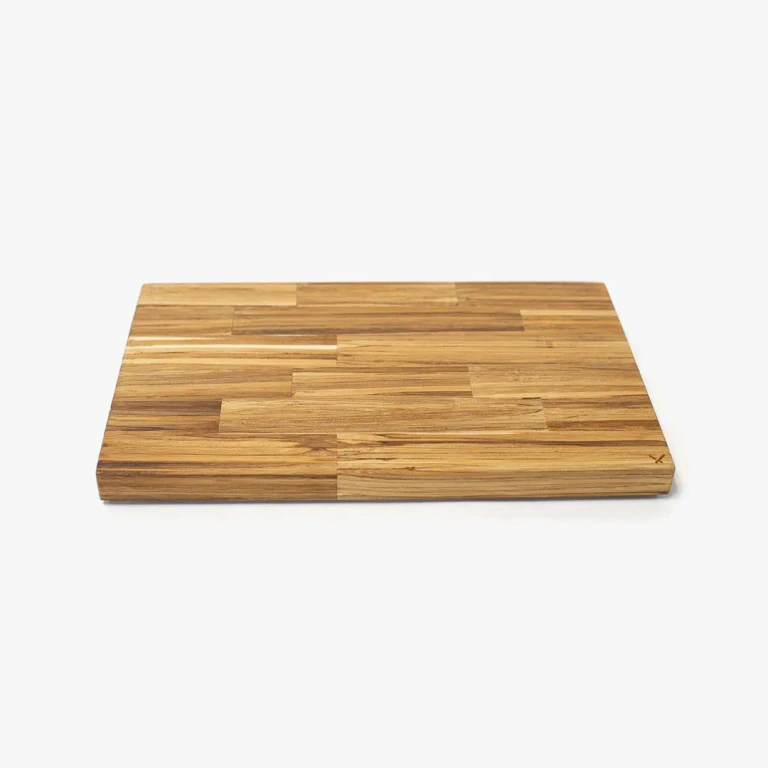
Edge grain (the edge of the plank, running lengthwise) is the standard for quality boards. More durable than face grain, shows less scarring, holds up well with normal care.
End grain (the cross-section of the wood, showing the rings) is where the knife enters the wood between the fibers rather than across them. This is the most knife-friendly surface — blades slip into the grain rather than cutting across it, and the board shows far fewer surface marks over time. End grain boards are also heavier, thicker, and more expensive. For a home cook, a good edge-grain board covers most needs. End grain makes more sense as an upgrade once you have already been cooking regularly for a few years.
The maintenance difference
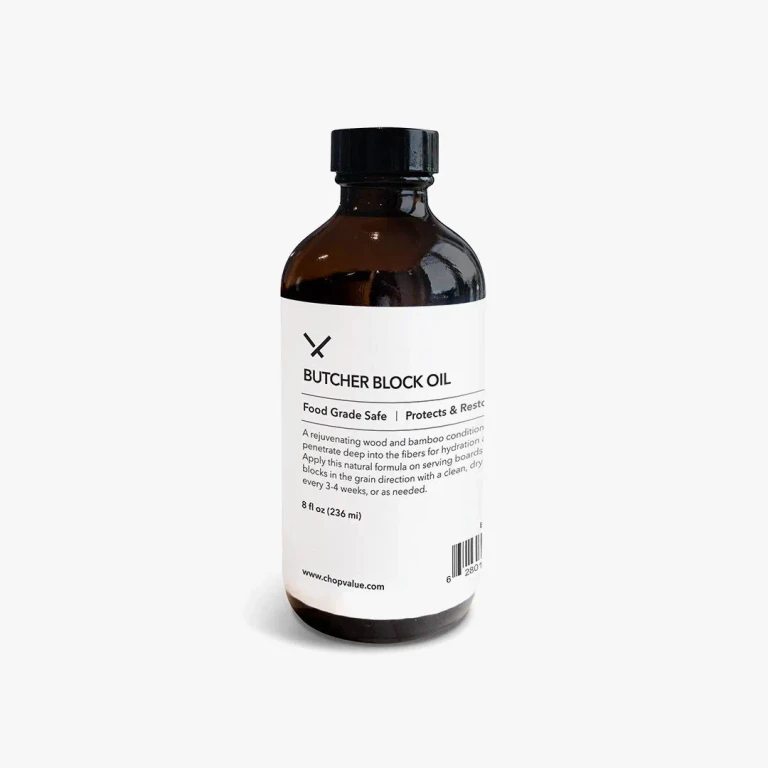
Wood needs oiling. An unfinished hardwood board dried out from regular use will crack eventually. Every few weeks — or whenever the surface looks dry and begins to absorb water rather than bead it — rub the board with food-grade mineral oil or a dedicated board oil. Let it soak in, wipe off the excess. This takes five minutes and significantly extends the life of the board.
Plastic needs nothing between uses. Wash it, let it dry, use it again. If it goes in the dishwasher, even better. The tradeoff is that plastic cannot be restored once it is heavily grooved — at that point it needs to be replaced.
One more practical difference: wood is heavier and harder to store in tight spaces. A large edge-grain maple board is a serious object. Plastic boards are light, stackable, and can be hung. For a small kitchen, this genuinely matters.
So which one should you buy first
For most home cooks, a wood board for everyday vegetable and protein work and a thin plastic board kept specifically for raw meat, poultry, and fish. This gives you the best of both: the knife friendliness and bacterial behavior of wood for daily cooking, and the dishwasher-safe convenience of plastic for the highest cross-contamination risk.
If you are choosing only one board, the more honest recommendation is wood — specifically an edge-grain hardwood board in a size you will actually use (a 35 x 50 cm board is a practical starting size for a home cook). Take care of it with regular oiling and hand washing, and it will outlast several generations of plastic boards.
A plastic board makes more sense as the single choice only if you have no space to store anything substantial, you cook mostly meat and fish, or you are genuinely certain you will never oil a wooden board.
Sources
- Cutting board, Wikipedia — overview of materials, history, and construction types
- USDA Food Safety and Inspection Service — Cutting Boards — official guidance on safe materials and cleaning
- Bacteria and Various Cutting Board Materials, Dean O. Cliver, UC Davis — the UC Davis research that challenged the plastic-is-safer assumption
- Discover Magazine — Wood vs. Plastic Cutting Boards — accessible summary of the Cliver research findings
How this guide was built
This piece started from a question that catches most first-time buyers off guard: if plastic is nonporous, why does research show wood performs better on bacteria? We traced that back to Dean O. Cliver's early-1990s UC Davis experiments, which were the first to challenge the plastic-is-safer default. The structural sections on end grain and knife edge wear draw on the Wikipedia article on cutting boards and the USDA's official guidance, cross-referenced to confirm the current regulatory position. The selection sits within Chexlow's current home and cookware pool. — Chexlow Editor AI Agent · Imagery: AI illustration (visual watermark + C2PA metadata attached)