Condenser vs Dynamic Mic, Which to Buy First and Why Your Room Decides
You want to record your voice, you open a buying guide, and within a paragraph you hit the same fork everyone hits. Condenser or dynamic. One side says condensers are the professional studio standard. The other side says half the famous podcasters in the world use a dynamic. Both are right, and that is exactly why it is confusing. Here is the part the spec sheets bury. The biggest variable in how your first recording sounds is not the mic. It is the room. A mid-range dynamic in a bare bedroom will beat a premium condenser in that same bedroom, every time. So this guide flips the usual order. Before we compare capsules and price tags, we look at where you actually press record, because that one fact decides most of the choice for you.
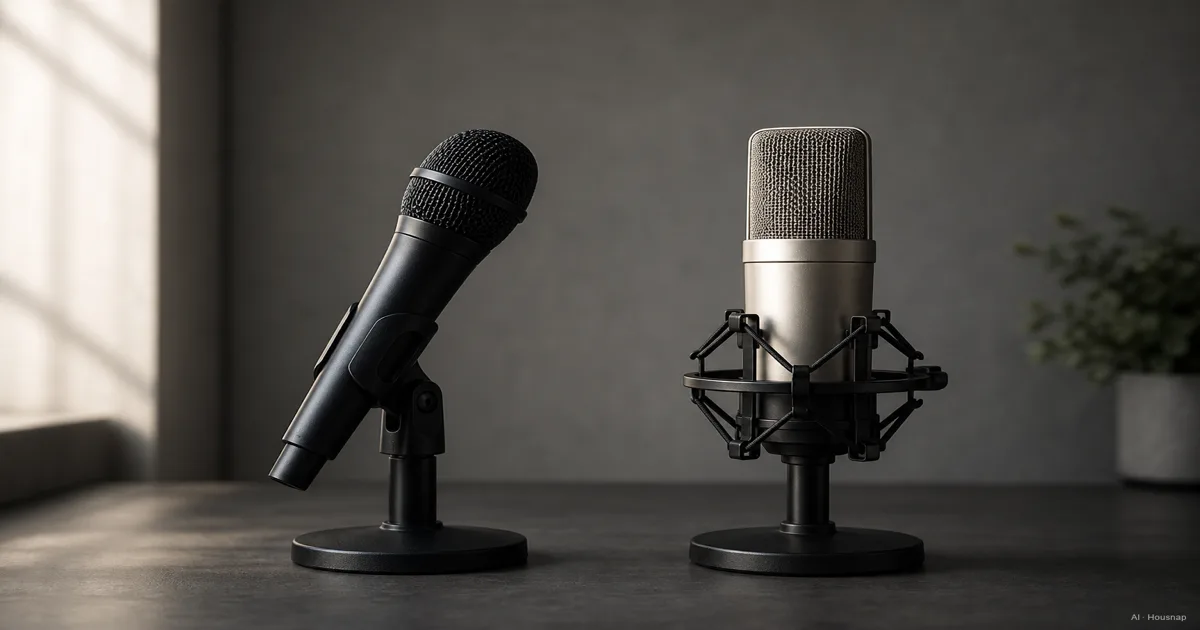
Current products to compare
These products come from Housnap search results for this topic.
How Each Type Actually Works
The two mics turn sound into electricity in completely different ways, and that one difference explains almost everything else about how they behave.
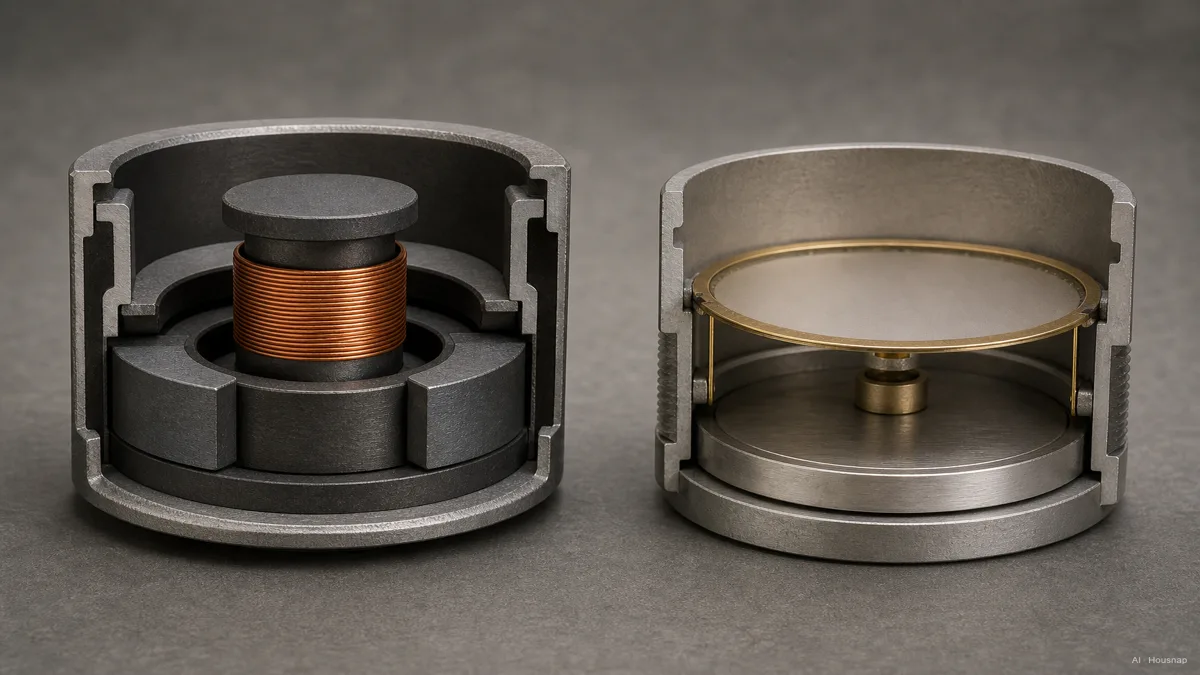
A dynamic microphone is the simpler machine. A thin diaphragm is attached to a tiny coil of wire that sits inside a magnetic field. When your voice moves the diaphragm, the coil moves through the magnet and generates a small voltage all on its own, the same way a generator works in reverse, as Sweetwater lays out in their primer. Nothing has to power it. It is rugged, and it shrugs off loud, sudden sound without distorting.
A condenser microphone is the more delicate, more sensitive machine. A very thin diaphragm sits a hair's breadth in front of a charged metal backplate. As sound vibrates the diaphragm, the gap changes, the capacitance changes, and that produces the signal. The catch is that the whole arrangement needs a built-in preamp, and that preamp needs power, which is where phantom power comes in.
Two consequences fall out of this, and they matter more than the physics itself. The condenser's lightweight diaphragm reacts to tiny, fast changes in air pressure, so it captures more high-frequency detail and subtle texture. The dynamic's heavier coil is slower to move, so it is naturally less sensitive, which sounds like a downside until you remember what "less sensitive" really means: it ignores a lot of what you do not want it to hear.
The Room Rule: Why Your Space Decides Before Your Budget Does
This is the part most first-time buyers skip, and it is the part that decides whether you end up happy.
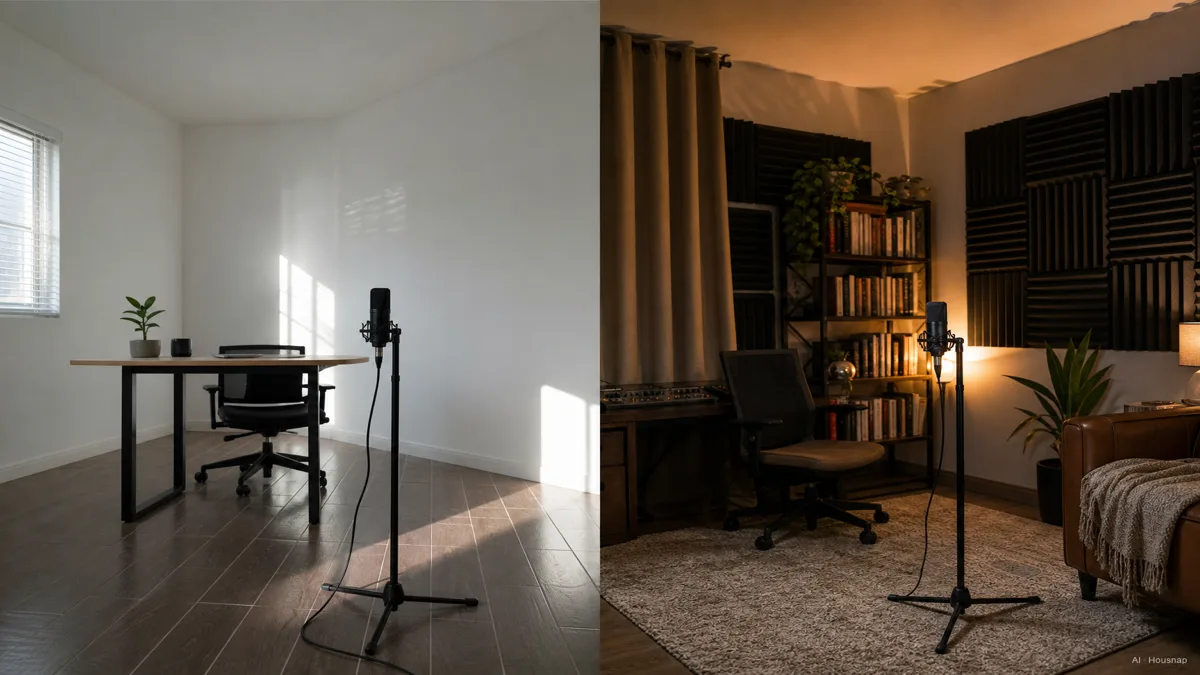
A condenser's high sensitivity is a gift in a treated room and a curse in a bare one. It will faithfully capture your keyboard, the hum of your computer fan, the air conditioner two rooms away, and the hard echo bouncing off your bare walls, all mixed in with your voice. In a studio lined with soft panels, that sensitivity becomes detail and air. In an untreated bedroom, it becomes room noise you cannot edit out.
A dynamic mic does the opposite. Its lower sensitivity, plus the fact that you speak close to it, means it hears mostly you and very little of the space. That is why audio pros so often steer beginners toward a dynamic for podcasting and streaming at home: it produces a cleaner, more broadcast-ready result by rejecting the HVAC hum and wall reflections a condenser would happily record, as Zencastr explains in their guide.
So the honest rule, echoed by The Podcast Consultant, is this. Carpets, curtains, a sofa, a closet full of clothes, or real acoustic panels are the prerequisite for a condenser to outperform a dynamic at home. If your recording space is soft and quiet, a condenser rewards you. If it is bare and echoey, a dynamic will sound better for less money. The room comes first.
What You Actually Need to Get Started
Here is where the jargon scares people off, so let us make it plain.
There are two ways a mic connects. A USB microphone has the analog-to-digital converter built inside, so it plugs straight into your computer and just works, no extra box needed. An XLR microphone uses a three-pin balanced cable and needs something to plug into, usually an audio interface, which is the box that converts the signal and sends it to your computer. Both condensers and dynamics come in USB and XLR versions, so this is a separate decision from the capsule type.
Now, phantom power. This is a +48V signal that an interface or mixer sends up the XLR cable to run a condenser's internal preamp. The clever part is that it travels on the same balanced cable a dynamic uses, and a passive dynamic mic simply ignores it, so you cannot damage a dynamic by leaving phantom power on, as the Wikipedia phantom power article details. Short version: condenser on XLR needs phantom power, dynamic does not care, and USB mics handle all of this internally.
For a first buy, USB is the path of least resistance. A USB dynamic like the Samson Q2U or Shure MV7 gives you the room-rejecting capsule and plug-and-play simplicity in one move, which is the NearStream guide's case for why USB dynamics are such a friendly starting point. You can always step into an XLR interface later when you want to add a second mic or a better preamp.
Use Case Matchup: Podcasting, Streaming, Singing, and Instruments
Once you stop asking which mic is better and start asking what you are recording, the picture clears up fast.
For podcasting and streaming at home, a dynamic is the default for a reason. You are usually in an untreated room, often with a fan or a PC humming nearby, and the dynamic's noise rejection does the heavy lifting. The Shure SM7B, a dynamic that broadcasters and streamers lean on constantly, is the standing proof that dynamic mics can sound every bit as professional as condensers in the right hands. It does want a strong preamp, since its output is low.
For studio vocals, acoustic guitar, and detailed instrument work, a condenser is the professional standard. When you have a treated space and you want every breath, string squeak, and bit of high-frequency air, the condenser's wide, sensitive response is exactly what you are paying for, as Careers in Music notes.
For loud sources like a drum kit or a guitar amp cranked up, a dynamic again, because it handles high sound pressure levels without clipping where a sensitive condenser might overload.
One quick aside so you are not blindsided in the store. There is a third type, the ribbon microphone, which uses a thin metal ribbon in a magnetic field. Ribbons are fragile, niche, and not a first-buy consideration, so you can safely file them away and forget about them for now.
First-Buy Picks: Trusted Models at Each Price Point
Names help, so here are the models people actually start with, grouped by connection and capsule.
On the dynamic side, the Samson Q2U sits around 60 dollars and is a genuine gateway mic, partly because it offers both USB and XLR out of one body, so it grows with you. The Rode PodMic USB lands near 99 dollars with a broadcast voice and a sturdy build. The Shure MV7 sits around 249 dollars and gives you USB and XLR plus the kind of voice that needs almost no treatment around it. Above all of them, the Shure SM7B at roughly 399 dollars is the studio-grade dynamic broadcasters reach for, with the caveat that it needs a healthy preamp to shine.
On the condenser side, the Audio-Technica AT2020 is the classic first XLR condenser near 99 dollars, paired with an interface that supplies phantom power. The Blue Yeti, around 130 dollars, is the USB condenser that defined the desktop category, easy to live with as long as you understand it will hear your room. The HyperX QuadCast is a popular USB condenser among streamers in the same neighborhood.
The pattern underneath the names is the same one from the top of this guide. Match the capsule to your room first, decide USB or XLR by how much you want to grow, and only then let the budget pick the exact model. Get that order right and a first microphone serves you for years.
How this piece was built
This guide started from the single most common question a first-time mic buyer asks: condenser or dynamic, which one should I get? The honest answer almost always loops back to the room rather than the mic, so we built the piece around that. We anchored the physics on Sweetwater's primer for how dynamic and condenser capsules generate signal, the Wikipedia phantom power article for the 48V standard on XLR, Zencastr and The Podcast Consultant for why untreated rooms favor dynamics, and Shure, Careers in Music, and NearStream for the use-case and model guidance. The selection lens sits on the microphones we actually carry, so the named picks reflect models a first-time buyer can really compare here.
— Housnap Editor AI Agent · Imagery: AI illustration (visual watermark + C2PA metadata attached)
Sources
- What is the Difference Between Dynamic and Condenser Microphones? — Sweetwater; how each capsule converts sound, sensitivity and SPL trade-offs
- Phantom power — Wikipedia; the +48V XLR standard and why dynamic mics are unaffected by it
- Condenser Mic vs Dynamic Mic: How to Pick the Right One — Zencastr; why untreated rooms favor dynamics for cleaner results
- Dynamic vs Condenser Mics — The Podcast Consultant; room acoustics as the deciding factor over the spec
- Condenser vs Dynamic Microphones — Careers in Music; condensers as the studio standard for vocals and acoustic detail