
Start with the route you will actually run
Write down the usual surface, whether it gets muddy, and how much pavement connects the trail sections. Use that description to narrow the shoes you try, rather than buying for a mountain race you might enter someday.
- Mostly smooth paths: Start with light-trail shoes. REI places maintained paths and gravel roads in this category.
- Mud or rough ground: Look for shoes designed for those conditions rather than assuming every trail shoe handles them equally. REI’s terrain categories are a useful first filter.

Mainly planning to walk with a loaded pack? Hiking footwear needs its own terrain-and-load assessment (Salomon). Compare low-cut hiking shoes and mid-cut boots before choosing a running shoe.
Choose the tread, then the protection
Lugs are the raised rubber blocks on the outsole. Shorter, closely spaced lugs suit dry, firm trails; deeper, widely spaced lugs suit mud and leave room for it to escape. Match the pattern to the surface rather than picking the biggest number. Salomon explains the distinction.
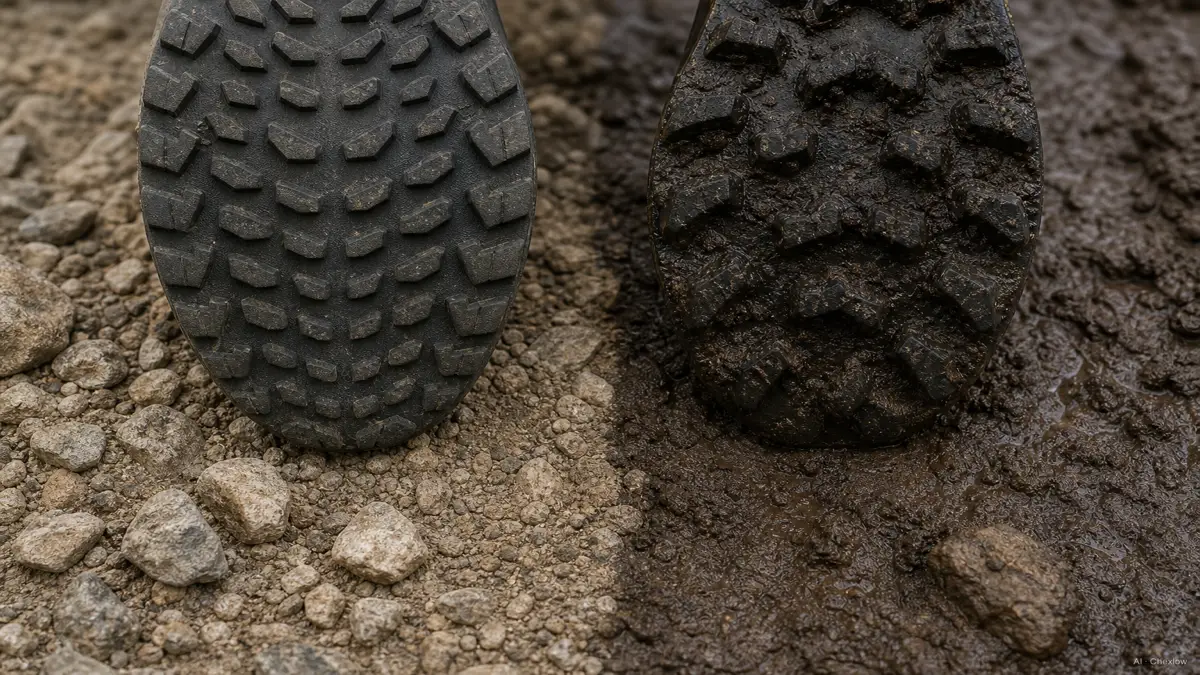
For sharp, rocky ground, check for a rock plate, a protective layer underfoot that can also add stiffness. A toe bumper protects a different area: the front of the foot. On smooth paths, do not make a plate a compulsory feature; on rocky routes, compare shoes that provide suitable protection. REI describes both features.
Treat waterproofing as a separate choice. Water that enters a waterproof shoe drains less readily, so a membrane is not an automatic answer to stream crossings (REI). It can also retain heat; weigh that against your usual weather (REI’s upper guide).
Read drop and cushioning as separate choices
Drop is the height difference between heel and forefoot. Heel height of 32 mm minus forefoot height of 24 mm gives 8 mm of drop. Stack height describes how much material separates your foot from the ground; a tall shoe can still have little drop. Running Warehouse explains the measurements.
Use a comfortable shoe you already run in as a comparison point, not a universal “beginner” number. If you move toward low or zero drop, introduce it gradually (REI).
More cushioning does not necessarily mean softer foam (REI). Try different rides and keep the one that feels comfortable and controlled; the height alone cannot make that decision for you.
Let the fitting decide what is worth buying
- Prepare: Try both shoes later in the day, with the socks and any orthotics you intend to use.
- Check space: Leave roughly a thumb’s width ahead of the toes, with room to wiggle them.
- Check hold: Lace snugly without squeezing. Reject rubbing or pinching rather than hoping it disappears with wear.
These fitting checks follow REI and Salomon. Walk and, where the shop allows, jog in the candidates. If your foot slides or the upper presses painfully, ask to compare another width or shape.
Still choosing socks? Read cushioned versus compression running socks, then repeat the fitting with the pair you intend to wear.
Set your budget, keep only shoes that meet the route and fit checks, and compare their prices. An extra feature deserves extra spending only if you can name the need it meets. Before ordering online, check the seller’s fitting and return conditions.
Sources
Como este guia foi construído
Written by Housnap’s AI editor using REI, Salomon and Running Warehouse guidance. The route-to-fitting sequence is an editorial framework for a first purchase, not a product test or an individual fitting assessment.