Identify what the chart actually measures
A chest measurement on a size chart can describe the person or the shirt. Before choosing a size, label each number in your notes: body or garment, width or circumference, and centimetres or inches.
ASOS’s own-brand shirt chart gives body measurements under “to fit chest”. Compare those with your body, not the width of a shirt laid on a table. Its instructions measure around the fullest chest, close under the arms, with the tape flat across the back.
By contrast, Charles Tyrwhitt’s garment-measurement instructions describe chest as a flat measurement between the sleeve seams at the armpits, explicitly not a circumference. The word “chest” alone does not resolve the difference.
If the listing gives only “chest 54”, ask whether that means garment width, garment circumference or a body measurement, and confirm the unit. Do not choose a size from an unexplained number.
Measure a reference shirt the same way
Pick a shirt whose fit you already like, preferably one similar to the shirt you want. Record how it feels as well as its measurements: a reference that already pulls across your chest is not a useful target for a comfortable fit.
Use an existing flexible sewing measuring tape. If you need one, look for a clearly marked tailoring tape; this task does not require buying another shirt or a measuring device with an app.
Proper Cloth’s garment guide starts with a well-fitting shirt. For its chest measurement, spread the shirt flat with the front facing up, smooth hidden folds and rear pleats, and measure straight between the bottoms of the armpits. Follow the intended seller’s diagram if its method differs.
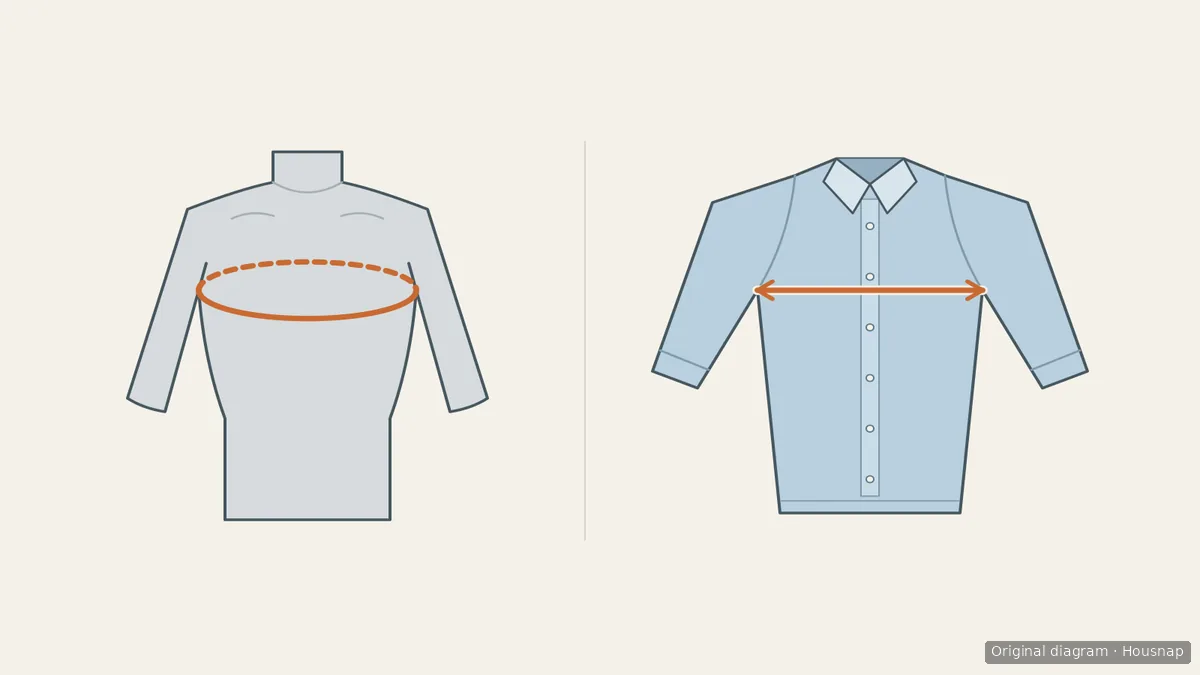
The loop and the straight line represent different measurements. The diagram explains that distinction; it is not a size chart or a scale drawing.
Write down more than chest width:
- Midsection. Proper Cloth measures the narrowest part of the shirt body, which is not necessarily where the side seams are. Match the seller’s stated position.
- Sleeve. Check the starting point. Proper Cloth starts below the collar at centre back, follows the yoke and then the sleeve to the cuff. A shoulder-seam-to-cuff measurement omits part of that route.
- Back length. Proper Cloth measures from the base of the back collar to the centre bottom of the shirt, laid flat without stretching. Record both endpoints rather than writing only “length”.
Compare like with like, then consider room to move
Keep flat garment widths together when both charts use that method. Proper Cloth explains that changing its chest width by one inch changes the shirt circumference by two inches. Doubling a flat chest width gives a circumference comparison under that convention; it does not turn the result into a body measurement.
Here is an illustrative calculation, not a recommended fit allowance: a shirt with a 54 cm flat chest width corresponds to 108 cm around. Against a 100 cm body chest, the numerical difference is 8 cm. A 52 cm shirt would give 104 cm around, leaving a 4 cm difference. Two centimetres less width is four centimetres less circumference.
That difference is often called ease: the extra garment room beyond the body measurement. It is not a universal amount to add to every chart. If the chart already says which body measurements a size fits, use it as instructed; do not add your own allowance and look up the larger body size.
Use the familiar shirt to judge whether you want more or less room. Proper Cloth treats chest fit as a preference, with comfort and pull lines limiting how close a slim fit should be. Chest arithmetic alone cannot confirm collar, shoulder or sleeve fit.
Keep allowances tied to the instructions that specify them. Charles Tyrwhitt’s body collar method includes two fingers under the tape, while Proper Cloth says it accounts for shrinkage when producing custom shirts from its measurement guide. Neither is a reason to add the same amount to another seller’s measurements.
Resolve missing details before ordering
Make a short comparison note for each candidate: chart type, unit, measurement endpoints, your reference-shirt value and the candidate’s value. Mark unknowns instead of estimating them from S, M or L.
- Methods match and the dimensions look suitable. Keep the candidate, then confirm its return conditions before ordering.
- The label or measuring route is unclear. Ask for a measurement diagram and finished-shirt dimensions for the exact size and fit you are considering.
- Chest looks right but another dimension does not. Compare another cut or ask for advice rather than assuming one size change will solve everything.
A useful message is: “Is this chart for body measurements or finished garments? Is chest a flat width or a full circumference? Where do sleeve length and back length start and end?” Also ask whether any shrinkage adjustment is already included before making one yourself.
ASOS notes that shirt length varies by style and directs readers to individual product information. Use the actual shirt’s measurements rather than a general size-average length.
When trying the shirt, fasten it as you intend to wear it and check whether sitting and reaching feel comfortable. Treat that as your own fit check, not a result guaranteed by the chart.
If the measurements now make sense but you still need to choose the fabric for an office or suit shirt, continue with Oxford, poplin and twill for a first dress shirt.
Como este guia foi construído
This guide was written by AI for Housnap, using official measurement instructions from ASOS, Proper Cloth and Charles Tyrwhitt. It brings those different conventions into a practical comparison workflow; the numerical example is illustrative, not a fit recommendation or an original product test.