Ir para o conteúdo
Housnap IA
Home / Kitchen Appliances

Rice Cooker First Buy: Basic, Fuzzy Logic, or Pressure

Most people who grew up eating rice already know they want a dedicated rice cooker. The question is not whether to buy one — it is which tier actually makes a difference worth paying for. There are four distinct heating technologies on the market, and the jump between them is not incremental. A basic coil cooker and a pressure induction cooker can both be labeled "rice cooker," but they produce noticeably different results, handle different rice types, and fail in different ways. Knowing where each tier stops and the next one starts makes the choice straightforward. The short version: a 5.5-cup fuzzy logic model covers most households well at $80–120. Pressure is worth it if brown rice or texture quality is a priority. Basic is fine if budget is the primary constraint. Induction sits between fuzzy logic and pressure, and earns its place in households that cook rice at least daily.

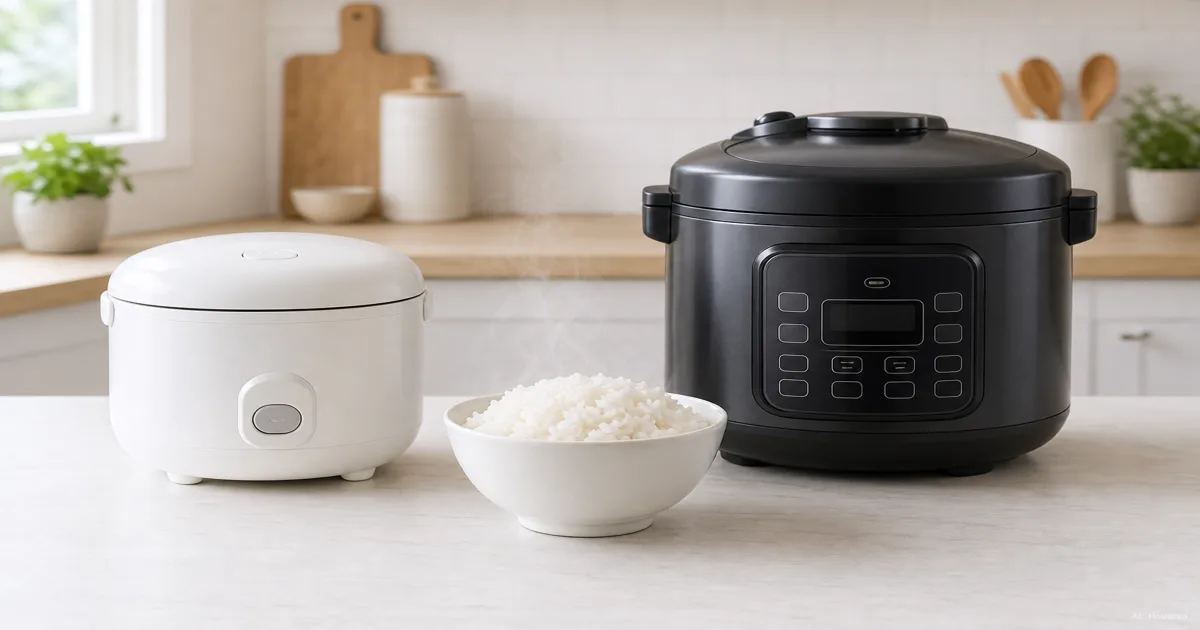
Rice Cooker First Buy: Basic, Fuzzy Logic, or Pressure — Ilustração IA

Disponíveis agora em uma única loja

No momento, cada um destes produtos está disponível em apenas uma loja. A comparação de preços abre com mais lojas.

Basic coil cookers: what they do well and where they stop

Basic rice cookers use a resistive heating element — a coil under the pot. Heat travels upward from the bottom. There is a single thermostat that detects when water has been absorbed and the temperature rises. When that threshold is reached, the cooker switches to keep warm.

The mechanism works well for standard white rice. For a household that eats jasmine or long-grain white rice and values simplicity, a $20–50 basic model is entirely functional. It cooks reliably, it is easy to clean, and it does not break in interesting ways.

The limitations show up in specific situations. Heat distribution is bottom-heavy, so the rice touching the pot base cooks differently from rice in the middle layer. Single-temperature control means there is no differentiation between rice types. Brown rice, which needs longer cooking at lower temperatures, is inconsistent — often underdone or gummy. Sushi rice, which needs precise starch development, is unpredictable. The keep warm function holds temperature at a fixed level, so rice quality after a few hours is noticeably worse than in higher-tier cookers.

For households that eat primarily white rice and want a straightforward, inexpensive appliance, basic is genuinely sufficient. For anyone who cooks multiple rice varieties or wants quality that holds overnight, this is the tier to move past.

Fuzzy logic: where the difference starts to matter

Fuzzy logic cookers — often called Micom models — add a microprocessor that continuously samples internal temperature and adjusts heating in small increments. Instead of one thermostat threshold, the cooker tracks temperature curves through soaking, heating, steaming, and resting phases (HowStuffWorks).

The practical result is that the cooker can handle different rice types reliably. The processor detects how a given batch of rice is absorbing water and adjusts accordingly. Brown rice, which needs longer, gentler cooking to soften the bran layer without making the grain gummy, is a genuine use case for fuzzy logic rather than luck. Sushi rice, congee, porridge — each benefits from different temperature and timing control that a basic cooker cannot deliver.

Keep warm is also better. Fuzzy logic keep-warm adjusts humidity in the pot rather than just holding a fixed temperature, so rice stays acceptable for several hours rather than drying out or going hard at the edges.

Price range: $60–150. The Zojirushi NS-TSC and Cuckoo CR-0631F class sit here. For most households that eat rice regularly and cook more than one variety, fuzzy logic is the right first-buy tier — not premium, not unnecessarily simple.

Induction heating: even heat, more headroom

Induction heating (IH) rice cookers pass alternating current through coils that surround the inner pot, creating a magnetic field that heats the pot itself rather than a plate under it (HowStuffWorks). Because the pot heats from all sides rather than bottom-up, temperature distribution is significantly more even.

This matters most for larger batches and denser rice varieties. In a 5.5-cup batch of brown rice, the difference between bottom-heavy heating and 360-degree even heating shows up in texture consistency. IH cookers also handle rice varieties that need more nuanced heat curves — mixed grain rice with barley or millet, glutinous rice, congee at a proper thick consistency rather than watery.

IH models also tend to pair with enhanced fuzzy logic, so the microprocessor control is typically more sophisticated than entry Micom models. The result is better rice quality across types, not just white rice.

Price range: $150–300. The Zojirushi NS-YAC series and similar IH-with-Micom models are in this tier. The upgrade from fuzzy logic to IH is meaningful for households cooking rice daily or in volume, less necessary for occasional or light use.

Pressure cooking: the biggest jump in texture

Pressure IH rice cookers build internal pressure above atmospheric level before and during cooking. The higher pressure raises the boiling point of water, which means the rice cooks at higher temperatures and the starch structure develops differently. The result is rice that is distinctly plumper, glossier, and stickier in texture — the kind of texture that is difficult to achieve in any other cooker (Zojirushi).

For white rice, the pressure method produces a quality difference that is noticeable when tasted side-by-side. For brown rice, the difference is more significant. Brown rice has a fibrous bran layer that resists water absorption and takes longer to soften. Pressure cooking forces water into the grain more aggressively, which means brown rice comes out consistently tender and fully cooked rather than the slightly chewy or uneven results common in non-pressure cookers.

Cuckoo pressure models — the CRP-P0609S class — cook white rice in 20–28 minutes, faster than fuzzy logic models (Prudent Reviews). Zojirushi pressure IH models (NP-NVC, NP-NWC class) take longer but are tuned for softer, more delicate Japanese-style texture rather than speed.

The tradeoff: pressure models cost more ($200–500), require periodic maintenance of the gasket and pressure valve, and are more complex mechanically. For households where rice texture is a genuine priority, or where brown rice is eaten regularly, the jump to pressure is worth it. For households where rice is a side dish and budget matters, fuzzy logic is the more practical ceiling.

Capacity: matching cup size to your household

Rice cooker cup measurements refer to dry, uncooked rice. One measuring cup (180ml in the Japanese standard) of dry rice roughly doubles in volume when cooked. A 5.5-cup cooker holds 5.5 cups of dry rice and produces enough cooked rice for 4–5 adults as a main dish, or more as a side.

Practical guidelines (Rice Array):

  • 3-cup (540ml dry): 1–2 person household, or households where rice is an occasional side. Compact, faster to cook.
  • 5.5-cup (990ml dry): 2–4 person household. The most common size. Handles guests without being wasteful for everyday use. Most fuzzy logic and IH models are available in this size.
  • 10-cup (1800ml dry): 4–6 person household or batch cooking. Better suited to family cooking where rice is cooked daily in volume.

One important note: all rice cookers work best when filled to at least a minimum level, usually around one-third capacity. A 10-cup cooker making one cup of rice will underperform compared to a 3-cup cooker doing the same job.

Rice types and which cooker handles them

This is the practical guide for matching cooker tier to what you actually cook:

  • White jasmine or long-grain white: any cooker. Basic is fine here.
  • Sushi rice (short-grain): fuzzy logic minimum. Precise starch development matters.
  • Brown rice: fuzzy logic works, but results vary. Pressure is noticeably more consistent.
  • Congee or porridge: fuzzy logic handles it with a dedicated setting. Pressure produces thicker, smoother congee faster.
  • Mixed grain rice (barley, millet, black rice blended): IH or pressure recommended for even cooking across grain types with different absorption rates.
  • Glutinous or sweet rice: pressure is preferred; the higher temperature and moisture develop the characteristic sticky texture better.

If your household primarily eats jasmine or basmati white rice, the jump from basic to fuzzy logic is worth making for consistency and keep-warm quality. The jump to IH or pressure is worth making if brown rice, mixed grains, or daily heavy use are in play.

What to buy first

For most households: 5.5-cup fuzzy logic, $80–120. This handles standard white rice, sushi rice, brown rice reliably enough, and porridge. Keep warm quality is meaningfully better than basic. The Zojirushi NS-TSC10 and Cuckoo CR-0631F are representative options in this tier.

Buy pressure if:

  • Brown rice is part of your regular rotation
  • You want the best possible rice texture on white rice
  • You cook for a household where rice is a daily staple and texture quality matters

Basic is fine if:

  • Budget is the primary constraint
  • You eat primarily white jasmine or long-grain rice
  • You cook rice occasionally rather than daily

IH without pressure is a meaningful step up from entry Micom, but sits in a narrower sweet spot. It earns its place in households cooking rice daily in volume — the everyday-use sweet spot where pressure feels like more maintenance than the benefit justifies.

Sources

Como este guia foi construído

Editado pela equipe Housnap · As imagens são ilustrações geradas por IA