Cooling Rack, Why You Need One and How to Choose an Oven-Safe Wire Rack
Most home bakers own a cooling rack — or think they do, until they realize the rack they have is chrome-plated over steel that rusts when washed, or that it wobbles because the feet are uneven, or that cookies fall through the grid spacing that was designed with larger baked goods in mind. A cooling rack is a simple tool, but the versions of it range from inexpensive and functional to cheap and counterproductive. The more important question for most home bakers is not just whether a rack can cool things, but whether it is oven-safe — meaning whether it can go into a hot oven to serve as an elevated roasting rack, to allow heat to circulate under a piece of meat, to broil without the food sitting in its own drippings, or to reheat things without steaming the bottom. An oven-safe rack doubles the number of tasks it can perform. A cooling-only rack is single-use. The difference is not always marked clearly on the rack itself, and the ways to tell them apart are worth knowing before buying.
Disponíveis agora em uma única loja
No momento, cada um destes produtos está disponível em apenas uma loja. A comparação de preços abre com mais lojas.
A cooling rack is a grid of wires elevated off the counter or pan by small feet. The principle is simple: by lifting food above the surface it rests on, the rack allows air to circulate on all sides of the food at once. This is the function that the pan cannot provide.
Why air circulation matters for texture
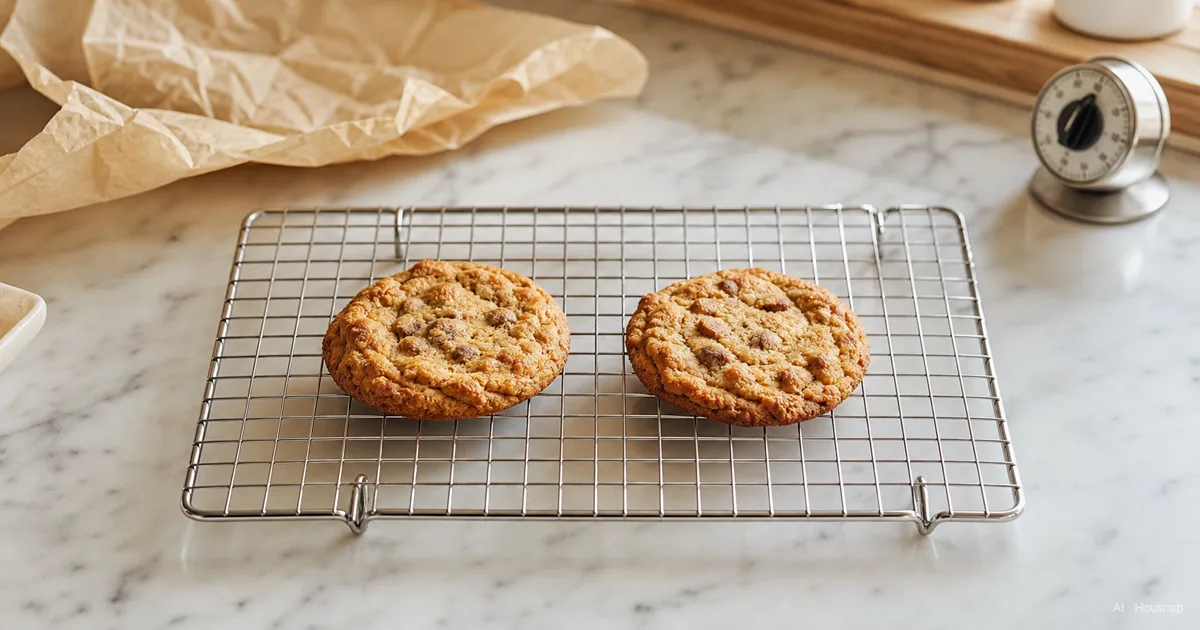
When you pull a baked item — cookies, a cake, bread, a pie — out of the oven and set it on a solid surface, the bottom of the item is in contact with a surface that has the same heat as the item. The trapped moisture from the baked item's interior has nowhere to go except down, where it condenses on the bottom surface. What was a crisp bottom on a cookie or a well-baked crust on a loaf of bread becomes soft and slightly soggy within a few minutes of sitting on the pan.
A cooling rack lifts the baked item above the pan or counter by about a centimeter. That gap allows the moisture that escapes from the bottom of the baked item to dissipate into the surrounding air rather than pooling on the bottom surface. The result is a baked item that cools without softening on the bottom, and that has a more even texture from edge to center because both the top and bottom surfaces are exposed to the same moving air ([How to Cool Baked Goods Correctly, Serious Eats](https://www.seriouseats.com/how-to-cool-baked-goods)).
This is the core function. It sounds incremental, but the difference between cookies cooled on a rack and cookies cooled on a pan is visible and tactile — softer, slightly compressed bottoms on the pan-cooled version versus crisper, more intact bottoms on the rack-cooled version. For bread, the difference is more dramatic: a loaf cooled on a pan can develop a gummy crust on the bottom from the condensed steam, a quality defect that will not self-correct once the loaf has cooled.
The same principle applies to fried food, meat rested after cooking, and any food that benefits from not sitting in its own released liquid. A cooling rack is not only for baking — it is a general-purpose tool for any food you want to rest without steaming the bottom.
Oven-safe vs. cooling-only racks
Not all wire racks are oven-safe. The distinction matters because oven-safe racks can also be used inside the oven during cooking — to allow heat to circulate under a whole chicken, to roast vegetables on an elevated surface so the underside crisps instead of steaming, to broil without the food sitting in drippings, or to keep cooked food warm without steaming it on a solid shelf.
The main difference between oven-safe and cooling-only racks is the coating. Many inexpensive cooling racks have a chrome plating that looks shiny and clean but is not rated for oven temperatures. Chrome platings vary — some are stable at oven temperatures, some are not, and the product listing rarely says clearly which you are buying. A chrome-plated rack at oven temperature may discolor, may release trace metals at elevated temperatures, or may show no visible change while developing small surface cracks in the plating that make the rack harder to clean.
Oven-safe racks are most reliably identified by a stainless steel construction, which is rated to far higher temperatures than any oven can produce and has no coating that can fail. Stainless steel racks are identified in product listings as "stainless steel" (not "stainless look" or "chrome"). They are heavier and more expensive than chrome-plated equivalents but do not degrade in the oven and last significantly longer ([The Best Cooling Racks, America's Test Kitchen](https://www.americastestkitchen.com/equipment_reviews/cooling-racks)).
A second check for oven-safety is to look at the product description or packaging for explicit oven temperature rating. A rack rated to 230°C or 250°C can handle oven use. A rack described only as "cooling rack" with no temperature rating should be assumed to be for cooling only. If the listing does not specify, contact the manufacturer or treat the rack as cooling-only.
The feet of the rack also matter for oven use. Rubber or silicone-coated feet keep the rack stable on a counter but will degrade in an oven. A rack with metal feet — or with removable feet — is more suitable for oven use. Rubber feet that melt onto the oven rack or the pan beneath are a common problem with "cooling racks" used in ovens.
Size and pan compatibility
The most useful cooling rack size is one that fits inside a half-sheet pan (approximately 45cm × 33cm / 18 × 13 inches). This fit is important for two reasons. First, it means the rack can sit inside the pan during oven use, allowing drippings from meat or vegetables to fall into the pan below rather than onto the oven floor. Second, it means you can roast or bake something on the rack and then move the whole assembly — rack plus pan — in and out of the oven as a single unit.
A rack that is slightly too large for the half-sheet pan is useless in the oven; it won't sit inside the pan. A rack that is too small wastes the pan's surface area and may tilt when food is placed unevenly. The standard half-sheet pan size is well-established, and manufacturers of quality racks generally produce sizes that match it — but always verify the dimensions of both the rack and your pan before buying ([Half-Sheet Pan, Wikipedia](https://en.wikipedia.org/wiki/Sheet_pan)).
Quarter-sheet pan dimensions (approximately 33cm × 23cm / 13 × 9 inches) are also standard, and quarter-sheet-fitting racks are useful for smaller roasting or cooking tasks. If you bake in smaller volumes or have limited storage space, a quarter-sheet rack that fits inside a quarter-sheet pan provides the same pan-set flexibility at a smaller footprint.
For a first purchase, buy a rack that fits your most-used pan. If you bake on half-sheet pans, buy a half-sheet rack. If you primarily use quarter-sheet pans or smaller, match accordingly.
Grid spacing and what falls through
Grid spacing is the distance between the horizontal and vertical wires of the rack's surface. For cooling baked goods, the grid spacing determines which items can sit on the rack without falling through.
Standard grid spacing of around 2 to 2.5cm (about an inch) is suitable for most baked goods: thick cookies, muffins, scones, loaves, cakes, and anything else with a footprint that spans multiple grid squares. Items smaller than this — thin cookies, small pastries, pieces of candy — can fall through or tilt at an angle that looks fine but means the item is not actually resting flat.
Closely spaced grids (1 to 1.5cm) are better for small items and anything where a flat, stable surface is important. The tradeoff is that a finer grid accumulates food and crumbs in more gaps, making the rack harder to clean.
Widely spaced grids (3cm or more) are common on roasting racks that are designed for large pieces of meat, where stability of the large item is the only concern. Wide-spaced racks are poor for cookies and small baked goods because items fall through or tilt.
For most home bakers who want a single rack that works for everything, the 2 to 2.5cm grid spacing is the practical standard. It handles cookies without items falling through and handles roasting without the grid being too fine to allow adequate heat circulation underneath.
Nesting and stackability for small kitchens
Cooling racks are flat, wide objects that take up disproportionate storage space relative to their weight and functionality. A single half-sheet rack takes up as much horizontal cabinet or drawer space as a half-sheet pan, which is a significant amount of real estate in a small kitchen.
Stackable cooling rack sets address this by stacking two or three racks vertically, which multiplies the cooling surface without increasing the storage footprint. A set of three stackable racks can cool three full batches of cookies simultaneously, using only the footprint of a single rack in storage. This is meaningful for batch baking and for kitchens where counter and storage space are limited.
The tradeoff with stackable racks is that the individual racks need to connect to each other securely — in a way that holds them at a consistent height and prevents them from collapsing under the weight of food. Not all stackable rack systems are well-designed. Some use a notch-and-slot system that is stable; others use a simple overlap that allows the racks to slip when food is placed unevenly. Examine how the racks connect before buying a set.
Nesting — where the racks fit inside each other flat, like nesting measuring cups — is a different approach that reduces storage height without enabling simultaneous cooling. Nesting is useful if you have multiple racks but primarily use one at a time.
For a first purchase, a single quality rack is more useful than a set of cheaper racks. If you find yourself batch-baking regularly, a stackable set becomes worthwhile.
Cleaning and warping prevention
Wire racks accumulate baked-on food, caramelized drips, and oxidized oil in their grid intersections. The intersections are hard to reach with a sponge and require a stiff brush or a scrubbing pad for effective cleaning.
Most stainless steel racks are dishwasher-safe. The high heat and long cycles of a dishwasher loosen baked-on residue more effectively than hand-washing. Running a stainless steel rack through the dishwasher periodically — particularly after high-heat oven use or after cooking something sticky — is the easiest way to keep it clean.
Chrome-plated racks are more vulnerable to dishwasher damage. The detergent and humidity of dishwasher cycles can accelerate the degradation of chrome plating, leading to rust spots and surface pitting. Handwashing is recommended for chrome-plated racks to extend their useful life.
For stubborn baked-on residue, soaking the rack in warm soapy water for thirty minutes before scrubbing is effective. A paste of baking soda and water, applied to stuck residue and left for fifteen minutes before scrubbing, works for particularly persistent spots.
Warping — where a flat rack develops a permanent bow or twist after repeated use — is a common failure mode for thin or poorly made racks. The cause is uneven thermal expansion: when a rack is placed in a hot oven or removed and cooled quickly, the metal expands and contracts. If the rack's construction does not distribute that stress evenly, one section expands or contracts more than the others, and the rack takes on a permanent deformation.
The primary prevention for warping is to avoid sudden temperature changes. Allow a rack to cool to room temperature before washing it with cold water. Do not put a very hot rack into cold water — the thermal shock is what causes the rapid uneven contraction that leads to warping. A quality stainless steel rack with welded rather than merely spot-connected intersections is significantly more resistant to warping than a thin chrome-plated rack, because the welded structure distributes stress across the whole grid rather than allowing each wire to flex independently.
Sources
- [The Best Cooling Racks, America's Test Kitchen](https://www.americastestkitchen.com/equipment_reviews/cooling-racks) — size, grid spacing, and oven-safety testing across models
- [How to Cool Baked Goods Correctly, Serious Eats](https://www.seriouseats.com/how-to-cool-baked-goods) — the science of why cooling method affects texture
- [Sheet Pan, Wikipedia](https://en.wikipedia.org/wiki/Sheet_pan) — standard sizes for half-sheet and quarter-sheet pans
- [Wire Mesh, Wikipedia](https://en.wikipedia.org/wiki/Wire_mesh) — construction and material properties of wire grids