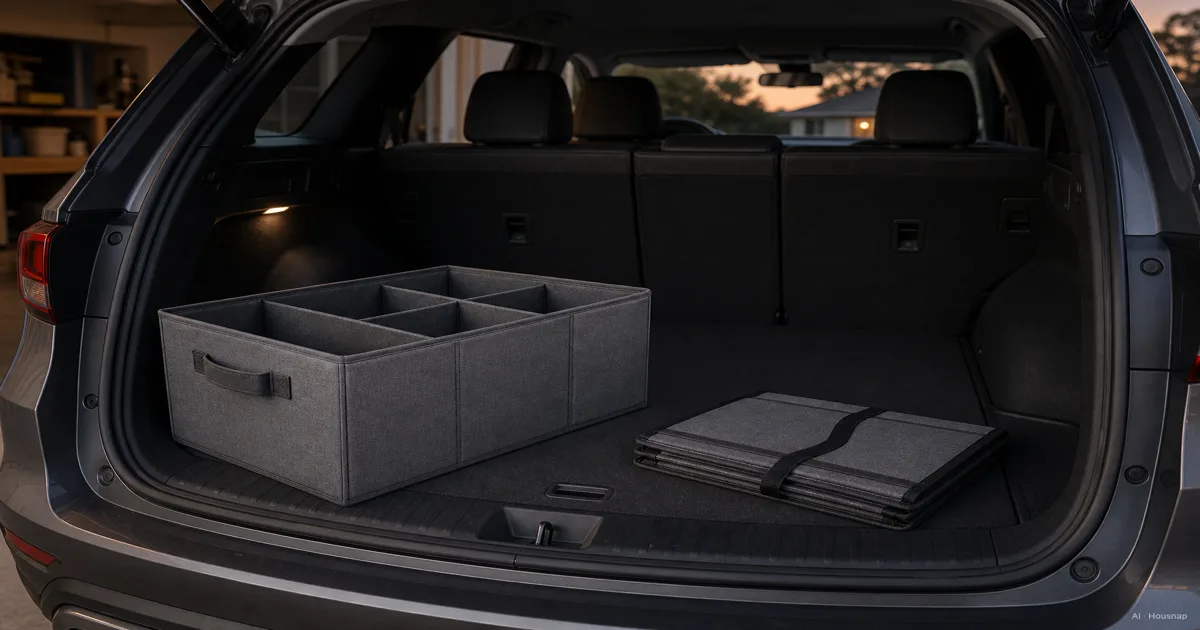
Measure the space you can give up
Take out what does not belong in the car, then separate your regular kit from things you carry only for a particular trip. If the remaining items already fit your car's built-in storage, you may not need another box.
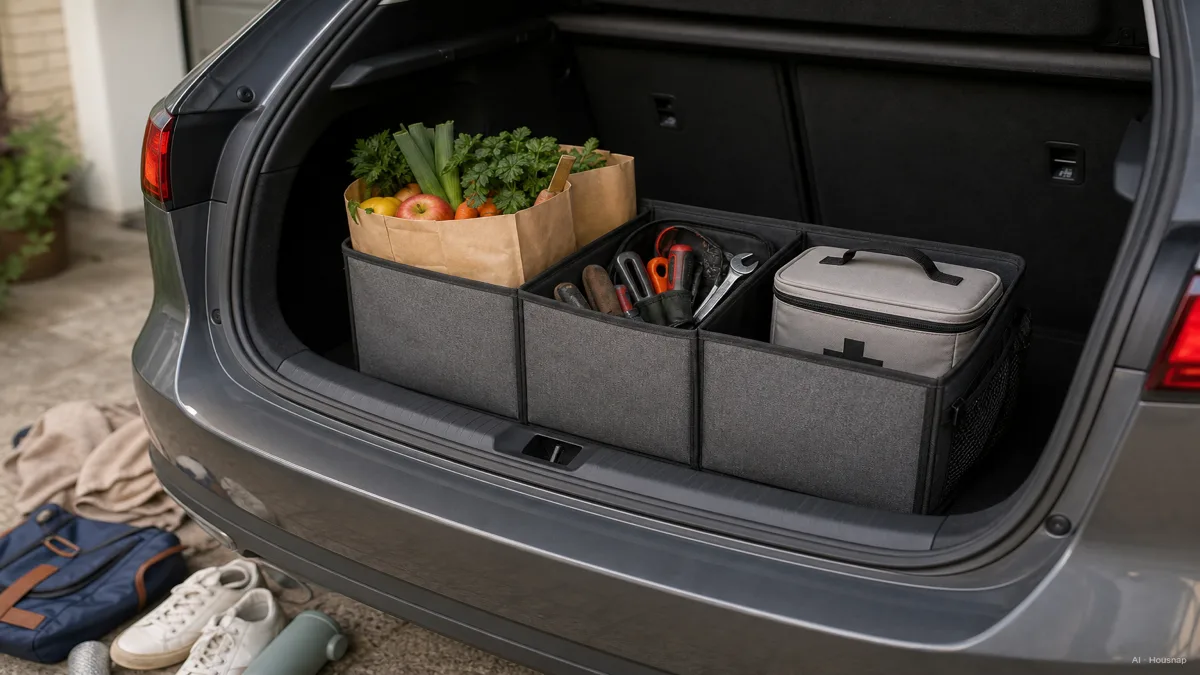
Measure with the stroller, suitcase or other bulky item you normally carry still in place. Use this order:
- First, the footprint. Mark out the organizer's proposed footprint on the usable floor, including any raised edges on your cargo mat.
- Next, the clearance. Check the opening it must pass through and the clearance for its lid and handles.
- Finally, access underneath. Leave access to the underfloor compartment and any vehicle equipment you need to reach.
Compare actual dimensions before liters. For example, Thule lists its Go Box Large as 24 × 18 × 12 inches; a volume figure alone would not tell you whether that shape fits beside your luggage.
If essential trip luggage still will not fit after sorting, a larger organizer is the wrong next purchase. Explore roof baskets and cargo boxes to assess a different carrying arrangement.
Choose how it stores, then how it supports a load
“Collapsible” and “reinforced” are not opposites. FORTEM's Original Large combines a folding design with rigid panels. Check the assembly instructions rather than treating the label as a strength rating.
- You regularly clear the trunk. Favor a folding design; check its folded dimensions and whether panels must be removed each time.
- You leave the same kit in place. Consider a rigid container if keeping its full footprint is acceptable. Check the usable interior and lid clearance before choosing it.
- You carry the contents into the house. Prioritize manageable loaded weight, accessible handles and a stated carrying limit. Do not infer that limit from the box's capacity in liters.
For mixed everyday use, start your shortlist with a folding organizer that has a supported base. Move toward a rigid container when the fixed shape serves your kit better, not because of an assumed lifespan advantage.
Read 600D and 1680D without buying a promise
D means denier, yarn mass relative to length, not weave density. Strength also depends on the material, and waterproofness has a separate test. MSR explains these distinctions in its fabric guide.

This illustration shows labeled swatches, not a measured durability comparison. You cannot conclude from it that every 1680D fabric is denser or that an organizer will last three times longer. Treat the number as one detail, then ask about reinforcement, seams and the permitted load.
For wet shoes or possible spills, ask exactly which parts are protected: the base, lining, seams or whole container. Look for an explicit leak-containment claim if that is your need; a fabric description alone is not enough. Prefer a removable, washable insert when the maker permits that cleaning method, and keep liquids in their own closed containers.
Check the floor and the fastening separately
Before ordering, identify your floor surface and the load anchors approved in your vehicle manual. Compare those with the organizer's attachment instructions. If the hooks cannot connect as instructed, choose a different setup.
A grippy base can help with everyday sliding, but it is not evidence of crash restraint. Volvo's XC90 loading instructions require large and heavy items to be secured with seat belts or cargo retaining straps. Follow your own vehicle's instructions and do not assume organizer straps have the same rating.
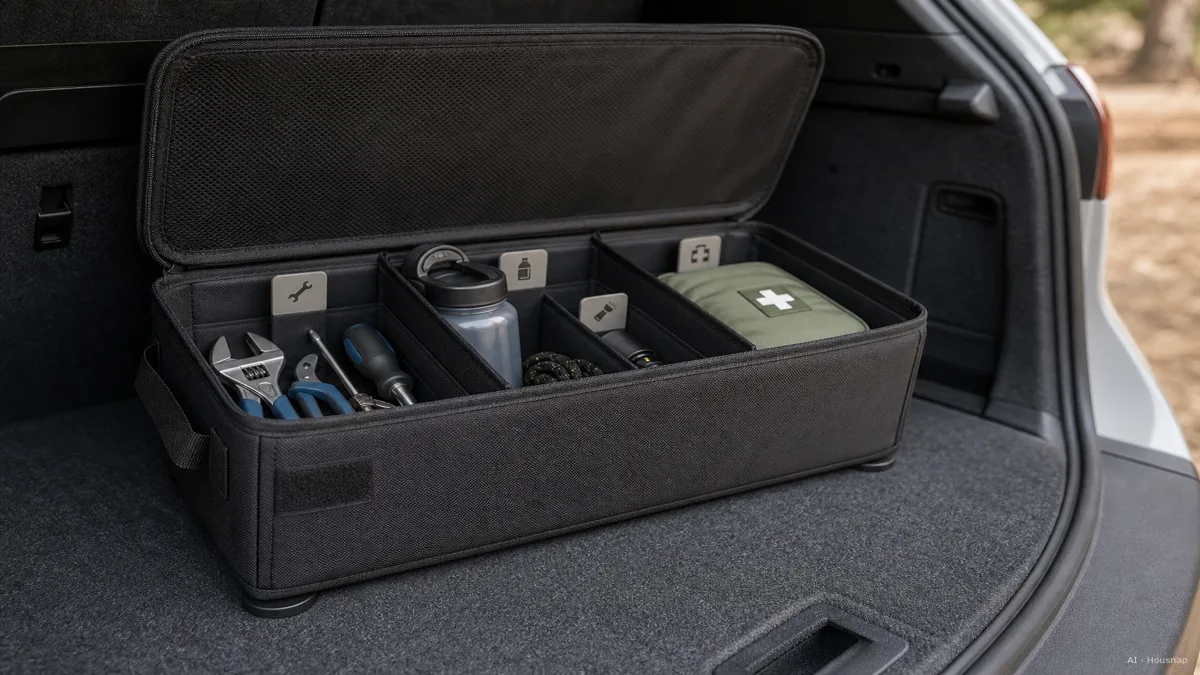
The illustrated feet, lid and dividers help you identify features; the picture does not demonstrate their holding strength.
Check for grit underneath, too. WeatherTech says its CargoTech blocks need clean contact surfaces to maintain grip. Use an existing suitable vacuum for loose debris; if you need a dedicated tool for recurring sand or pet hair, see how to choose a car vacuum.
Turn your shortlist into one clear purchase
Compare candidates against your measured space and actual load, then check the details you will use:
- Dividers. Will your largest regular item fit with them installed, or can they be removed? Check compartment dimensions as well as overall size.
- Lid. Can you open it in the intended position without unloading the trunk? Choose one if covering the contents matters to you.
- Cleaning. Can you remove the liner or base panels, and what cleaning method does the maker allow?
- Fixing and carrying. Are the required fittings included, compatible with your car and suitable for the stated load? Is a carrying limit documented?
A useful purchase note is: “Must fit this footprint, hold these items, attach to these approved points and fold away when needed.” Choose the simplest candidate that meets those conditions. If dimensions or fastening instructions are missing, get them before ordering.
Como este guia foi construído
Housnap's AI editor wrote this guide using manufacturer product information from Thule, FORTEM and WeatherTech, Volvo loading instructions, and MSR's explanation of fabric specifications. The measuring sequence and purchase checklist are editorial guidance, not results of hands-on product or crash testing.