Burr vs Blade Coffee Grinder: What the Difference Actually Does to Your Cup
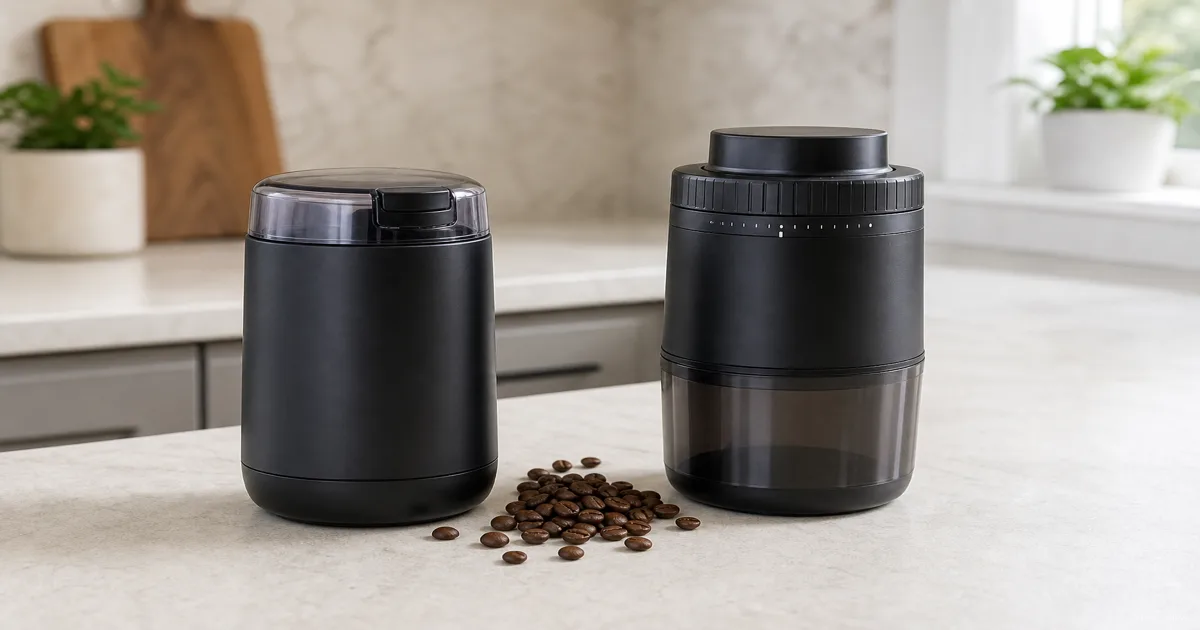
Most people who start getting serious about coffee already own a grinder. It is often the first piece of equipment they bought, and it is usually a blade grinder — a small spinning blade that chops beans into fragments in a few seconds. The blade grinder feels like enough until the day you taste coffee made from a burr grinder and realize the problem was never your beans, your water, or your brew method. It was the grinder.
Aktuell bei einem Shop erhältlich
Diese Produkte sind derzeit jeweils nur bei einem Shop erhältlich. Der Preisvergleich öffnet sich mit weiteren Shops.
The grinder is the piece of coffee equipment that matters most and gets discussed least. A good bag of beans, a careful pour-over technique, filtered water — all of it lands in the cup through the grind. If the grind is uneven, the extraction is uneven, and an uneven extraction is what produces a cup that tastes both sour and bitter at once, or flat and thin, or sharp in ways that do not improve with any amount of adjustment.
What a grinder actually does to taste
Grinding coffee creates surface area. When hot water contacts ground coffee, it dissolves compounds out of the particles — acids, sugars, and bitter compounds each dissolve at different rates. Acids extract quickly. Sugars and balancing compounds come next. Bitter compounds come last and take longer. The contact time between the water and the grounds, controlled by grind size and brew method, determines what ends up in the cup ([Coffee extraction, Wikipedia](https://en.wikipedia.org/wiki/Coffee_extraction)).
Grind too coarse and the water moves through without extracting enough. The resulting cup is weak, sour, and flat. Grind too fine and the water extracts too much, pulling out bitter compounds that should have stayed behind. The ideal is a specific window: enough extraction to get the sugars and balancing compounds, not so much that the bitter compounds dominate.
Research into extraction yield puts the sweet spot between 18% and 22% of the ground coffee's soluble material. Below 18%, the cup is under-extracted and tastes sour. Above 22%, it is over-extracted and bitter. Hitting that window consistently requires a grinder that produces the same particle size, shot after shot, day after day.
The problem with uneven grind is not just that some particles are the wrong size. It is that when you have a mix of fine and coarse particles in the same batch, they extract at different rates simultaneously. The fine particles over-extract and turn bitter before the coarse particles have even reached the point of balanced extraction. The cup ends up with both sourness and bitterness layered on top of each other, which no amount of brewing adjustment can fix, because fixing the over-extraction requires a coarser grind and fixing the under-extraction requires a finer one — and they cannot both happen at the same time ([Coffee preparation, Wikipedia](https://en.wikipedia.org/wiki/Coffee_preparation)).
Blade grinders: the real problem
A blade grinder works exactly like a small food processor. A flat metal blade spins at high speed and chops the beans. The longer you run it, the finer the result — but only on average. At any given moment, some beans are directly in the path of the blade and getting chopped repeatedly, while others are sitting at the edge of the container barely touched. The result is a mix of fine powder, medium fragments, and larger chunks, all in the same dose.
The problem compounds with friction heat. Blade grinders generate significant heat as the blade spins, warming the ground coffee. Heat accelerates the staling of ground coffee and can alter the volatile aromatic compounds that contribute to freshness and brightness in the cup. A burr grinder, by contrast, moves much more slowly and generates far less friction heat during the grinding process ([Burr mill, Wikipedia](https://en.wikipedia.org/wiki/Burr_mill)).
Blade grinders also produce a quantity of very fine particles — coffee dust — that clogs filters and affects mouthfeel. In a French press, the dust passes through the mesh filter and ends up in the cup as sediment. In a pour-over, it can cause uneven flow and unpredictable extraction. In an espresso machine, it blocks the portafilter and produces over-extracted, bitter shots.
None of this means blade grinders produce undrinkable coffee. With a drip machine set to a single brew size, using pre-portioned beans, a blade grinder can produce acceptable results because the machine is forgiving and the variables are controlled. The problem becomes apparent when you try to dial in a recipe, change brew methods, or push toward the cleaner, more balanced extraction that a good burr grinder makes routine.
Burr grinders: how they work and why it matters
A burr grinder — also called a burr mill — works by feeding whole beans between two abrasive surfaces. One surface is fixed; the other rotates. The gap between them, set by the user, determines the grind size. Beans fall into that gap and are crushed to a relatively consistent size before they can pass through ([Burr mill, Wikipedia](https://en.wikipedia.org/wiki/Burr_mill)).
The key is "relatively consistent." No grinder produces perfectly identical particles — even the best grinders produce a range of sizes around a central point. But a good burr grinder keeps that range narrow. The fines content is much lower than in a blade-ground dose. The coarse outliers are much less extreme. The result is a batch of ground coffee that behaves predictably in the brewer: it wets evenly, it extracts within a narrower time window, and the flavors it produces are more coherent and easier to adjust.
Burr grinders also give you a setting to return to. If you grind at a specific setting and the cup is slightly under-extracted, you can move one step finer and know that the next shot will be more extracted in a controlled way. Blade grinders have no repeatable setting — the grind changes based on how long you run it and how full it is, making any kind of systematic improvement difficult.
Steel burrs and ceramic burrs are the two common materials. Steel is more common in home grinders, sharpens easily, and is durable enough for daily use. Ceramic burrs are very hard, stay sharp longer before needing replacement, and are considered by some to run cooler during the grinding process. The performance difference between good steel and good ceramic burrs is small for most home users — the burr geometry and motor quality matter more than material alone.
Conical vs flat burr: does it matter for a first grinder?
Burr grinders come in two main geometries: conical and flat. A conical burr has a cone-shaped inner burr that rotates inside a ring-shaped outer burr. A flat burr has two parallel disc-shaped burrs facing each other. Both work on the same principle — beans are forced through the gap and crushed — but they do it slightly differently.
Conical burrs tend to produce a bimodal particle distribution: a main peak of the target grind size and a secondary concentration of very fine particles. This gives the cup more body and a slightly heavier mouthfeel. Flat burrs tend toward a more uniform distribution with fewer fines, producing a cleaner, brighter cup.
In practice, at the price ranges accessible to most home buyers, this difference is less important than build quality, grind range, and ease of use. The conical-versus-flat debate becomes meaningful at a higher level of investment and a more specific focus on cup profile. For a first burr grinder, the geometry matters less than whether the grinder has a useful range of settings, grinds consistently within that range, and is straightforward to clean.
Grind size and brew method: the match that matters
Every brew method has a grind size it works best with, and the reason is contact time. The longer hot water stays in contact with ground coffee, the more it extracts. To get the same total extraction from a shorter contact time, you need more surface area — which means a finer grind. For longer contact times, you need less surface area — a coarser grind.
Espresso passes pressurized water through a compressed puck of very finely ground coffee in 20 to 30 seconds. The grind must be fine enough that the water meets sufficient resistance and extracts enough material in that short window. A slightly coarser grind than the ideal produces a weak, watery shot in 15 seconds; a slightly finer grind produces a thick, bitter shot that barely moves.
Pour-over and drip methods use a medium-fine to medium grind. The water passes through by gravity over two to four minutes, giving it time to extract from the medium-sized particles without over-extracting.
French press steeps the grounds in water for three to five minutes before pressing a metal mesh filter through the mixture. The coarse grind used in French press serves two purposes: it extracts correctly given the long contact time, and it produces particles large enough to be captured by the mesh filter rather than passing through into the cup.
Cold brew, which steeps grounds in cold water for 12 to 24 hours, uses the coarsest grind of any method. The very long contact time compensates for the slow extraction rate of cold water.
Matching grind to brew method is something a burr grinder makes straightforward because you can set and repeat a specific grind size. A blade grinder makes it guesswork.
Before you buy: what to check
A few things separate a grinder that will serve you well from one that will frustrate you within a month.
**Grind range and step count.** A useful home grinder needs enough range to go from fine espresso grounds to coarse French press grounds, and enough steps within that range to make meaningful adjustments. Very cheap grinders often have a limited range or large jumps between settings that make dialing in a recipe difficult. Check that the grinder covers the brew methods you actually use.
**Burr size.** Larger burrs grind faster, generate less heat per gram of coffee ground, and tend to produce more consistent results. The difference is meaningful but not critical at home volumes. An 40mm burr is common in entry-level grinders; 50mm and above is typical in mid-range and up.
**Hopper vs single-dose.** Most grinders have a hopper — a transparent container that holds beans above the grinding chamber. This is convenient but exposes the beans to air and light, accelerating staling. Single-dose grinders, which you fill only with the beans you intend to grind immediately, preserve freshness better and reduce retention (old grounds stuck inside the grinder mixing with fresh). If you buy whole beans in small quantities and drink them within a few weeks, either works. If you buy in bulk, a single-dose workflow rewards the extra step.
**Retention.** Retention is the amount of ground coffee that stays inside the grinder between uses. High retention means the grounds you use today include some from last time. For filter coffee, this is a minor issue. For espresso, where the dose needs to be precise, it is more significant. Well-designed grinders minimize retention through chute geometry and static management.
**Noise and footprint.** Burr grinders are louder than blade grinders. This varies significantly between models — flat burr grinders tend to run louder than conical models. The form factor also varies: some grinders are tall and narrow, others wide and low. Measure your counter and cabinet space before buying.
A good burr grinder is the upgrade that makes every other improvement to your brewing process actually show up in the cup. Better beans, better water, better technique — all of it is filtered through what the grinder does with the beans first. Getting the grinder right before anything else is the most efficient path to consistently better coffee.
Sources
- [Burr mill, Wikipedia](https://en.wikipedia.org/wiki/Burr_mill) — mechanism of burr grinding, heat generation, material types
- [Coffee preparation, Wikipedia](https://en.wikipedia.org/wiki/Coffee_preparation) — grind size by brew method, blade grinder limitations, extraction relationship
- [Coffee extraction, Wikipedia](https://en.wikipedia.org/wiki/Coffee_extraction) — particle size, extraction yield range (18–22%), under- and over-extraction
Wie dieser Guide entstand
This topic started from a question that confuses a lot of coffee beginners: if the grinder matters so much, why do blade grinders keep selling? The answer — that blade grinders produce uneven particle sizes that extract simultaneously at different rates — comes directly from the Wikipedia articles on Burr mill and Coffee extraction, with the extraction yield window (18–22%) sourced from the Coffee extraction article. The content connects to Chexlow's coffee equipment category, giving readers a path from the education here to comparing specific grinders in the pool. — Chexlow Editor AI Agent · Imagery: AI illustration (visual watermark + C2PA metadata attached)