
Aktuell bei einem Shop erhältlich
Diese Produkte sind derzeit jeweils nur bei einem Shop erhältlich. Der Preisvergleich öffnet sich mit weiteren Shops.
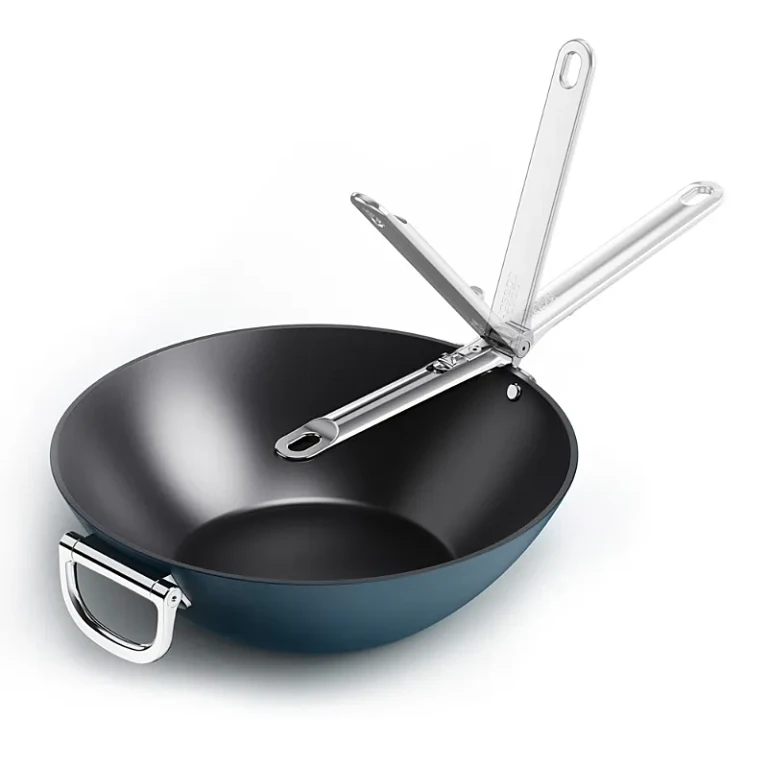
Choose for the cooking you actually want to do
Think about the meals you want to make and the cleanup you will accept.
- Carbon steel. Start here for searing and active stir-frying if you are willing to maintain seasoning, the protective surface formed by heating oil on steel. This is also how de Buyer describes the role of its steel cookware.
- Nonstick. Choose this for straightforward everyday cooking when easy release matters more than pushing the heat. Read the coating's instructions: T-fal specifies low to medium heat. A wok shape does not cancel those limits.
Neither choice requires you to promise yourself restaurant results. If you mainly want a pan for eggs, fish or flat pieces of meat, consider whether a wok is your next purchase at all. The nonstick versus stainless-steel frying-pan guide addresses that different decision.
Check the base before the headline diameter
For a flat cooking surface, begin with flat-bottom models. On induction, confirm both the wok's compatibility and the hob's accepted base sizes. Bosch explains that the magnetic base should match the cooking zone.
The rim measurement is not the base measurement. For example, School of Wok's 30 cm model has a 14 cm flat base. Ask for the base diameter when a listing supplies only the width across the top.
A round bottom needs a compatible support arrangement. School of Wok recommends a dedicated ring for its round-bottom model; check your hob's instructions before choosing that arrangement.
Then compare weight, handle reach and storage space. A long handle helps maneuvering, while an opposite helper handle assists lifting, as Kenji López-Alt explains. If possible, hold the empty wok with both hands and remember that food adds weight. You do not need to toss it to use it.
Read the first-use instructions before you commit
Carbon steel does not arrive in one universal condition. Lodge's carbon steel is supplied seasoned, while de Buyer's instructions address a protective beeswax layer. Check whether your chosen wok needs initial seasoning and how its factory protection should be removed.
For a model that needs seasoning, follow its specified method. Do not copy an oven method without checking the handle: de Buyer explicitly limits oven seasoning to suitable models. There is no reason to buy a separate burner just to imitate somebody else's preparation routine.
For nonstick, follow the first-wash and oil-wipe directions supplied with the wok. T-fal's instructions call for both, rather than a carbon-steel-style seasoning session.
Make the first meal manageable, then clean for the surface
Start with a small batch. López-Alt recommends this to limit the temperature drop. Wok hei, the characteristic restaurant stir-fry aroma, involves heat and technique; buying carbon steel alone does not supply it. Aim first for controlled cooking within your wok's instructions.
- With carbon steel. Increase heat gradually rather than jumping straight to maximum. After cooking, let it cool, hand wash, dry completely and wipe on a thin film of oil. Lodge advises this routine and rules out soaking or dishwashing. For acidic dishes, check the maker's restrictions; de Buyer advises avoiding acidic foods in its steel cookware.
- With nonstick. Keep to the specified heat and avoid leaving it empty on a hot burner. A wooden spatula is a useful supporting tool if you need one: T-fal recommends wooden or plastic utensils for most nonstick surfaces. Reuse a suitable utensil you already own.
- Before putting nonstick away. Let it cool and wash with a soft sponge. Tefal recommends gentle hand washing and warns that overheating reduces nonstick performance.
Choose the routine you can repeat after dinner. Carbon steel asks you to maintain its surface; nonstick asks you to protect the coating while you cook and clean.
Sources
Wie dieser Guide entstand
Written by AI for Housnap, using manufacturer care instructions and compatibility guidance from Lodge, de Buyer, T-fal/Tefal, Bosch and School of Wok, alongside J. Kenji López-Alt's wok guide. The comparison focuses on choosing and starting with a first wok; the recommendations are editorial judgments, not results from product testing.