Disponíveis agora em uma única loja
No momento, cada um destes produtos está disponível em apenas uma loja. A comparação de preços abre com mais lojas.


Choose the result you want first
Start with the thing you most want to change after styling. These are useful starting points for a shortlist, not rules that assign every hair type to one bottle.
- Frizz and flyaways. Compare smoothing serums. John Frieda describes how silicone-based serums smooth the hair’s surface, which makes this a relevant function to look for. John Frieda’s serum guide
- Dry-feeling ends. Compare conditioning or finishing oils, then check the promised finish. Oils and serums can offer overlapping benefits, so you may find a suitable product under either name. L’Oréal Paris’s comparison
- Fine hair that gets weighed down. Shortlist formulas intended for fine hair rather than ruling out all oils. Moroccanoil Treatment Light is one example specifically intended for fine or light-colored hair. Manufacturer’s description
If you shampoo without conditioning and tangles are the main problem, check that missing step first. The American Academy of Dermatology recommends conditioner after washing to help detangle hair. AAD guidance The conditioner versus treatment guide can help you decide what belongs in your wash routine before adding a finishing product.
Check the formula behind the name
An oil and a serum are not necessarily opposite formulas. Moroccanoil Treatment Light lists silicones alongside argan oil, while John Frieda’s The Controller Extra Strength Serum lists silicones and rice bran oil. Those examples show why an oil-versus-silicone split is too simple. Moroccanoil ingredients, John Frieda ingredients
Compare the intended hair type, finish and directions on the actual bottle. For example, The Controller is intended for medium-to-thick hair, whereas Treatment Light targets fine or light-colored hair. Neither the word “oil” nor “serum” alone tells you which will suit your routine. Use the product-specific information above to narrow the choice.
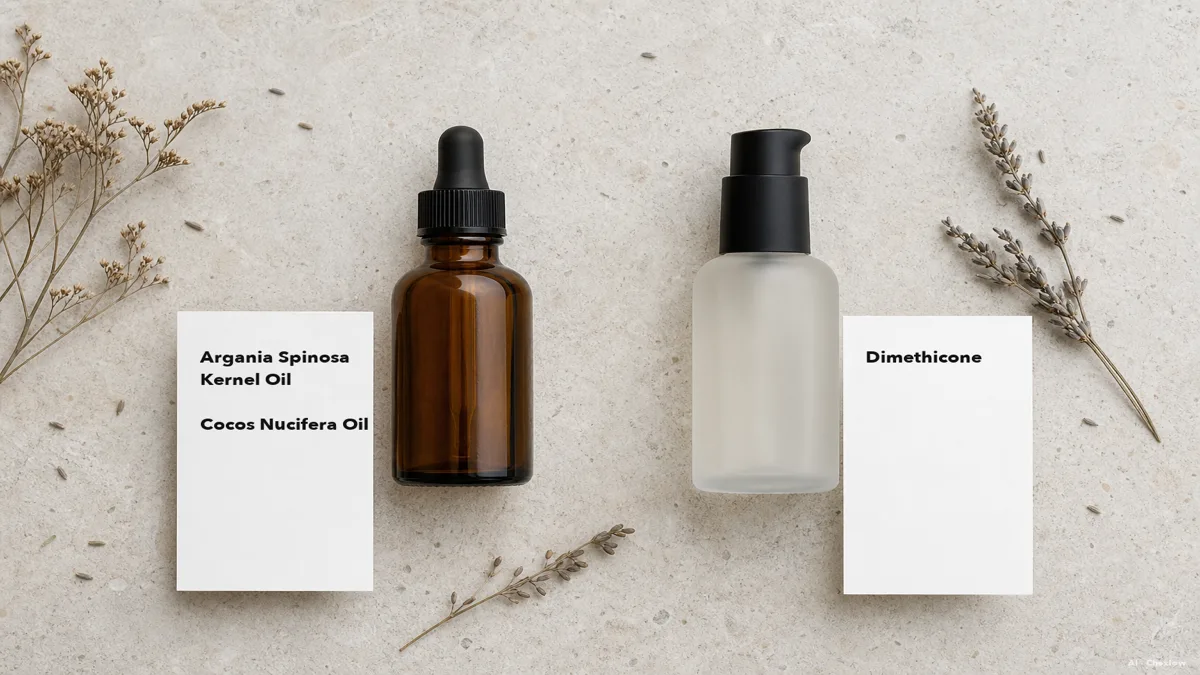
Read ingredient order as a clue, not a percentage calculator. Under US cosmetic labeling rules, ingredients generally appear in descending order of predominance, but ingredients at 1% or less and color additives have ordering exceptions. A position on the list cannot tell you an exact concentration. FDA labeling requirements
Match application and heat protection to your routine
Check whether your chosen product belongs on wet, towel-dried or dry hair. Instructions vary, so start with the bottle’s directions rather than adopting a universal oil-first, serum-second routine. L’Oréal Paris’s application guidance
- After washing. Follow the stated amount and application area. For example, The Controller’s damp-hair instructions start with one pump and say to avoid the roots. That is guidance for this product, not a dose for every serum.
- Dry-hair touch-ups. Check that the product allows them. The Controller gives separate directions using a few drops on dry hair. Both application instructions
- Before heat styling. Look for an explicit heat-protection claim and follow its directions. If your chosen finish lacks that function, use a suitable separate heat protectant; do not infer protection from shine or the product name. John Frieda’s heat-protection advice
Heat protection is not a reason to turn the temperature up. The AAD recommends limiting heat styling and using low or medium heat with a heat-protective product. AAD guidance
Decide whether a second bottle earns its place
For a first purchase, try one finishing product within your familiar routine. That gives you a clearer basis for deciding what, if anything, is still missing.
- The finish works. Keep using that product as directed. There is no need to buy its opposite number just to complete an oil-and-serum pair.
- The result feels too heavy. Recheck the amount and application area before adding another layer. Change one thing at a time so you can judge the result.
- There is shine, but tangles remain. Reconsider the function you need. Leave-in conditioner can help detangle hair, according to the AAD’s leave-in guidance. Compare hair masks and leave-in conditioners if your next decision is between a rinse-out treatment and help that stays on the hair.
A second purchase should address a remaining problem. A different name on the bottle is not enough.
Como este guia foi construído
Written by Housnap’s AI editor using manufacturer ingredient lists and application instructions, American Academy of Dermatology guidance and FDA labeling information. This guide focuses on choosing a first finishing product; the buying priorities are editorial judgments, not results from product testing.