Ir para o conteúdo
Housnap IA
Electronics / Car Jump Starters

Your First Car Jump Starter, How to Read Peak Amps and Battery Size Before You Buy

You're standing in the jump starter aisle, or scrolling through a dozen nearly identical black bricks online, and every listing shouts a different number. 2000A. 3000A peak. CCA 800. 12,000mAh. None of it means anything yet, and the box with the biggest number isn't necessarily the one that will actually start your car. Here's the calmer way in. A jump starter purchase really comes down to a handful of questions. How much current does your engine actually need, and does the number on the box measure that? What kind of battery is inside, and does it match how you'll actually use the thing? And once it's clamped onto a dead battery in a dark parking lot, does it protect you if a wire ends up backwards? The reason this matters is the moment itself. You reach for a jump starter when your car won't start, usually somewhere less than convenient, and you want the thing in your trunk to work on the first try, not the fifth. A jump starter that can't deliver the current your engine needs is just dead weight you paid for. This guide walks through the real math behind the peak-amp number, how to size a unit to your specific car, the lithium-versus-lead-acid decision, the safety features that matter most, and the extras worth paying for.

Your First Car Jump Starter, How to Read Peak Amps and Battery Size Before You Buy — Ilustração IA

Disponíveis agora em uma única loja

No momento, cada um destes produtos está disponível em apenas uma loja. A comparação de preços abre com mais lojas.

What Peak Amps and Cranking Amps Actually Mean, and Why the Marketing Number Isn't the Whole Story

Every jump starter listing leads with one huge number, something like "3000A Peak" printed bigger than anything else on the box. It's the number people repeat to each other in forum threads, and it's also the number that tells you the least about whether the thing will actually start your car.

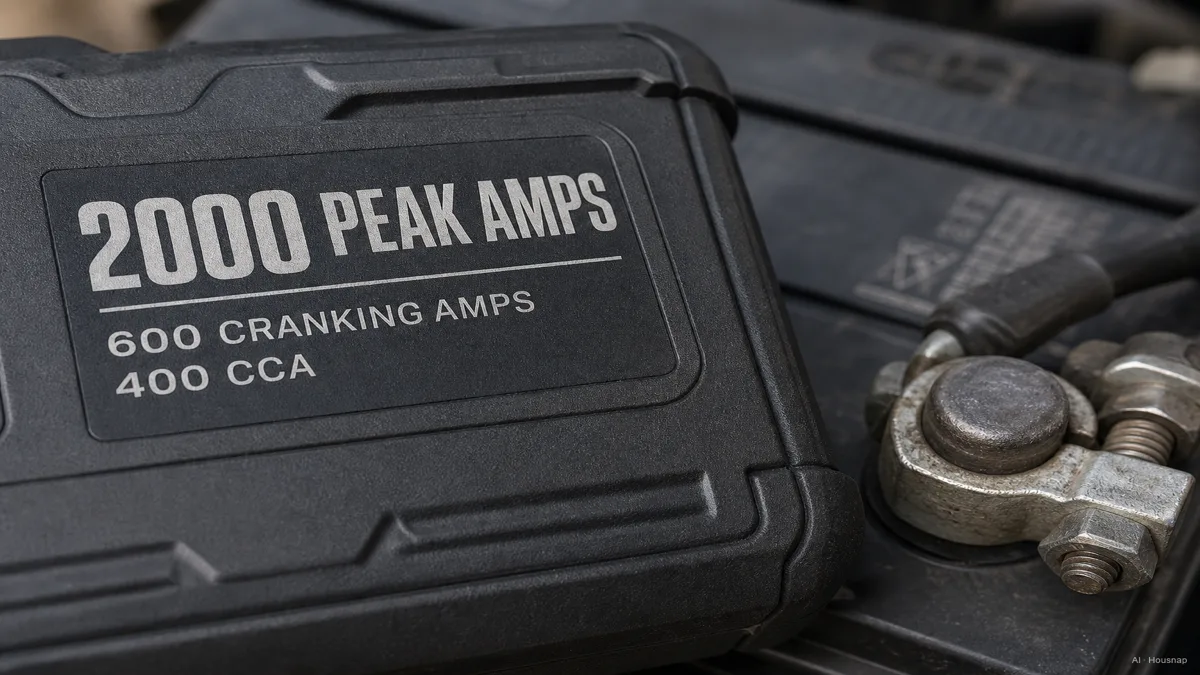
Peak amps, sometimes called marketing amps, is the maximum instantaneous burst the unit can push out for a fraction of a second. It's a real measurement, but your starter motor doesn't need a fraction-of-a-second burst, it needs sustained current for several seconds while it fights compression and cold, thickened oil. That sustained number has its own name, CA (cranking amps) or CCA (cold cranking amps), tested at 0°F for CCA, and held for roughly 3 to 30 seconds rather than an instant. XenonPro's breakdown of the three specs is worth reading once, because it's the one page that makes the difference click.

Practically, this doesn't mean ignore peak amps, it still tells you something about a unit's ceiling. It means don't shop on that number alone. If a listing shouts peak amps in giant font and buries CCA in the fine print, or skips it entirely, read that as a listing trying to distract you rather than inform you.

If your eyes glazed over at that spec sheet before you even knew which number mattered, that's normal. Most of it collapses into one question once you know which number to trust.

Image: a close-up product shot of a jump starter's spec label, the peak amp number printed large and bold, a smaller cranking amps and CCA number beneath it in fine print, next to a car battery terminal — Ilustração IA

How to Size a Jump Starter to Your Vehicle, Compact Car vs. SUV vs. Truck or Diesel

Once you know CCA is the number that matters, the next question is how much of it your car actually needs. There's a rough rule of thumb tied to engine size. Small cars and compacts, roughly 2.0 liters and under, generally need something in the 800 to 1200 peak-amp range. Mid-size sedans and SUVs, in the 2.0 to 3.0 liter band, want more like 1200 to 2000. Trucks and diesels, 3.0 liters and up, are the ones that actually justify the scary 2000 to 3000-plus numbers, since diesel engines run higher compression and need more sustained current to turn over. GOOLOO's vehicle-specific sizing guide breaks this down by engine class if you want the exact bracket for your car.

Here's the honest number underneath all of it. Most gas engines only actually pull around 400A of real sustained cranking current, according to Consumer Reports' jump starter buying guide. So why buy a unit rated for 1200 or 2000? Because real-world output tends to undershoot the number on the box, cold weather cuts into it further, and a battery that's been sitting dead for a while needs more push than a fresh one. Buying meaningfully above the bare minimum, not right at it, is the difference between a jump starter that works on the first try and one that leaves you troubleshooting in a parking lot.

One more spec gets confused with peak amps constantly, battery capacity, usually listed in mAh, commonly 12,000 to 18,000mAh in consumer units. That number has nothing to do with how much punch a single jump delivers, it's how many jumps you get before the unit itself needs recharging, typically somewhere around 10 to 20 for a standard lithium unit. A jump starter can have huge peak amps and a small battery, meaning it starts your car fine but runs out after two uses, or the reverse, a big battery with modest output that struggles on a larger engine. Read the two specs together, not in isolation.

Image: three simple vehicle silhouettes side by side, a compact car, a mid-size SUV, and a pickup truck, each labeled with its rough peak-amp range — Ilustração IA

Lithium-Ion vs. Lead-Acid, Which Battery Type to Buy

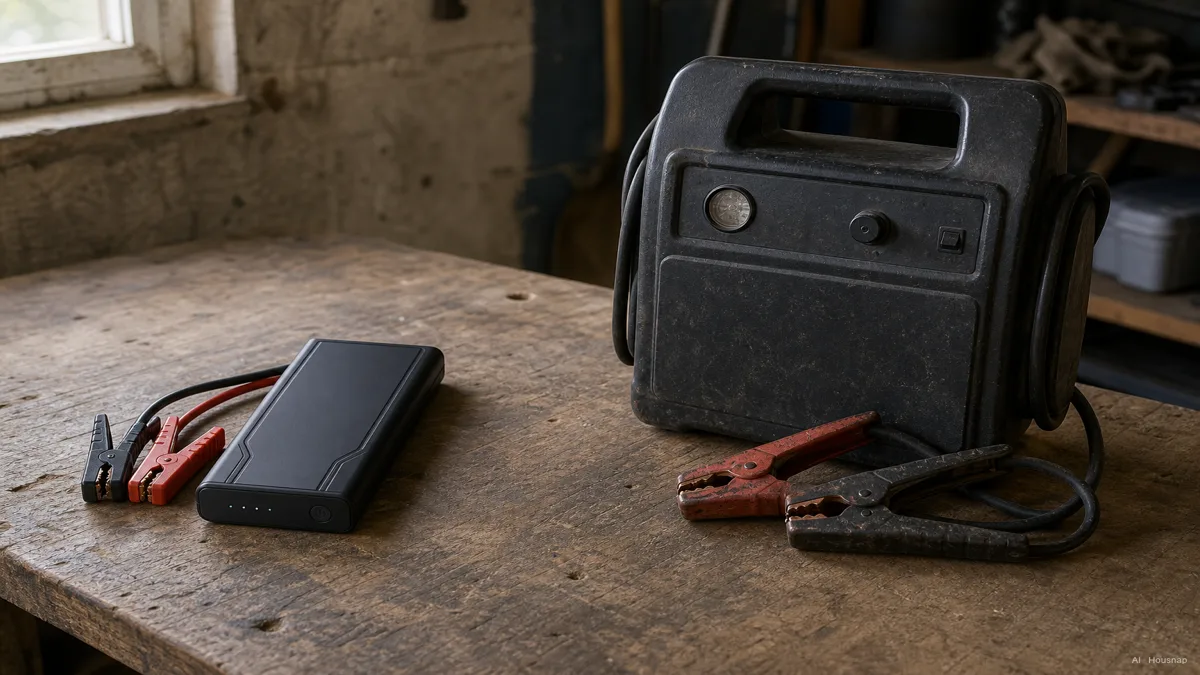
The battery inside the jump starter matters almost as much as the amps it delivers, and this decision has mostly already been made for you by the market. Lithium-ion units have largely pushed the old lead-acid and AGM jump boxes out of the mainstream, and for good reason. AutoZone's comparison of the two and Schumacher Electric's rundown of lithium's advantages both land on the same points. Lithium units are dramatically lighter, closer to a couple of pounds than the ten-plus pounds a lead-acid box could weigh. They hold a charge in storage for months without much loss, where lead-acid self-discharges fast enough that it needs a top-off charge every month or two just sitting in your trunk. Lithium units also tolerate hundreds of recharge cycles with little capacity loss, and they typically pack in more of the protection circuitry covered in the next section.

Lead-acid isn't extinct, it's just a maintenance commitment now. If you'd rather not remember to charge a battery you're not using, lithium is the one that survives sitting in a glovebox for six months and still works when you need it.

One compatibility check that's easy to skip, most modern passenger cars run a 12V electrical system, and a 12V jump starter is what you want. But some classic and vintage vehicles run on 6V batteries, and Consumer Reports' buying guide flags this specifically, don't assume 12V universally. If you're buying for an older car, confirm the voltage before you confirm anything else.

Image: two jump starters side by side on a workbench, a slim modern lithium-ion unit about the size of a paperback book next to a bulkier older-style lead-acid jump box with a carry handle, showing the size difference — Ilustração IA

Must-Have Safety Features Before You Clamp Onto a Battery

The moment you're actually using a jump starter, clamps in hand over a car battery in a dark parking lot, is exactly the moment human error is most likely. A handful of protection features exist specifically to cover the common mistakes, and Consumer Reports and XenonPro both flag the same short list as non-negotiable.

Reverse-polarity protection. This catches the single most common clamp mistake, putting the red clamp on negative or the black on positive. Without it, a reversed clamp can damage the jump starter, the car's electronics, or both. With it, the unit simply refuses to send power or warns you instead of frying anything.

Anti-spark clamp technology. Sparks at the clamp point are how battery gas ignites, which is the actual fire risk in jump-starting. Anti-spark clamps only complete the circuit once they confirm a proper connection, instead of arcing the moment metal touches metal.

Over-current and over-voltage protection. This keeps the unit from pushing more current than it or your car's electronics can safely handle, which matters most on newer cars packed with sensitive onboard computers.

Back-feed, or short-circuit, protection. This stops current from flowing the wrong way if the clamps touch each other or bridge something they shouldn't, a real risk when you're fumbling with clamps in a dark trunk.

None of these show up in the headline spec. They're usually a line item buried in the product description or a small icon on the box. Look for them before you look at the amp number.

Bonus Features Worth Paying For, Air Compressor, USB-C, and Cold-Weather Headroom

Once amps, battery type, and safety are settled, the remaining differences between similarly specced units come down to extras, and some of them are worth paying for.

A built-in air compressor turns the jump starter into a two-problem device, useful if a dead battery and a low tire ever happen on the same bad day, or just for topping off tires without a separate pump. A USB-A or USB-C output means the unit doubles as a phone power bank, which matters if the reason your car wouldn't start is the same reason your phone is at 12 percent. An LCD screen showing actual battery percentage beats a vague four-dot light bar, and a built-in flashlight or SOS light mode earns its keep on the side of a dark road. Consumer Reports and GOOLOO both list these as the real differentiators once the core specs are equal.

Cold weather deserves its own line, because it works against you twice. It makes your engine harder to crank in the first place, thicker oil means more resistance, and it reduces how much current a jump starter's own battery can deliver. If you regularly deal with temperatures below freezing, both guides recommend sizing up, roughly 20 to 50 percent more peak current in reserve than you'd buy for a mild-climate baseline. A unit rated exactly at your engine's minimum on a spec sheet tested at room temperature may come up short on an actual January morning.

As for what's actually on shelves right now, TechGearLab's tested and ranked 2026 roundup is a reasonable cross-check on the field. Premium picks like the NOCO Boost X GBX55 sit around 1750 peak amps with fast USB-C PD recharging, mid-tier all-rounders like the WOLFBOX MegaVolt24 aim at the average buyer, budget options like the GOOLOO GP2000 cover small to mid-size cars and SUVs, and compact units like the NOCO Boost Plus GB40 trade some peak output for fitting in a glovebox at around two pounds. None of that changes the math above, it just shows the math currently maps onto real, actively reviewed products.

Sources

Como este guia foi construído

Editado pela equipe Housnap · As imagens são ilustrações geradas por IA