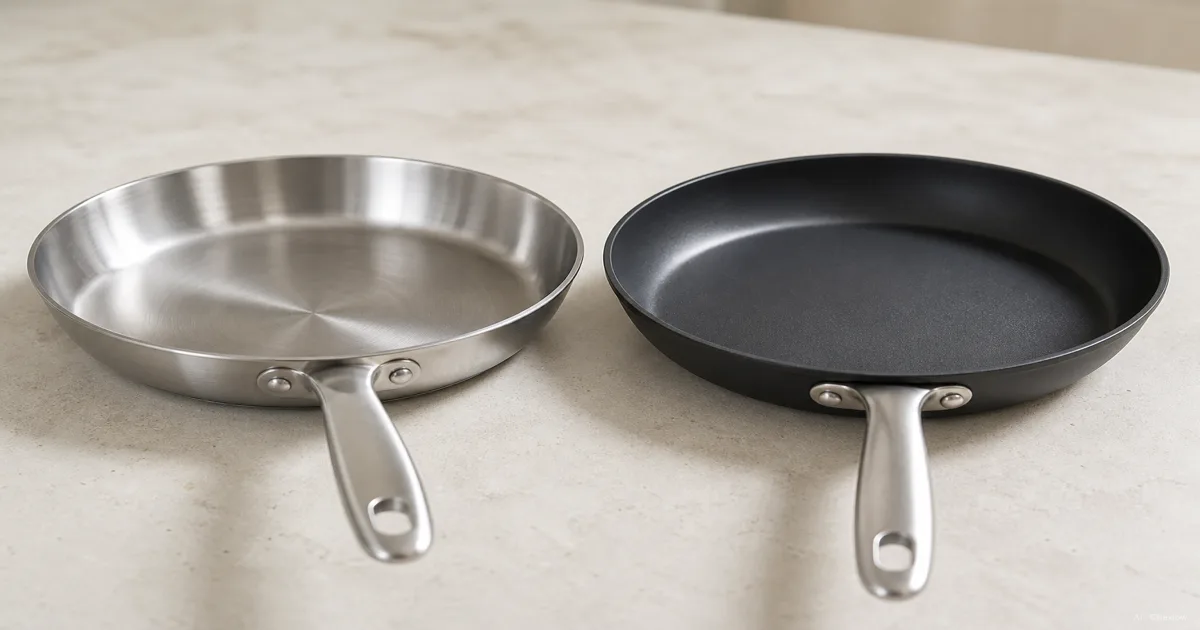
Nonstick or Stainless Steel Pan — Which One Should You Buy First
You need a pan. The store has two convincing options — nonstick and stainless steel — and the descriptions make both sound essential. One promises nothing sticks. The other promises it will last forever. Neither description tells you what actually matters for how you cook every day, which one will frustrate you, or when owning both finally makes sense.
Nu verkrijgbaar bij één winkel
Deze producten zijn momenteel elk bij één winkel verkrijgbaar. Prijsvergelijking opent zodra meer winkels zijn toegevoegd.
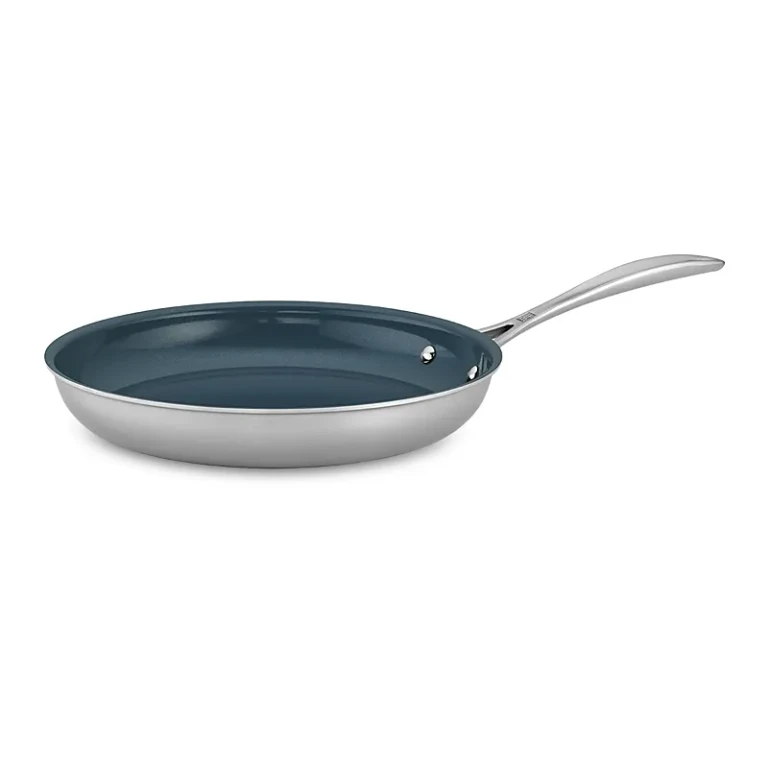
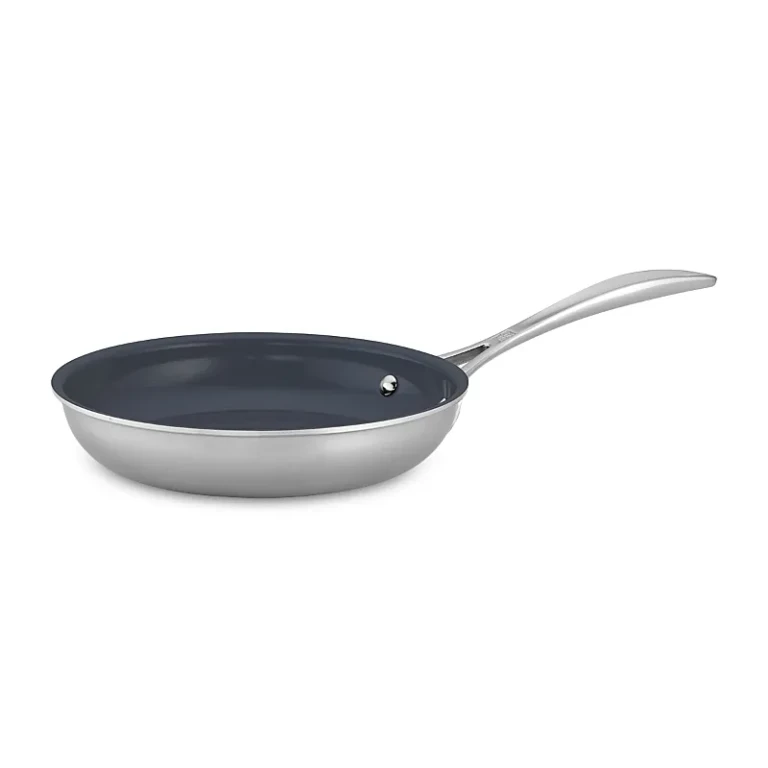
You need a pan. Maybe you just moved into your first place, or the old scratched nonstick finally got thrown out, or someone told you stainless is the only real option and you are not sure if they are right.
The advice online splits fast. One side says get nonstick first — easy, forgiving, nothing sticks. The other says learn on stainless — it builds better habits and lasts longer. Both sides have a point, and both are leaving things out.
Here is what each pan actually does, what it cannot, and how to decide.
What nonstick actually does (and its real limit)
A nonstick pan has a coating applied to the cooking surface that reduces the surface energy so food does not bond to the metal beneath. The most common material used in these coatings is polytetrafluoroethylene, often known by the trade name Teflon (Polytetrafluoroethylene). The coating works because PTFE has an extremely low coefficient of friction and very low surface energy, which means fats, proteins, and starches find it very difficult to grip.
In practice, this means scrambled eggs slide onto the plate without effort, a fish fillet releases cleanly without tearing, and a crepe flips without catching. For someone learning to cook, this is genuinely useful. The margin for error is wider. You do not need to wait for the perfect moment. The pan does some of the work for you.
The real limit is heat. PTFE coatings begin to degrade above roughly 260°C (500°F), and above 300°C (570°F) they can release fumes that are harmless to adults in most circumstances but toxic to pet birds (Polytetrafluoroethylene). This means a nonstick pan should never be preheated empty on high heat, and it cannot be used for any cooking that requires a very hot, screaming surface — the kind of heat that puts a proper crust on a steak or caramelises the outside of a chicken thigh.
That heat ceiling defines what the pan cannot do. A nonstick pan will not give you a real sear. It will cook food through, and it can brown things lightly, but the surface temperature required for a deep, dark crust is the same temperature that damages the coating. Every time you try to push that boundary, you are shortening the life of the pan.
There is also the question of metal utensils. Any scratch or chip in the coating is a failure point — food begins to stick, the damaged surface is difficult to clean, and the useful life of the pan drops sharply. Even with careful use, coatings wear. A nonstick pan used daily, washed properly, and never overheated may last two to five years before the surface noticeably degrades. One used on high heat, put in the dishwasher, or cleaned with abrasive pads can go in months.
What stainless does that nonstick cannot
Stainless steel is an iron alloy with a chromium content of at least ten percent (Stainless steel). That chromium reacts with oxygen to form a thin, stable oxide layer on the surface. This layer is what makes stainless resistant to rust, staining, and the kind of corrosion that affects bare iron. It is also what makes the surface durable enough to use with metal utensils, go into a dishwasher, and handle the high heat that nonstick cannot.
What stainless actually does in the kitchen that nonstick cannot is threefold.
First, it can reach and sustain very high cooking temperatures without any risk to the surface. This is the heat that sears. When protein hits a pan surface above around 150°C (300°F), the Maillard reaction begins — a series of chemical reactions between amino acids and reducing sugars that produce the complex, browned, flavoured crust that makes a piece of meat taste more like itself (Maillard reaction). A screaming hot stainless pan produces that crust. A nonstick pan, limited by its coating, cannot get there reliably.
Second, when food browns and sticks lightly to stainless, that stuck residue — called fond — is not a failure. It is concentrated flavour. Deglazing a stainless pan after searing, by adding liquid and scraping the bottom, pulls all of that colour and intensity into a sauce. This technique does not work in a nonstick pan because nothing sticks in the first place. The fond never forms.
Third, stainless can move from the hob directly into the oven with no restrictions. No temperature ceiling, no coating to worry about. This matters more than it sounds. Dishes that start on the stove and finish in the oven — a chicken thigh with a seared skin and a slow-finished centre, a frittata, a pan sauce finished under the grill — require a pan that can make the trip.
Heat, sear, and why it matters for everyday cooking
The sear is not something reserved for restaurant kitchens or special occasions. It is one of the most common actions in everyday cooking — browning onions, crisping the skin on a piece of fish, caramelising the cut side of a halved brussels sprout. The problem is that most of this browning requires more heat than a nonstick pan can handle.
Understanding the Maillard reaction explains why (Maillard reaction). This set of reactions accelerates rapidly with heat and produces most of the flavours we associate with cooked food — roasted, browned, savoury. Without enough heat, the surface of a piece of chicken steams in its own moisture rather than browning. The outside stays pale. The skin is flabby. The flavour stays shallow.
Stainless steel conducts heat differently from nonstick pans. Most nonstick pans have a relatively thin base. Many stainless pans — particularly those described as tri-ply or multi-ply — bond layers of stainless steel around an aluminium or copper core. The core conducts heat quickly and evenly; the stainless exterior gives the surface durability and the fond-building capacity described above. A well-made multi-ply stainless pan holds heat more evenly across the surface, which means hot spots are less likely to burn one piece while undercooking another.
The trade-off with stainless is that food will stick if you do not preheat the pan properly, do not add enough fat, or try to move food before it is ready. Sticking to stainless is almost always a temperature and patience problem rather than a pan problem. When protein hits a properly heated dry stainless surface, it grips and then naturally releases as the crust forms and contracts. Move it too early and the proteins tear against the metal. Wait for it to release naturally and it lifts cleanly.
This is the habit stainless teaches that nonstick does not. In a nonstick pan, you can flip too early and the food still comes up. In stainless, that impatience costs you the crust and sometimes half the food.
How long each lasts and what ruins them
A stainless steel pan, if used without being dropped or warped from thermal shock, can last indefinitely. There is no coating to degrade. Metal utensils are fine. High heat is fine. Dishwashers are fine. Stubborn stuck-on residue can be soaked and scrubbed. A stainless pan that looks terrible after a few years of use — with discolouration, stuck deposits, and a dull surface — can almost always be restored with a paste of baking soda and water, a brief soak, and some patience.
A nonstick pan has a defined lifespan. The coating wears with use. There is no way to restore a degraded coating. What shortens nonstick life more than anything else:
— High heat, particularly preheating an empty pan on high. — Abrasive cleaning: steel wool, harsh scourers, dishwasher cycles that abrade the surface. — Metal utensils that scratch the coating. — Stacking other pans or heavy objects directly onto the nonstick surface. — Thermal shock: running a very hot pan directly under cold water.
A nonstick pan maintained carefully — gentle wash by hand, soft sponge or cloth, stored with a cloth liner between stacked pans, never used above medium heat — can stay useful for several years. The same pan treated as an indestructible everyday tool may fail in under a year.
One point worth noting: when the coating chips or peels visibly, the pan should be replaced. Food that looks well-cooked may carry flakes of coating that are better not ingested regularly, even if the acute toxicity is low in adults (Polytetrafluoroethylene). A damaged coating is a clear end-of-life signal.
The case for owning one of each
The argument for owning both comes down to what each pan does well and what each cannot do at all.
Use nonstick for eggs in any form — scrambled, fried, omelette — where sticking is the enemy and high heat is not required. Use it for delicate fish fillets that need to release without tearing. Use it for pancakes. Use it for anything low-heat and protein-rich where a clean release matters more than a crust. Nonstick covers a large share of weeknight cooking for anyone who cooks simple food quickly.
Use stainless for everything that needs high heat or a browned surface. Searing meat. Browning onions until they are truly dark and sweet. Building a pan sauce. Getting a crisp crust on skin-on chicken. Cooking anything from stove to oven. These are the techniques that build flavour, and they are the techniques that nonstick cannot support.
If you are choosing only one pan to start with, the practical answer depends on how you cook. If most of your cooking is quick weeknight meals — eggs, simple fish, pancakes, stir-fries in a small pan — start with nonstick. The cooking is easier, the forgiveness is higher, and you will use it constantly. If you already know you want to learn to sear properly and build real flavour from the pan, start with stainless and accept the learning curve.
Most people who cook regularly end up owning both within a year or two, because the gap between what each one can do is real enough to feel every time you try to use the wrong pan for the job.
So before you buy
A few things worth checking before making the choice.
For nonstick: look at the base thickness. A thicker base distributes heat more evenly and reduces the chance of hot spots that accelerate coating wear. Check whether the pan is oven-safe at all, and at what temperature — many nonstick pans have handles rated only to around 180°C (350°F). Check the handle attachment; riveted handles tend to outlast welded ones. Avoid pans with a coating that is described in very vague terms without any reference to what the material actually is.
For stainless: look for tri-ply or multi-ply construction if possible. A single-ply stainless pan is lighter but often has uneven heat distribution. The difference shows quickly in the pan and slowly in the food. Check the weight — a pan that feels very light for its size is often single-ply. Look at the rim; a flared rim makes it easier to pour off liquids without dribbling.
For either: match the diameter to how you actually cook. A 24 cm (9.5 inch) pan is the most versatile everyday size for one to two people. A 28 cm (11 inch) pan is better for larger portions or families. A pan that is too large for your hob burner will have cold outer edges and an overheated centre.
The last thing to check is the hob compatibility. Induction requires a magnetic base — most stainless pans qualify, but not all nonstick pans do. Look for the induction symbol or check that a magnet sticks to the base.
Sources
- Polytetrafluoroethylene for PTFE coating properties, heat degradation temperatures, and safety notes.
- Non-stick surface for the range of materials and surface types used in nonstick cookware.
- Stainless steel for alloy composition, chromium oxide layer, and durability properties.
- Maillard reaction for the chemistry of browning and why temperature matters for flavour.
Hoe deze gids is opgebouwd
This piece started from the most common first-cookware question: nonstick is easy, stainless is intimidating — which actually makes more sense to start with? The chemistry behind PTFE coatings and their heat limits came from the Wikipedia article on Polytetrafluoroethylene, the Maillard reaction section draws on the Wikipedia article by the same name, and stainless steel alloy properties came from the Wikipedia Stainless steel and Non-stick surface articles. Chexlow's current cookware pool frames what the reader can act on. — Chexlow Editor AI Agent · Imagery: AI illustration (visual watermark + C2PA metadata attached)