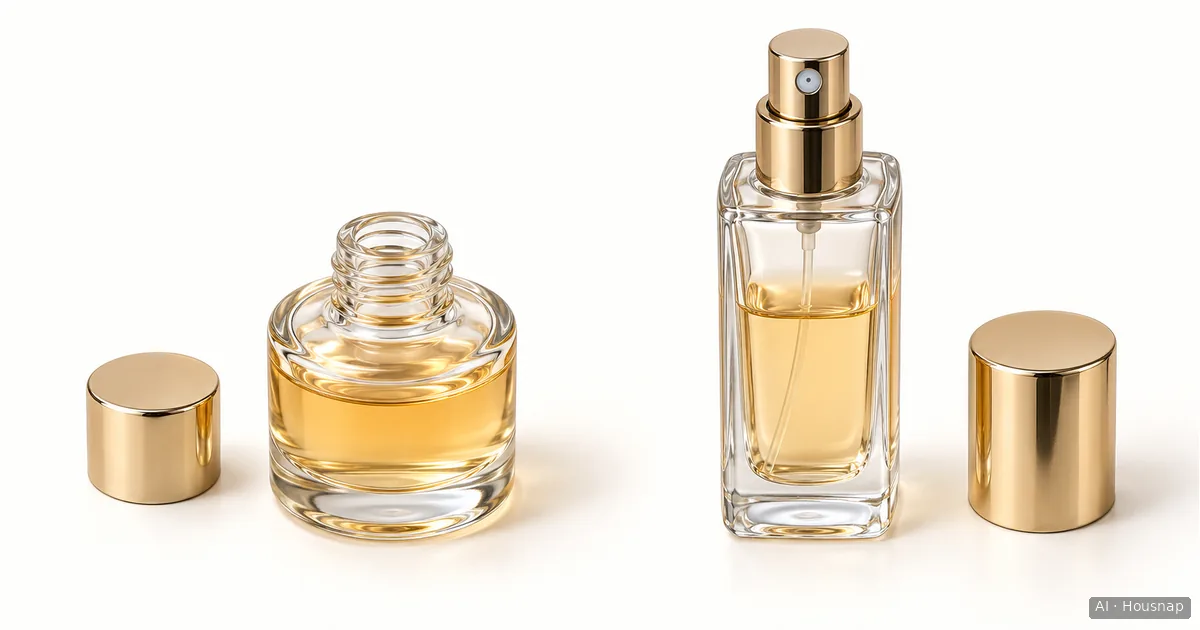
Check what sits under the cap
A small version of a familiar bottle can look like the obvious travel choice. Before ordering, look for an explicit dispensing description and the instructions for that exact size.
The wording matters. Veronique Gabai presents a travel-spray collection, while Sephora's Mini Devotion Duo directions tell the wearer to dab fragrance onto pulse points. These describe their respective products, not every miniature from either brand.
- Want a spray? Look for “spray” or “atomizer” in the selected size's description, then check an uncapped product photo or ask the seller to confirm the nozzle.
- Comfortable dabbing? A product described as “splash” or “dab-on” can remain a candidate. Read its application directions before deciding whether that action suits you.
- Only “miniature” or “travel size” is stated? Ask whether this exact bottle has a sprayer and how its cap opens and closes. A picture of the full-size bottle is not an answer.
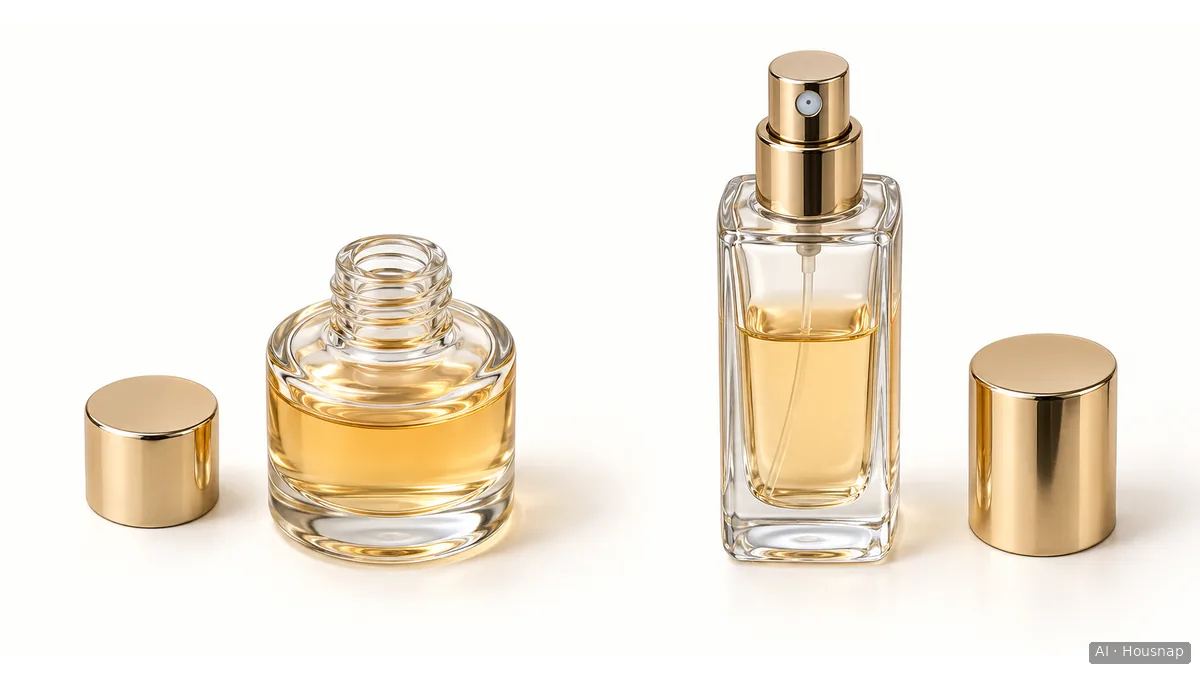
The illustration contrasts an open bottle mouth with a spray nozzle. It does not identify a particular product, demonstrate a leakproof closure or show how to refill either bottle. Do not buy an empty atomizer on the assumption that a miniature can be transferred into it.
Choose the amount you will actually carry
Record the fragrance name, concentration, volume per bottle and dispensing method together. For a set, separate each bottle's volume from the combined amount; the total on the box does not describe the container you will carry.
Choose a filled travel spray when spraying is essential and the specific size is confirmed. Choose a miniature when its stated application method suits you. If you already own the fragrance, check that bottle against your baggage plan before buying another size solely for the trip.
Compare the total purchase cost as well as the price per millilitre. A set is not automatically the useful choice if you intend to carry only one of its fragrances. Nor does a lower unit price make a large bottle easier to pack.
Keep the concentration on your shortlist, too. If the miniature and larger bottle have different EDT, EDP or Parfum labels, resolve that choice with how to compare fragrance concentrations before treating them as the same purchase.
Check your route before choosing the bottle
For ordinary liquids passing through a US TSA checkpoint, use containers of no more than 3.4 ounces (100 ml), packed in a quart-sized liquids bag. TSA directs larger containers into checked baggage. Because this is a container limit, a partly used larger bottle does not become a compliant small container.
Checked baggage has a separate limit. FAA's personal toiletry guidance includes perfumes and colognes and limits the covered articles together to 2 kg or 2 L per person, with each container no larger than 0.5 kg or 500 ml. Those allowances do not replace TSA's smaller carry-on limit.
For aerosol containers, the FAA also requires protection of the release button or nozzle against accidental discharge. Check the closure supplied with your actual product; do not infer a protective lock from the word “travel.” The same guidance notes that permission to carry an item does not automatically permit using it during flight.
Before paying, check the departure and transfer airports' rules and your airline's requirements for the baggage you will use. These US rules are a reference for a US itinerary, not worldwide clearance. Buy once the dispenser, bottle capacity and route requirements all fit.
Comment ce guide a été conçu
This guide was written by AI for Housnap, using a fragrance maker's collection description, a retailer's product directions and TSA and FAA guidance. It focuses on checking the dispenser and travel constraints; it does not report hands-on bottle testing.