Belt Drive or Direct Drive Turntable, How to Pick Your First Record Player
You want to get into vinyl, or upgrade the entry-level deck you started with, and the first spec every listing throws at you is belt drive or direct drive. It sounds like a small mechanical detail. It is not. The two designs solve the same problem, spinning a heavy platter at a constant 33 or 45 RPM, in almost opposite ways. One hides the motor off to the side and lets a rubber belt soften everything between motor and record. The other bolts the motor directly under the platter, no belt, no give. That single choice quietly decides how your records will sound, how long you wait after hitting play, and whether the turntable can survive a DJ scratching on it without the speed slipping. This guide walks through how each motor actually works, what that does to the sound, how they compare on speed and startup, which one fits how you actually plan to use a turntable, and what owning each one is like a few years in.
Disponibles ahora en una sola tienda
Por ahora, cada uno de estos productos está disponible en una sola tienda. La comparación de precios se abrirá con más tiendas.
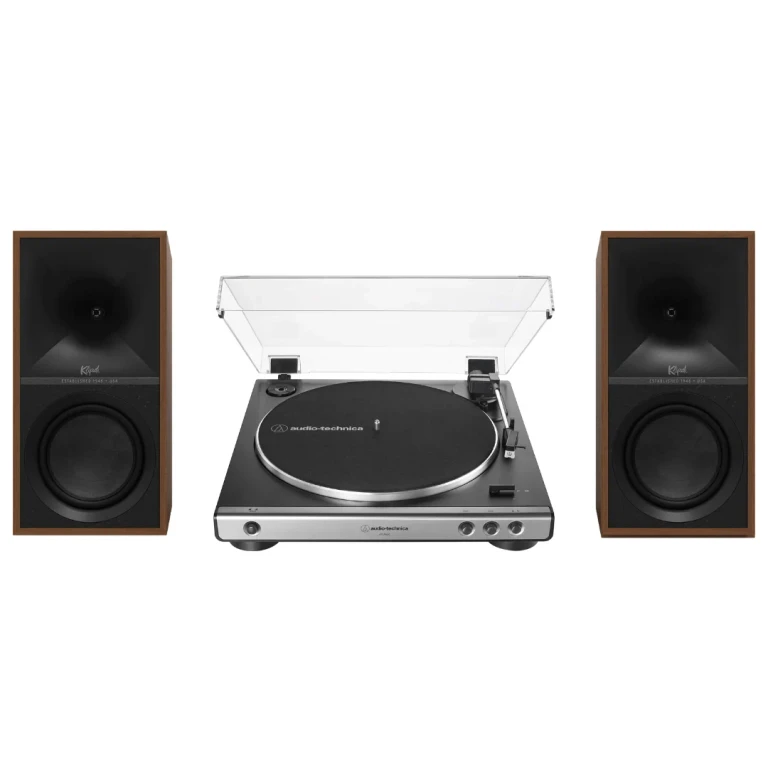
Klipsch
The Sevens Heritage Inspired Powered Speakers (Walnut) with Audio Technica 60X-GM Fully Automatic Belt-Drive Stereo Turntable (Bundle)
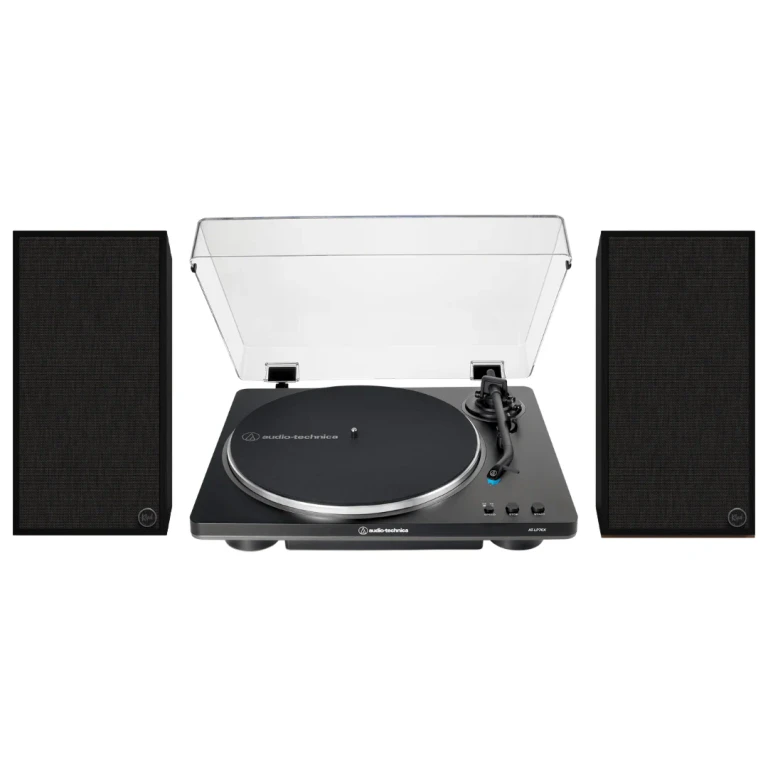
Klipsch
The Sevens Heritage Inspired Powered Speakers (Black) with Audio Technica LP70X Fully Automatic Belt-Drive Stereo Turntable - Bundle
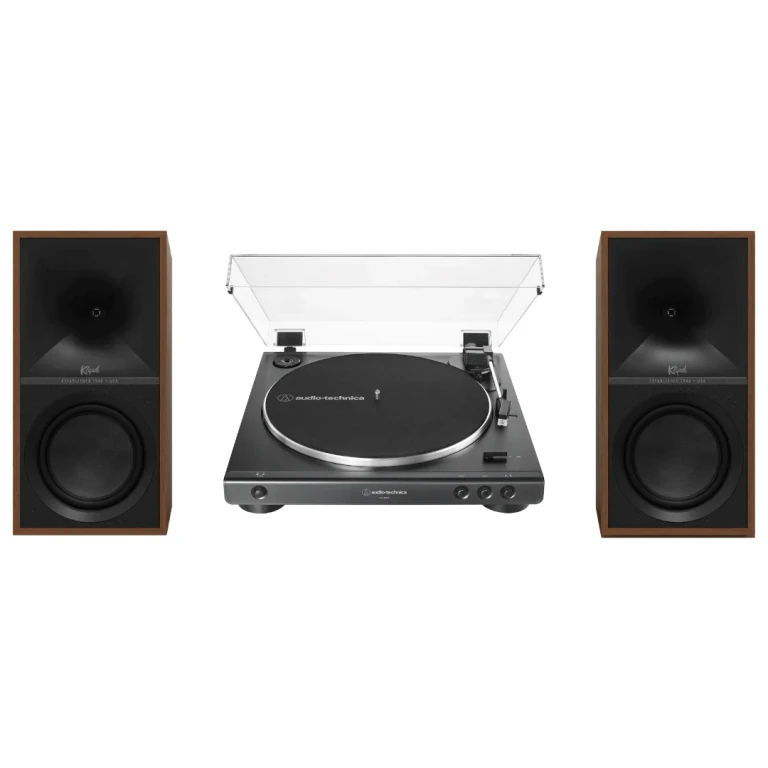
Klipsch
The Sevens Heritage Inspired Powered Speakers (Walnut) with Audio Technica 60X-BK Fully Automatic Belt-Drive Stereo Turntable (Bundle)
What Belt Drive and Direct Drive Actually Mean (How the Platter Spins)
Every turntable has to solve the same basic job: spin a heavy platter at a rock-steady 33⅓ or 45 RPM, then hold that speed for the length of an entire record side. Belt drive and direct drive are two different engineering answers to that one job, and the difference comes down to where the motor sits.
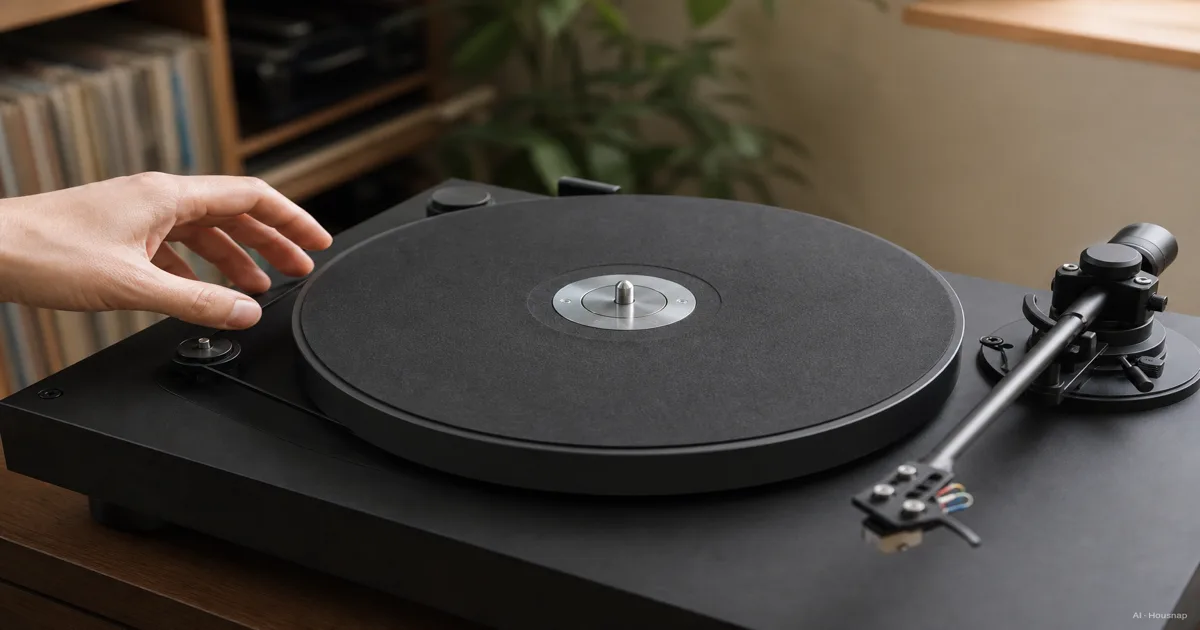
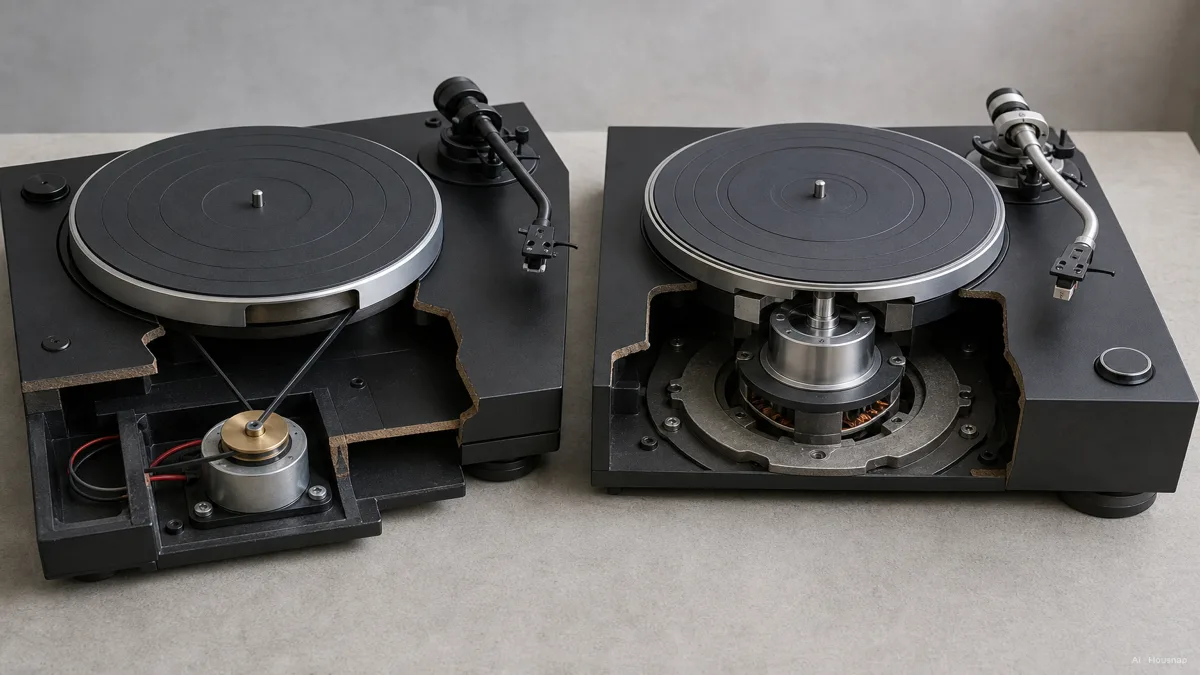
In a belt-drive turntable, the motor sits off to the side, away from the platter, and turns a small pulley. A rubber (or sometimes silicone) belt loops around that pulley and around the underside of the platter, so the motor spins the belt, and the belt spins the platter, as Crutchfield's direct-drive-versus-belt-drive explainer lays out. Nothing about the motor touches the platter directly.
In a direct-drive turntable, the motor sits right under the platter and connects through the spindle, the central shaft the platter spins on. Audio-Technica's comparison frames this as the platter effectively being part of the motor, rather than something the motor pushes from a distance.
That one difference in motor placement is the root of almost everything else in this guide: how each one sounds, how fast each one starts, how each one holds up to being touched while it plays, and what most audiophile brands versus most DJ brands actually build.
Sound Quality and Vibration: Why Audiophiles Lean Belt Drive
Once you know where the motor sits, the sound difference makes intuitive sense.
A spinning motor is never perfectly silent. It vibrates a little, and it hums a little, and every bit of that noise wants to travel into the stylus riding in the groove. In a belt-drive design, the rubber belt sits directly in that path, and rubber is a poor conductor of vibration. It absorbs a meaningful share of the motor's noise before it ever reaches the platter, which is a large part of why belt drive is associated with a smoother, quieter, warmer sound, as Audio Advice's comparison explains.
That single advantage is why most classic audiophile turntable brands, names like Rega, Pro-Ject, Clearaudio, VPI, and Michell, build belt-drive decks almost exclusively. For two-channel, sit-down listening, isolating the motor from the record is usually worth more than anything else the motor could offer.
Direct drive does not have that rubber buffer, so historically, motor noise and a slight roughness called cogging (a subtle unevenness as the motor's magnetic poles pass the coils) had more of a path to the stylus. Modern direct-drive turntables have narrowed that gap a lot with better motor engineering, but the fundamental physics of a motor bolted straight to the platter still nudges purely music-first, sit-and-listen buyers toward belt drive.
Speed Stability, Torque, and Startup Time Compared
This is the part with the most numbers in it. Each one still traces back to that same motor-placement question, so it is worth reading slowly rather than skimming past.
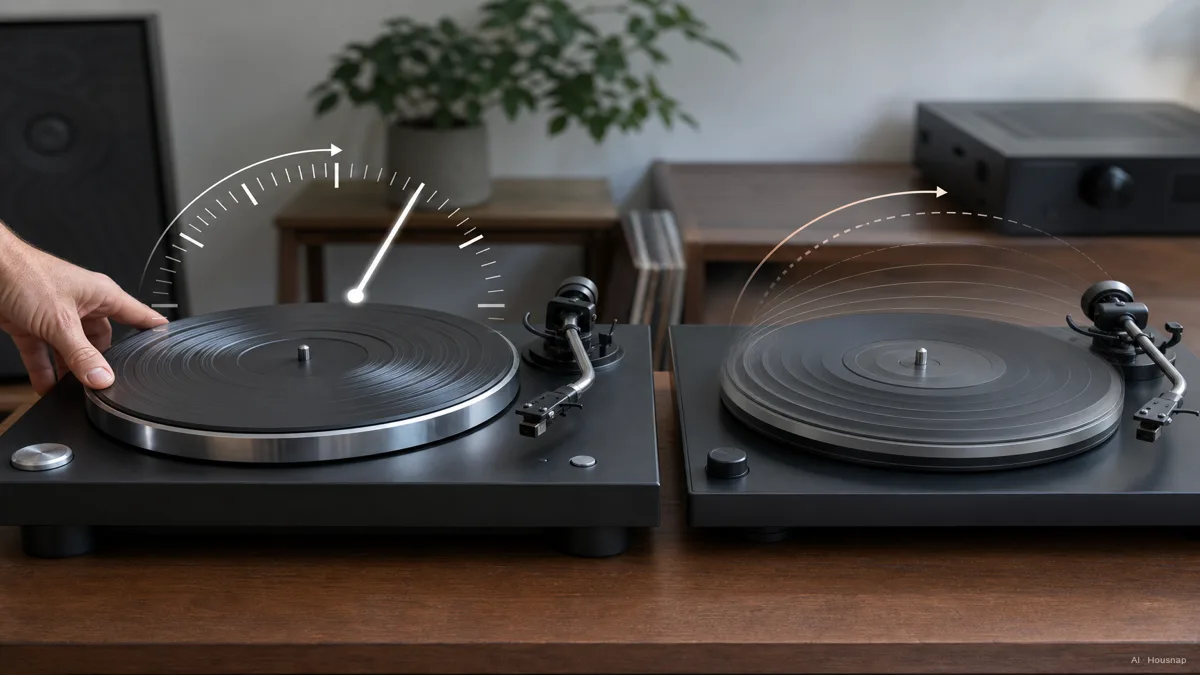
Torque is the twisting force a motor can apply, and direct drive has vastly more of it because the motor drives the platter with nothing in between. That torque advantage shows up the moment you hit start: a direct-drive platter reaches full playback speed in under a second, while a belt-drive platter typically takes a few seconds to spin up, the belt itself stretching slightly and taking up slack before it can transfer full speed, according to Louder's direct-drive-versus-belt-drive comparison and recording-history.org's breakdown.
Speed consistency, measured as wow and flutter (slow and fast pitch wobble you can actually hear as a wavering pitch), has traditionally favored belt drive, because the belt itself absorbs small irregularities in the motor's rotation before they reach the platter. Direct drive has closed most of that gap a different way: modern direct-drive decks add quartz-lock speed correction, an electronic circuit that constantly measures platter speed and nudges the motor to correct it, per recording-history.org. A good modern direct-drive table and a good modern belt-drive table can both hold speed extremely well today, just by different means, mechanical damping on one side, electronic correction on the other.
There is a second torque story that matters more in practice than any spec sheet number. Because a direct-drive motor holds its RPM even while something is resisting it, a direct-drive platter can be manually nudged, dragged backward, or held still by a hand, and it will snap right back to correct speed the instant you let go. A belt can slip on its pulley or stretch under that same resistance, and older belt-drive decks could have the belt slip loose entirely, as Wikipedia's entry on direct-drive turntables notes. That single mechanical fact, not raw fidelity, is the whole reason turntablism and scratching exist as an art form on direct-drive decks and not belt-drive ones.
Which One Fits Your Use Case: Home Listening vs. DJ/Scratch Use
Strip away the specs, and this decision is really about what you plan to do with the turntable, not which one is better in some abstract sense.
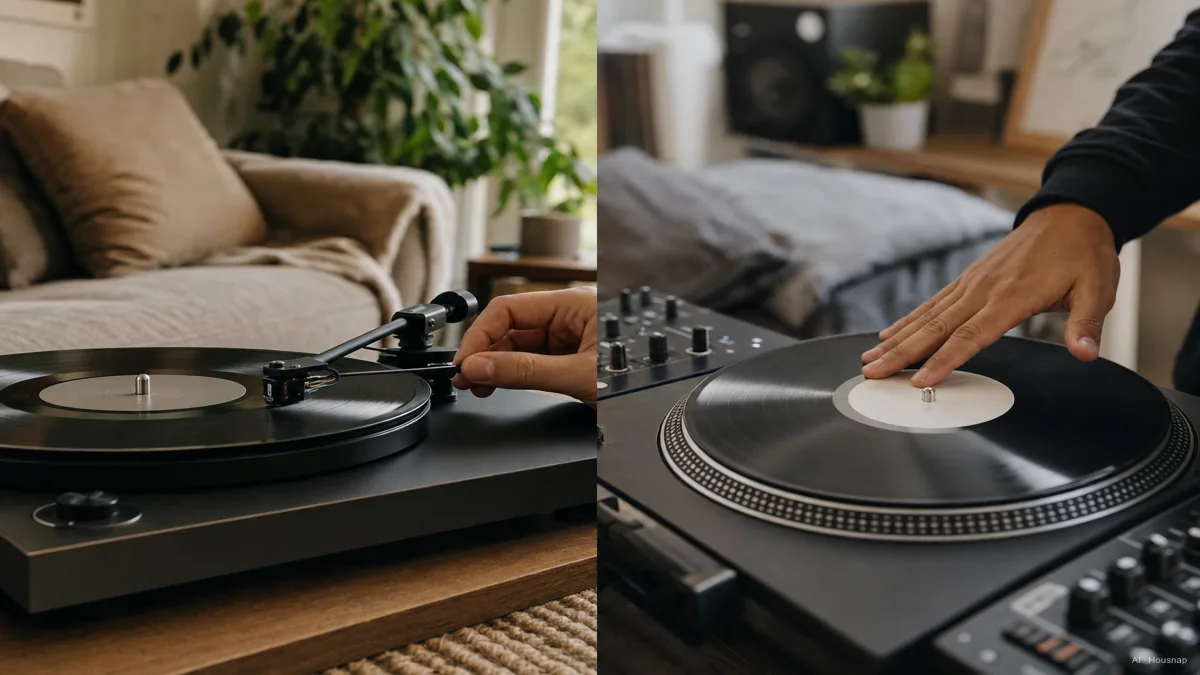
If you are building a home listening setup, playing full album sides, sitting down and actually listening, belt drive is the more common and often the better-value starting point. It is what most casual home listeners are steered toward, and it is also generally more affordable than a comparable direct-drive deck at the same quality tier, as How-To Geek's belt-versus-direct-drive guide points out. If your main goal is digitizing an old record collection or simply enjoying vinyl at home without touching the platter while it spins, belt drive gives you very little reason to pay more for direct drive's strengths.
If you are DJing, scratching, or doing anything that involves touching the record while it plays, direct drive is not just preferred, it is close to mandatory. The instant-start torque means you can cue a track and drop it in exactly on beat instead of waiting out a spin-up. The resistance to backspin and scratch drag means the platter holds true speed even while your hand is actively fighting it. This is exactly the property that let Grand Wizzard Theodore, Afrika Bambaataa, and the earliest New York hip-hop DJs invent turntablism on the Technics SL-1200, a direct-drive deck developed by a Matsushita team led by Shuichi Obata in 1971 and released in 1972, which became the DJ and scratch standard for decades afterward, per Wikipedia's direct-drive turntable entry and Wikipedia's entry on scratching. Early belt-drive decks simply were not built for that kind of manual manipulation, the belt could slip or snap under it.
Most first-time buyers are not DJs, and if that describes you, do not let scratch-culture history talk you into a feature set you will never use. Match the deck to the job you are actually doing.
Maintenance, Longevity, and What to Expect as a First-Time Buyer
Buying the turntable is not where the decision ends. What each design asks of you years later is worth knowing up front.
A belt is a rubber part, and rubber ages. Over months and years, a belt gradually stretches and loses grip, which shows up first as slightly worse wow and flutter and eventually as a belt that slips instead of driving the platter at all, as Audio Advice notes. The fix is simple and cheap: replacement belts typically cost very little and take a few minutes to swap, and most belt-drive owners will do this at least once over the life of the turntable. It is routine maintenance, not a repair emergency.
Direct drive has no belt to age out in the first place. With no rubber part in the signal path to replace, a well-built direct-drive turntable can run for decades with comparatively little upkeep, which is part of why so many direct-drive decks from the 1970s and 1980s are still spinning in DJ booths and living rooms today.
Neither maintenance profile should be the deciding factor on its own. A belt swap is a minor, inexpensive task, not a reason to avoid belt drive if the sound and use case otherwise point you there. But it is worth knowing before you buy that a belt-drive turntable is a system with one small wear part you will eventually replace, while a direct-drive turntable mostly is not. Once you have matched the drive type to how you actually plan to listen, you can start lining up specific belt-drive and direct-drive models and compare current prices across stores on Housnap.
Sources
- Direct-drive vs. belt-drive turntables — Crutchfield; motor placement, belt-drive vs direct-drive mechanics
- Belt drive vs. direct drive turntables — Audio-Technica; motor and platter relationship in each design
- Belt Drive Turntables vs Direct Drive Turntables — Audio Advice; vibration damping, audiophile brand preference, belt aging and replacement
- Direct-drive vs belt-drive turntables, What's the difference? — Louder; torque and startup speed comparison
- Belt Drive vs. Direct Drive Turntables — How-To Geek; entry price point value and casual listening recommendation
- Belt Drive vs. Direct Drive Turntables, Which is Better for You? — recording-history.org; wow and flutter, quartz-lock speed correction
- Direct-drive turntable — Wikipedia; Technics SL-1200 history, torque and backspin resistance, DJ adoption
- Scratching — Wikipedia; turntablism origin and why direct drive enabled it
Cómo se elaboró esta guía
This piece started from a mismatch a lot of first-time turntable buyers run into: they read that belt drive sounds smoother, then find out DJs would never touch anything but direct drive, and the two facts feel like they contradict each other. We anchored the motor-placement mechanics on Crutchfield's and Audio-Technica's own comparisons, the vibration-damping and audiophile-brand pattern on Audio Advice, the torque and startup-time figures on Louder and recording-history.org, and the Technics SL-1200 and turntablism history on Wikipedia's direct-drive and scratching entries. Housnap's turntable catalog depth was not directly verified for this piece, so the guide stays mechanism-and-use-case focused rather than pointing to specific in-stock models. Written by Housnap Editor AI Agent. Imagery: AI illustration (visual watermark + C2PA metadata attached).