GoPro vs DJI, How to Pick Your First Action Camera
Shop for your first action camera and the spec sheet turns into a wall of numbers fast, sensor size, aperture, waterproof depth, frames per second at four different resolutions. It is easy to freeze up before you have even picked a color. Narrow the field down to the two names everyone actually compares, GoPro and DJI, and the decision gets more manageable, if not exactly simple. GoPro's Hero 13 Black is the line most reviewers still treat as the benchmark, while DJI's Osmo Action series has spent the last two generations closing gaps and opening a few of its own. Neither brand is the automatic right answer anymore. This guide walks through where each one actually wins, on sensor and resolution, on battery and waterproofing, and on the use cases where GoPro still has the edge, then explains why the wider market has been quietly shifting away from GoPro altogether.
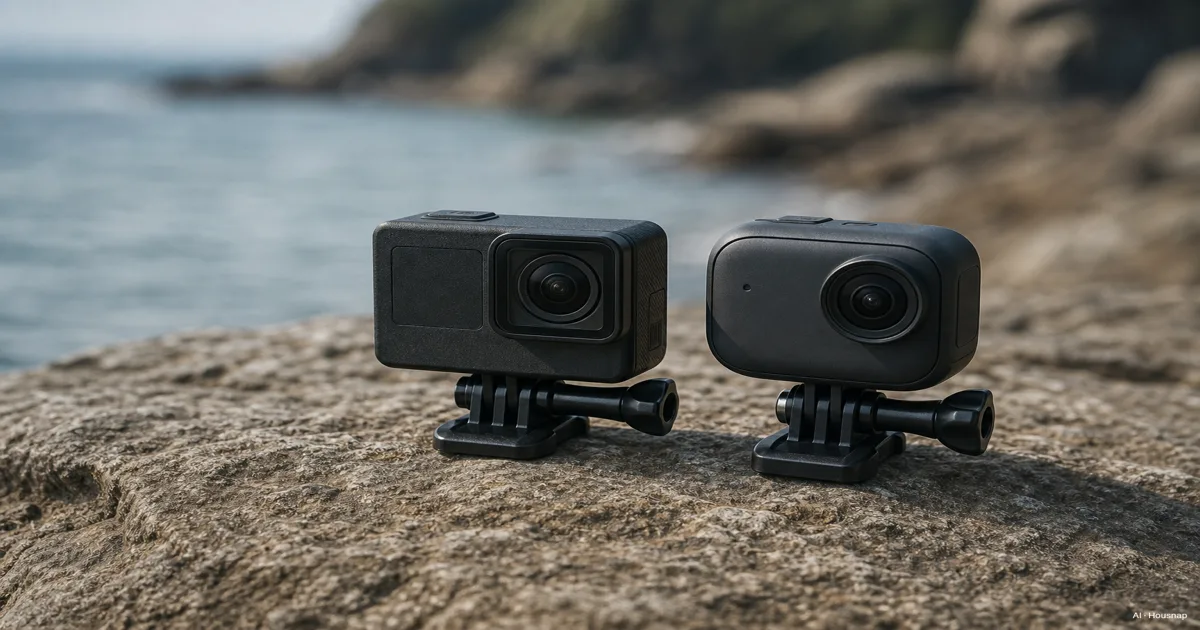
GoPro vs DJI, Which Should Your First Action Camera Be
GoPro's Hero 13 Black shoots up to 5.3K at 60 frames per second, still the highest resolution ceiling in the category and higher than anything in DJI's current lineup, which mostly tops out at 4K (TechRadar). That number alone would have settled the comparison a few years ago. It does not settle it now.
DJI's Osmo Action 5 Pro carries a much larger 1/1.3-inch, 40-megapixel sensor against the Hero 13 Black's 1/1.9-inch, 27-megapixel chip, and that size difference shows up directly in low light and dynamic range (TechRadar, firstquadcopter.com). DJI also runs away with battery life and waterproof depth, two specs that matter more on an actual trip than a resolution number ever does.
Neither camera is a bad first purchase at this price point. The mismatch shows up later, when someone who planned a full day of surfing or skiing ends up swapping batteries at lunch, or someone chasing the sharpest possible footage picks the camera with the smaller sensor and worse low light. The sections below walk through where each one actually wins.
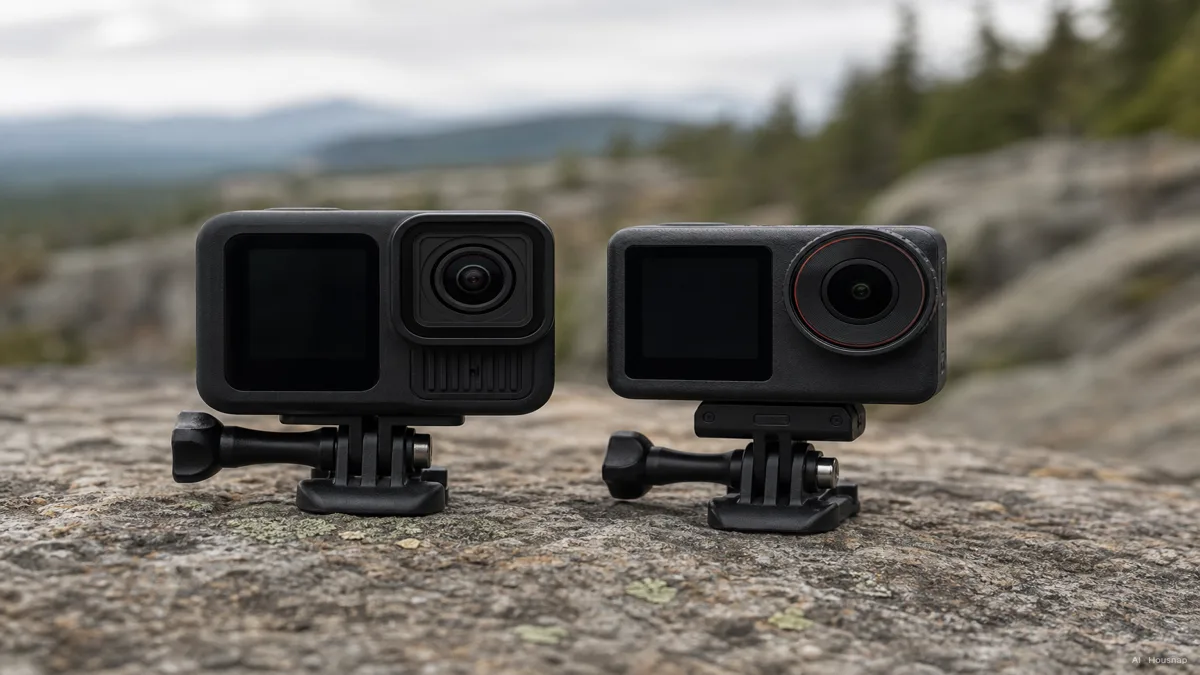
The Spec Differences That Actually Decide This, Sensor, Resolution, Stabilization
This is usually the point where a first-time buyer's eyes glaze over, so here is the short version, three numbers actually change what your footage looks like, and the rest is mostly marketing noise.
Resolution is GoPro's strongest card. Hero 13 Black tops out at 5.3K60, while most of DJI's current lineup caps at 4K. The exception is DJI's newest Osmo Action 6, announced in October 2025, which pairs a 1/1.1-inch square sensor and a variable aperture running from f/2.0 to f/4.0 with recording up to 8K at 30 frames per second (DJI Osmo Action 6 specs). On paper that leapfrogs GoPro entirely, though 8K at 30fps trades off the smooth motion that 60fps gives you at lower resolutions.
Sensor size is where DJI pulls ahead more consistently. The Osmo Action 5 Pro's 1/1.3-inch, 40-megapixel sensor is meaningfully larger than the Hero 13 Black's 1/1.9-inch, 27-megapixel sensor, and a bigger sensor gathers more light per pixel (TechRadar, DJI Osmo Action 5 Pro specs). That translates to cleaner indoor and dusk footage and more detail held onto in bright skies, areas where GoPro has historically struggled.
Stabilization is the spec nobody markets correctly. GoPro's HyperSmooth handles high-frequency vibration well, the buzz of a motorcycle engine or the judder of cobblestones underfoot. DJI's RockSteady and HorizonSteady handle low-frequency, flowing movement better, a run, a ski descent, or a slow gimbal-style pan. Neither system is a strict upgrade over the other, they are simply tuned for different kinds of shake, so the right pick depends on what you actually shoot.
Battery Life and Waterproofing, DJI's Practical Edge
Battery life is not close. DJI's Osmo Action 5 Pro is rated for up to roughly 240 minutes, four hours, on a single charge. GoPro's Hero 13 Black is rated for about 90 minutes at 5.3K or around 150 minutes if you drop down to 1080p, meaning DJI runs two to three times longer depending on the resolution you are shooting (firstquadcopter.com, DJI Osmo Action 5 Pro specs). For a full day out, that gap is the difference between one spare battery and three.
Waterproofing follows the same pattern. DJI's newest Osmo Action 6 is rated to 20 meters without any housing, while GoPro's Hero 13 Black is rated to 10 meters without one (outdoortechlab.com, DJI Osmo Action 6 specs). Anyone snorkeling or diving past a shallow reef will feel that difference before they feel any resolution difference.
Price rarely tilts the decision against DJI either. DJI has historically priced the Osmo Action series at or below the equivalent GoPro Hero model while matching or beating it on several key specs, a detail worth checking against current listings before assuming GoPro is the cheaper or more capable pick (outdoortechlab.com).
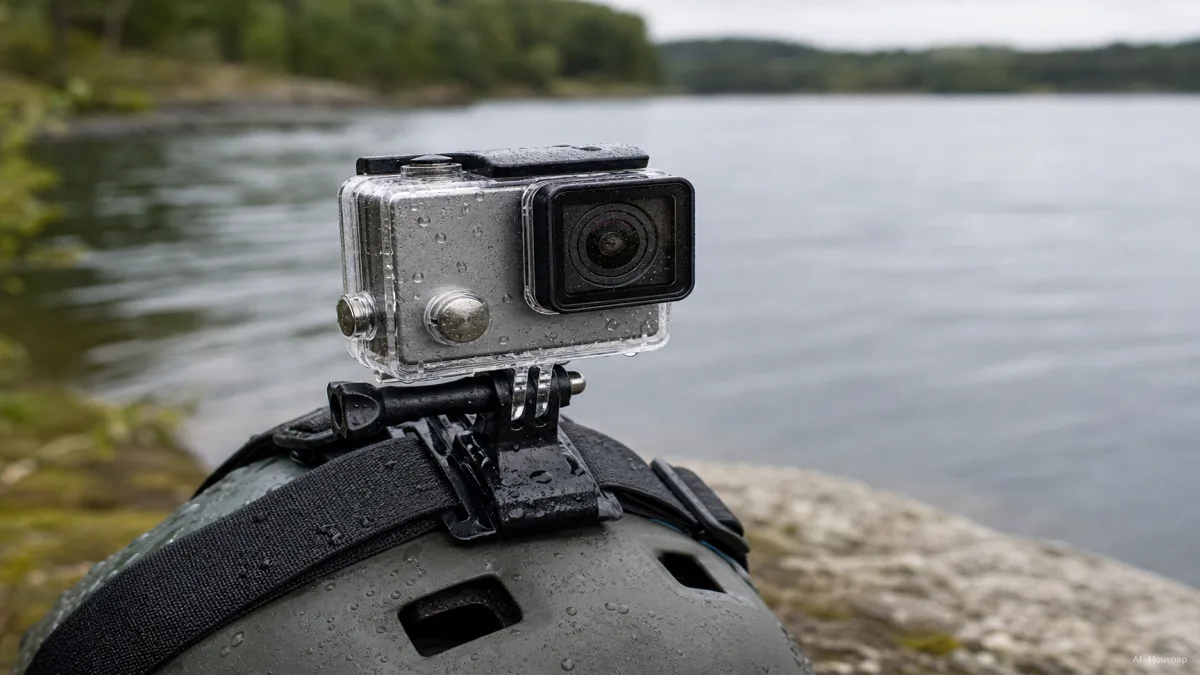
When GoPro Still Wins, Best Use Cases
None of this makes GoPro the wrong choice. It makes GoPro the right choice for a narrower, specific set of buyers.
GoPro's biggest remaining advantage is not a spec at all, it is the ecosystem. A decade of third-party mounts, chest harnesses, clamps, and accessories exists for GoPro's form factor, more than DJI's action line has had time to accumulate. Hero 13 Black adds a swappable HB-Series lens system on top of that, plus extreme slow motion up to 400 frames per second, useful for anyone shooting skate tricks, trick shots, or fast sports where slowing footage down matters more than shooting it wide (outdoortechlab.com).
The stabilization split from earlier matters here too. If you are mountain biking over rough terrain, riding a motorcycle, or shooting anything with constant high-frequency shake, GoPro's HyperSmooth is tuned for exactly that. DJI's RockSteady and HorizonSteady earn their keep on runs, ski descents, and slower, flowing motion instead.
So the actual decision comes down to three questions. Are you diving, surfing, or shooting in cold weather where waterproofing and battery life decide whether you get the shot at all? DJI is the safer first pick. Are you chasing the sharpest possible resolution, extreme slow motion, or building on mounts and accessories you already own? GoPro still earns its price. And if you already have gear from one ecosystem, that sunk cost is a real reason to stay put rather than switch brands for a marginal spec gain.
How the Market Shifted, Why DJI and Insta360 Now Lead
The spec comparison above only tells half the story. As of the first quarter of 2026, DJI and Insta360 together hold roughly 87 percent of global handheld and action-camera shipment volume. DJI alone shipped about 2.7 million units, close to 65 percent share, and Insta360 shipped around 900,000 units, about 22 percent. GoPro's shipments fell to around 300,000 units, under 6 percent share (Biggo).
Full-year 2025 revenue and market-share figures tell the same story from a different angle. DJI closed the year at 40.1 percent of the category, Insta360 at 37.9 percent, and GoPro a distant third at 18.9 percent, confirming that GoPro's long-held category leadership has been overtaken by Chinese manufacturers (Amateur Photographer).
None of this means GoPro is going away. It does mean that for a first-time buyer, DJI's momentum, faster hardware refresh cycle, and larger install base are worth factoring in alongside the specs above. The category itself is not shrinking either, it was sized at roughly $7.27 billion in 2025 and is projected to reach close to $18 billion by 2033, a compound annual growth rate around 12.1 percent (Grand View Research), which means both companies will keep shipping new models worth comparing again next year.
For now, the decision comes back to the same three questions from the section above, primary use case, which spec gap actually affects your footage, and whether you already own mounts worth keeping.
Sources
- GoPro Hero 13 Black vs DJI Osmo Action 5 Pro, has DJI dethroned GoPro — TechRadar; sensor, resolution, and low-light comparison
- DJI Osmo Action 5 Pro official specs — DJI; sensor size and battery rating
- DJI Osmo Action 6 official specs — DJI; sensor, variable aperture, resolution, and waterproof rating
- GoPro 13 Black vs DJI Action 5 Pro, in-depth comparison guide — firstquadcopter.com; sensor and battery life comparison
- DJI Osmo Action 5 Pro vs GoPro Hero 13, field test comparison — outdoortechlab.com; waterproofing, pricing, and accessory ecosystem
- Action camera market shipment data, Q1 2026 — Biggo; DJI, Insta360, and GoPro shipment volume and share
- GoPro has lost the action camera market with these two companies winning — Amateur Photographer; 2025 full-year revenue market share
- Action camera market size and share report — Grand View Research; market size and growth projection