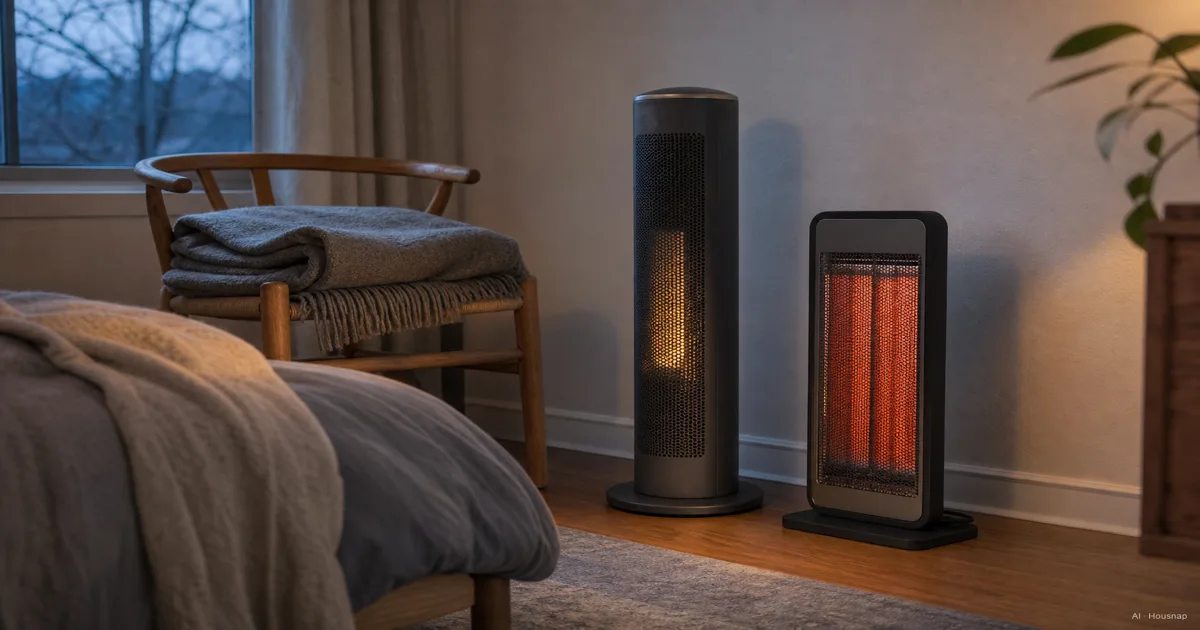
Decide whether you need a warm seat or warmer room air
Choose the job before the technology.
- One occupied spot. Shortlist directional infrared if you stay at a desk or chair with an unobstructed path to the heater. Radiant heating warms people and objects in its line of sight (portable-heater guidance).
- Several occupied spots. Start with a ceramic fan heater when your aim is to circulate warmed air. Check room suitability and thermostat control; the word “ceramic” alone does not establish heating capacity (Lasko example).
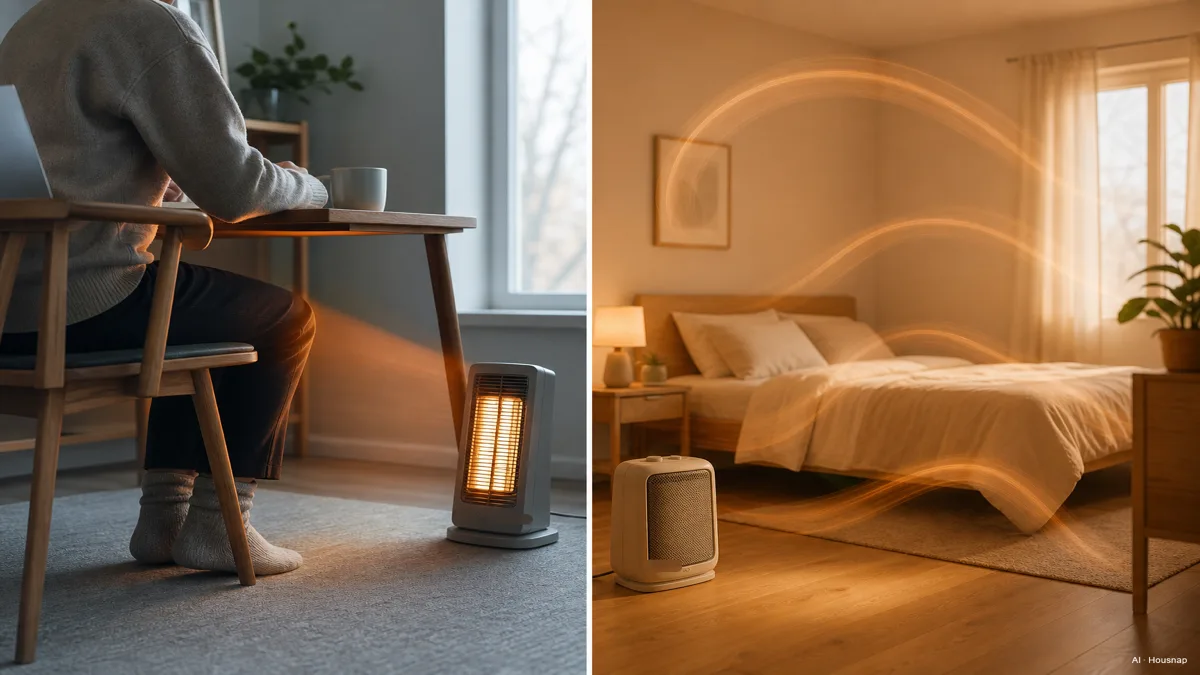
The illustration compares heating goals, not guaranteed coverage or safe placement distances.
If you already have heating but the warmth is uneven, investigate air circulation before adding another heater. Vornado explains winter heat redistribution; the circulator-versus-fan guide helps you assess that alternative.
Check how the actual heater delivers warmth
Here, “ceramic” means a ceramic fan heater: its ceramic element heats air moved by a fan (Dimplex manual). Infrared describes radiant heat transfer; Herschel explains how surfaces absorb that heat. These labels describe different aspects of a heater, so they need not be mutually exclusive.
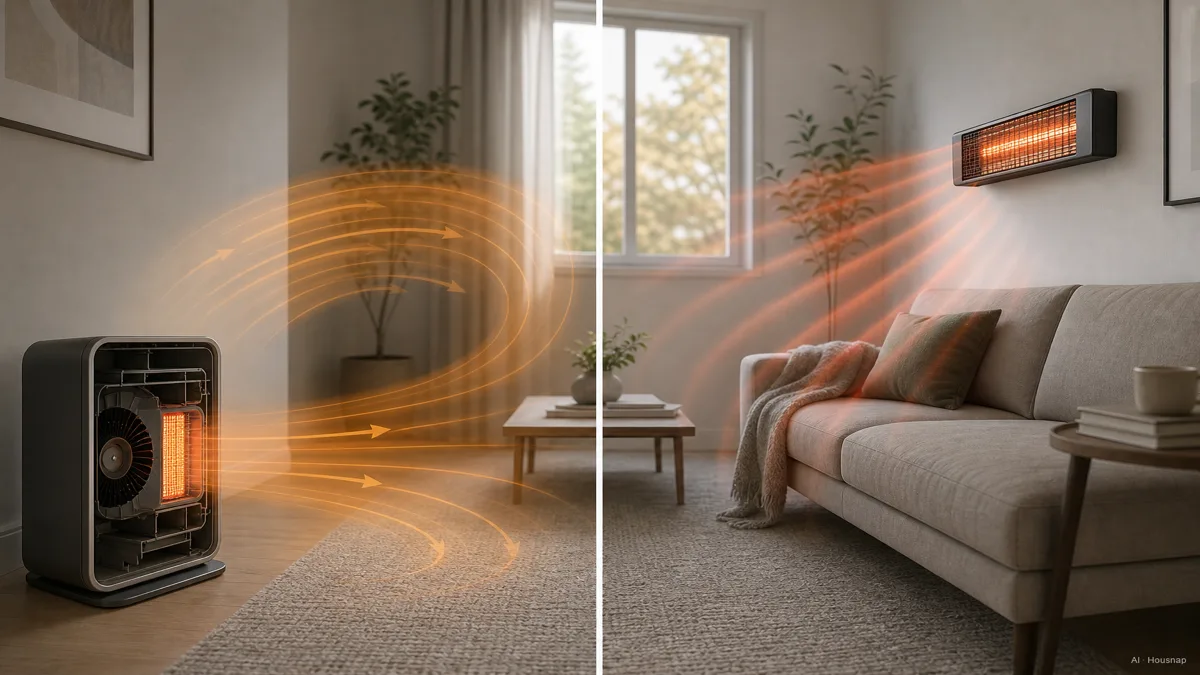
The waves are explanatory graphics, not a visible beam or a measured heating range.
For example, the Dr Infrared DR-978 combines ceramic PTC and quartz infrared elements with a blower. If avoiding fan noise or moving air is your priority, require explicit fanless operation in the model documentation. Do not rank warm-up speed from the category name alone; ask whether the claim concerns nearby warmth or raising room temperature.
Compare electricity used, not efficiency slogans
At equal power, operating time and electricity tariff, these resistance-heating options cost the same to run (Dimplex technical guidance). A lower bill needs lower consumption or a lower tariff, not just a different heater label.
- Calculate energy. Watts ÷ 1,000 × hours at that power = kWh. A heater drawing 1,500W continuously for two hours uses 3kWh.
- Calculate cost. Multiply those 3kWh by your applicable electricity rate; this is an example, not a quoted bill.
- Check the controls. Thermostats can interrupt heating, as the DR-978 documentation describes. Two hours switched on need not mean two hours at full power.
Compare the settings you expect to use. Do not pay extra for an “infrared saves money” promise without knowing what power and operating time it assumes.
Make the installation check before ordering
Measure the proposed location first. CPSC guidance calls for at least three feet, about 0.91m, from combustibles, a direct wall-outlet connection without a power strip or extension cord, and switching off for sleep.
Then check the exact model’s voltage, required clearances, tip-over shutoff and overheat protection. A ceramic label is not a burn-safety guarantee: the Dimplex manual warns of hot parts. Follow the model’s larger clearance requirement where applicable.
Keep a level position away from passing feet, children and pets (placement guidance). If your chosen seat cannot accommodate the heater’s safe installation, change the plan before buying. A safety switch does not make an unsuitable location suitable. Use it only while you can supervise it; Vornado’s heater guidance calls for active monitoring.
Wie dieser Guide entstand
Written by Housnap’s AI editor using CPSC safety guidance, manufacturer documentation and Farmer City’s republished DOE guidance. This comparison turns those sources into checks for a first portable-heater purchase; it does not report hands-on product testing.