Check the handle and joints before choosing a method
Look up the exact utensil, not just “silicone care.” Check whether its head is designed to come off, which parts may go in the dishwasher and whether the instructions permit any treatment beyond washing. Do not pull apart a fixed head to reach a suspected smell.
Le Creuset’s silicone care instructions show why construction matters: the wooden-handled utensils described there have removable silicone blades that can go in the dishwasher. The handles must be hand-washed and dried well before the clean blades are replaced. The same page permits dishwashing its entirely silicone accessories; that is not permission to wash every assembled utensil the same way.
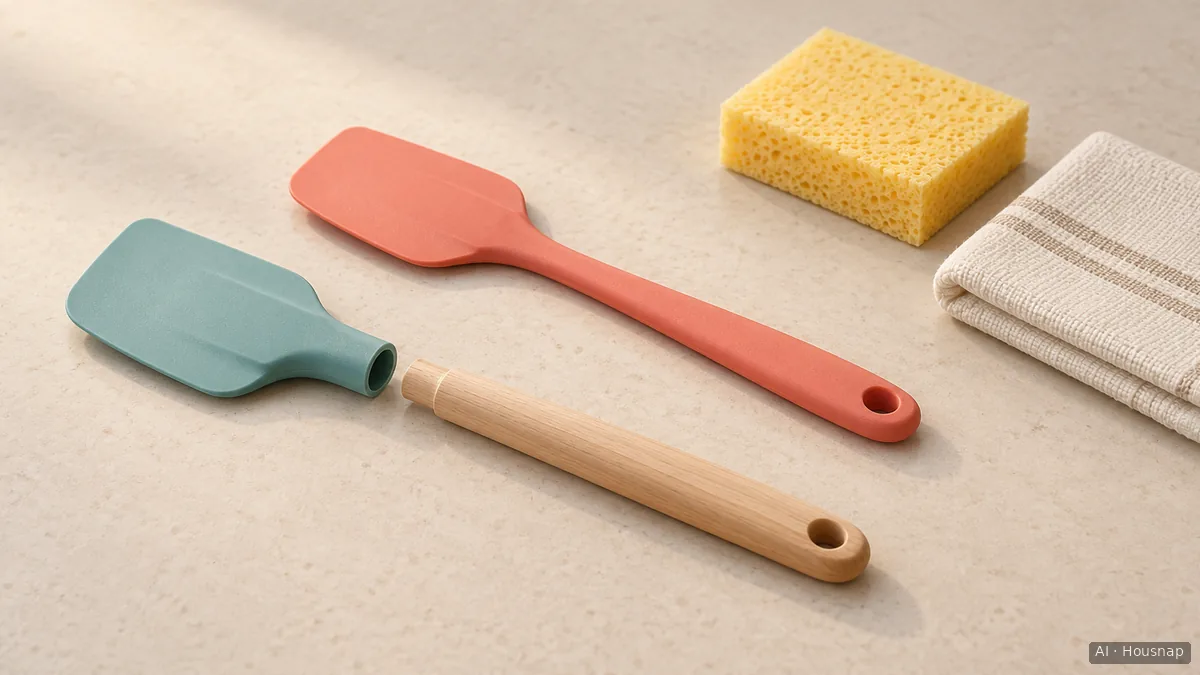
The illustration compares two constructions; it does not establish dishwasher or oven compatibility. For a separate product example, OXO labels its Good Grips 2-Piece Silicone Spatula Set dishwasher safe. Match that permission to the named product rather than extending it to other tools.
Wash away residue before assessing the smell
Start with a suitable dishwashing liquid and a soft, nonabrasive dish sponge. Reuse what you have if it meets the utensil’s instructions; a special silicone-cleaning kit is not the starting point. Souper Cubes recommends dish soap and a nonabrasive sponge and prefers unscented products.
- Clean the working surface. Wash the head, its edges and accessible joins using the temperature and method allowed for your utensil. If removal is intended, clean the separate parts according to their respective instructions.
- Rinse and dry. Remove the washing solution and let the parts dry fully. Reassemble a removable head only as instructed, and put the utensil away dry.
- Check what remains. Is there a greasy film, a lingering smell, a color mark or a damaged edge? Note these separately rather than treating them all as a stain that needs harder scrubbing.
Souper Cubes describes oil and grease leaving a tacky film that ordinary washing may not remove. That gives you a reason to reassess remaining residue, not to assume that every sticky surface has the same cause. Its guidance also calls for full air-drying before storage.
Do not turn a heat rating into an oven-cleaning recipe
A cooking temperature rating and an approved deodorizing method answer different questions. Le Creuset specifically warns that stove heat can damage its wooden handles. Checking only the silicone head leaves out a relevant part of the tool.
Souper Cubes limits its oven method for lingering smells to 100 percent silicone products that can withstand high heat. Do not transfer that method to a spatula with a wooden or plastic handle, an unidentified internal construction or unclear instructions merely because its outside looks like silicone.
If odor remains after the permitted wash, check the maker’s instructions for that exact utensil or ask for a compatible deodorizing method. Confirm which parts may be treated, how and for how long before trying heat, soaking or a cleaning paste. If those details are unavailable, pause the deeper treatment rather than inventing a temperature or duration.
Decide whether to keep cleaning or stop using it
A remaining color mark does not, by itself, tell you whether the tool is clean or needs replacing. After washing and drying, inspect the edge and attachment as well as the stained area. Do not keep escalating the treatment solely to restore the original color.
As a practical stop rule, set the utensil aside if the head is torn, an internal part is exposed or the head no longer stays securely attached. Ask the manufacturer whether a compatible replacement head is available or the whole tool needs replacing. These are conservative editorial decisions, not a manufacturer-issued universal replacement schedule.
If the tool is intact but an unexplained smell or film persists, describe the symptom and the cleaning already tried when contacting the maker. Avoid treating stronger cleaning as proof that the utensil is fit to use.
When replacement really is needed, compare a silicone spatula with a wooden cooking spoon for the jobs you do. That is the point to reconsider shape and cleaning requirements, rather than buying a new set because one utensil has a mark.
Wie dieser Guide entstand
Written by AI for Housnap, using Le Creuset’s care instructions, Souper Cubes’ cleaning guidance and OXO’s named product information. The troubleshooting order and stop rules are editorial judgments based on those sources, not hands-on cleaning tests or a universal treatment for every silicone utensil.