Look at the coating before treating the mark
Check the shoe’s material description first. Patent leather gets its gloss from a coated surface, as Collonil explains in its patent-care guide. Do not identify the material from shine alone; confirm the finish and its care instructions with the maker if necessary.
Look at the marked area from different angles without picking at it. Our practical sorting rule is:
- A streak on an apparently continuous surface. Consider a gentle wipe if the maker permits it. Appearance alone cannot establish that the streak will come off.
- A visible split, lifted edge or missing patch of coating. Stop before cleaning that area and ask the maker or a shoe-repair specialist to assess it.
- An uncertain finish or mark. Send the maker a photograph and the model details before choosing a cleaner.
If you confirm that the shoe is ordinary smooth leather polished to a shine, rather than patent, continue with choosing cream, lotion or wax for leather shoes. That is a different care decision.
Try a gentle cloth wipe, then reassess
For an intact patent surface whose care instructions allow damp wiping, start with a clean, soft microfibre cloth. An appropriate cloth you already own is enough. Collonil recommends damp microfibre; the Dr. Martens patent-footwear routine also begins with a damp wipe, followed by drying with a different cloth.
As a cautious starting point, try an inconspicuous area of the same finish. Lightly wipe rather than repeatedly scrub, use a clean part of the cloth, and dry with a separate soft cloth before inspecting the result.
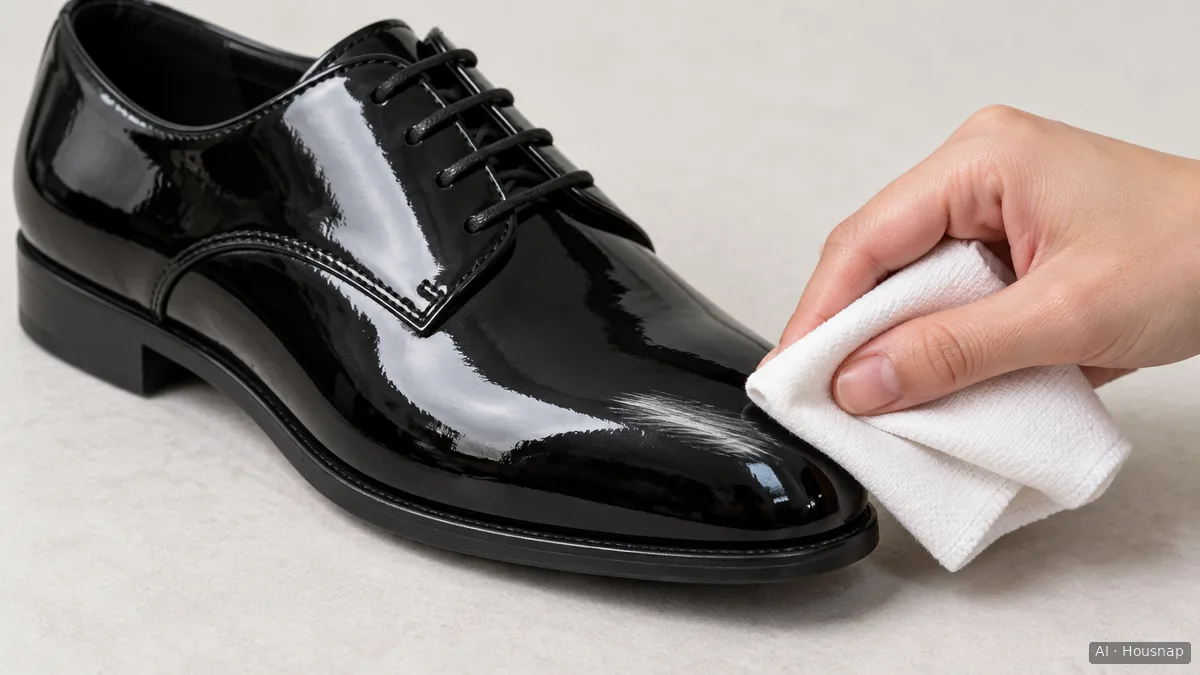
If the mark diminishes without an unwanted surface change, that suggests at least some removable material was present. It does not identify what caused the mark. If the mark remains, do not increase pressure to prove whether it is a scratch.
A brush is not our default here. Dr. Martens includes light brush buffing in its own routine, whereas Collonil advises against brushes on patent shoes because they may scratch. Follow the guidance for your pair rather than combining those instructions.
Consider a cleaner only after checking compatibility
A remaining mark does not automatically justify another product. If the shoe maker permits a patent cleaner, check its stated materials and application instructions before buying or using it.
For a concrete example, Dr. Martens Patent Cleaner is labelled for patent leather and vinyl. Its instructions allow spraying onto a cloth and then wiping off; the brand’s care guide also says to remove excess with a clean cloth. These are instructions for that named product, not approval for every shiny shoe or synthetic finish.
We recommend trying an inconspicuous area first and inspecting it after drying before proceeding. If the maker’s guidance is unclear, ask rather than treating the product label as complete confirmation for your shoe.
Do not substitute ordinary leather grease or add a waterproofing spray simply because you use it on other shoes. Collonil warns that oils and greases can leave blotches beneath the film, and that solvents in standard waterproofing sprays can cause the coating to detach. Household solvent experiments are outside this gentle-cleaning approach.
A persistent mark is a reason to pause
Cleaning can help you judge the mark, but it cannot guarantee a diagnosis. Collonil specifically warns that light-coloured patent can absorb colour pigments that can no longer be cleaned away. A dark mark on a pale shoe therefore is not proof of either removable transfer or a scratch.
Stop if the permitted cleaning leaves the mark unchanged, or if you notice lifting, splitting or an unwanted change in the surface. Our recommendation is to record what you used and send photographs to the maker or a shoe-repair specialist. Ask whether the remaining problem is surface residue, absorbed colour or damaged coating, and what result is realistically possible before agreeing to treatment.
For storage, avoid pressing patent surfaces together. Collonil notes that these coatings can stick when stored incorrectly. If the gentle wipe has already produced an acceptable result, finish there; you do not need to add cream or wax just to complete a routine.
Wie dieser Guide entstand
Written by AI for Housnap, using Collonil’s patent-care guidance and Dr. Martens’ care guide and Patent Cleaner instructions. The article separates manufacturer statements from a cautious editorial approach to inspecting and wiping an already-owned shoe; it does not report hands-on testing or diagnose a particular mark.