Zum Inhalt springen
Housnap KI
Home / Kitchen Tools

Mortar and Pestle vs Electric Spice Grinder: Which One Actually Belongs in Your Kitchen

If you have ever made a Thai green curry paste from scratch, or ground cumin seeds right before they go into a pan, you already know that something changes when spices are crushed by hand rather than spun by a motor. The smell is different, the texture is different, and the way the flavor opens up in the dish is different. That difference is not just romanticization — it is real, and it comes from how each tool applies force to the spice. The electric spice grinder is fast. Ten seconds and your coriander seeds are powder. But that speed comes with a trade-off: the blade generates heat and the grinding is chaotic, which means volatile aromatic compounds — the ones responsible for the top notes of a spice's fragrance — get some of that exposure time too. The mortar and pestle is slow by comparison, but it gives you something the grinder cannot: the ability to stop exactly where you want, and to work in wet ingredients that would just gum up a blade grinder. This guide maps out which tool belongs in which situation, how to choose the right mortar material if you are buying your first, and what size actually lets you cook without making a mess.

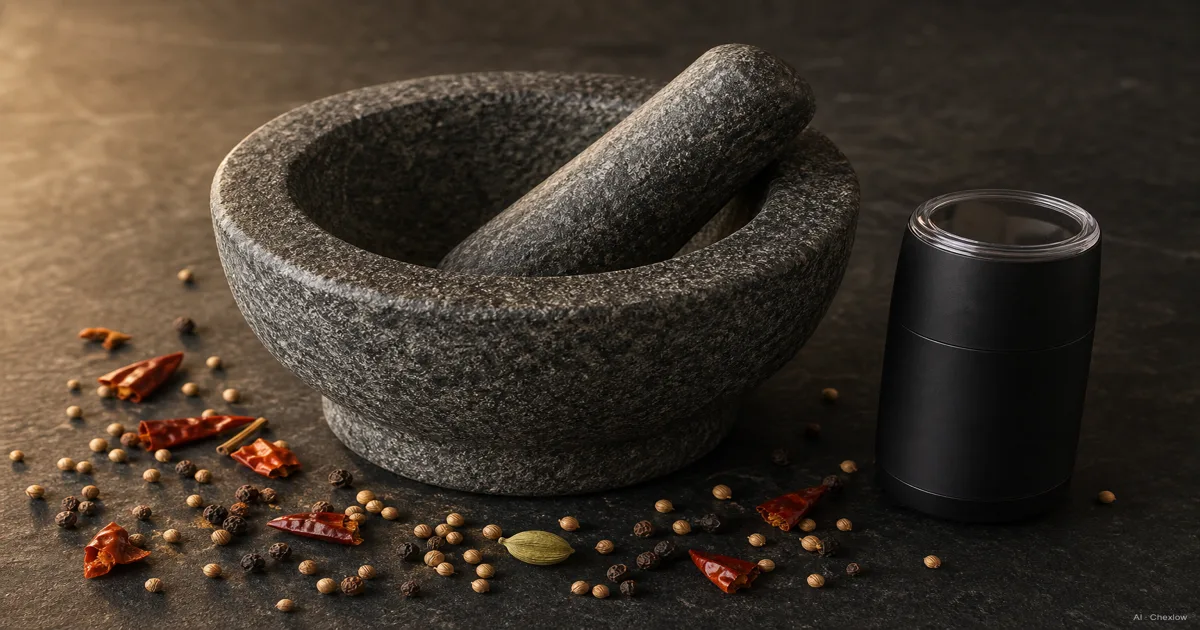
Mortar and Pestle vs Electric Spice Grinder: Which One Actually Belongs in Your Kitchen — KI-Illustration

Aktuell bei einem Shop erhältlich

Diese Produkte sind derzeit jeweils nur bei einem Shop erhältlich. Der Preisvergleich öffnet sich mit weiteren Shops.

Why the two tools produce different results

The physics of grinding spices matters more than most people expect. An electric blade grinder works by spinning a metal blade at high speed inside a small chamber. The spice particles bounce around, get cut, and gradually break down — but the process is uneven. Larger chunks survive longer, smaller particles get over-processed, and the friction from the blade generates heat throughout. For spices like cumin, coriander, and cardamom, that heat is the problem: the aromatic compounds responsible for the volatile top notes begin to dissipate the moment temperature rises.

A mortar and pestle works through direct compression and shear force — the pestle presses down and rotates, crushing and bruising the spice against the rough surface of the mortar. There is no motor speed to manage, no blade heat, and no particle bouncing. The result is more predictable: you can see and feel the texture developing, stop when it is right, and the cell walls of the spice rupture in a way that releases aromatic oils without immediately vaporizing them.

This is why cooks making curry pastes, garam masala, and fresh herb sauces consistently reach for a mortar. The flavor difference is not imaginary — it is the result of how each tool handles the volatile chemistry of the spice.

When the mortar and pestle wins

Pastes and wet-ingredient combinations. An electric spice grinder is a dry tool. Throw garlic, ginger, lemongrass, and fresh chilies into a blade grinder and the blades will struggle with the moisture and fibrous texture, producing an uneven and often underwhelming paste. A mortar handles moisture easily — in fact, combining wet and dry ingredients is where it outperforms any electric alternative. The classic Thai trinity of lemongrass, galangal, and kaffir lime zest cannot be properly processed in a blade grinder. The mortar is the correct tool.

Small quantities of whole spice. If you need a tablespoon of freshly ground cumin for a dish, filling, running, and cleaning an electric grinder is more effort than the task warrants. A mortar grinds a tablespoon of cumin in sixty to ninety seconds — by the time the grinder is cleaned, the mortar user is already done.

Spices where texture control matters. Not every spice should be reduced to fine powder. Whole peppercorns for a steak au poivre need a coarse, irregular crack — something an electric grinder almost never produces correctly without significant risk of over-grinding. Fennel seeds for a spice rub can range from lightly cracked to medium-ground depending on the application. The mortar gives you that range precisely because you can stop where you want.

Fragrance-forward spices. Cardamom, star anise, and fresh herb blends like chermoula or gremolata rely heavily on top-note volatility. Grinding these at speed in a hot blade grinder and the top notes are partially gone before the powder hits the pan. Hand-grinding in a mortar — which is cooler and slower — is why many cooks find that freshly ground cardamom in a mortar smells dramatically different from the same spice run through a machine.

When the electric grinder wins

Large batches of hard whole spices. If you are preparing a large quantity of spice blend — a batch of berbere, a 100g mix of garam masala components — grinding by hand becomes impractical. Hard dried spices like dried red chilies, cinnamon bark pieces, black peppercorns in quantity, and dried fenugreek seeds are exactly the use case where an electric grinder provides unambiguous value: consistent fine powder, produced quickly, without physical effort.

Fine powder for baked goods or spice blends. If the recipe requires genuinely fine powder that will suspend evenly in a sauce or a batter — turmeric powder, chili powder, sumac — a blade grinder delivers a consistency that is difficult to achieve by hand within a reasonable time.

Speed when texture control is not the priority. Making a large pot of a spiced braise, a dal, or a curry base where you need three different spices ground coarsely and consistency matters less than getting dinner on the table — a grinder gets you there in under a minute. The flavor difference between the two methods is real but not always worth the time trade-off.

Choosing a mortar material

The material of your mortar determines how effective it is at grinding and how easy it is to keep clean. The main options are granite, marble, and wood or ceramic, and they are not interchangeable for all tasks.

Granite is the most recommended material for a first mortar. It is hard (6 to 7 on the Mohs scale), heavy, and its natural surface texture provides the friction needed to break down even the hardest whole spices and seeds. Granite does not absorb flavors, odors, or colors from previous use, which means you can grind turmeric one day and black pepper the next without flavor carry-over. The weight — which is the main complaint — is also a feature when you are grinding: the mortar stays put. Most professional cooks and food writers who recommend a single mortar type recommend granite (Cookly Magazine, Marble vs. Granite Mortar and Pestle).

Marble is aesthetically attractive and more widely sold in Western kitchen stores. It works for light grinding and is gentle on soft spices and delicate herbs. However, marble is significantly softer than granite (3 to 4 on the Mohs scale), which means it provides less friction and takes more effort to grind harder spices. Marble is also porous in the way granite is not and can absorb colors — turmeric, for example, will stain marble permanently. Avoid using marble with acidic ingredients, as acids react with calcium carbonate in the stone and can etch the surface.

Wood and ceramic mortars are common in specific culinary traditions — wooden mortars in Southeast Asian cuisine, ceramic in Japanese (suribachi). They are effective for the tasks they were designed for but are generally not versatile enough to replace a granite mortar for general use. Wood is difficult to clean thoroughly and can retain odors. Ceramic suribachi are excellent for sesame seeds and miso but too gentle for hard whole spices.

Size: why 15cm (6 inches) is the practical minimum

The most common mistake when buying a first mortar is buying one that is too small. A mortar with an interior diameter of 10cm (4 inches) will technically grind a teaspoon of spice, but ingredients scatter on the rim during grinding, you cannot build up enough pestle pressure across the surface, and you cannot combine more than a small pinch of multiple ingredients without overflow.

A 15cm (6 inch) interior diameter is the practical minimum for home kitchen use. At that size you can grind enough spice for a dish for four, combine two or three wet ingredients for a paste base, and work with real leverage on the pestle. A 17 to 18cm mortar is comfortable for larger curry pastes and spice blends. Beyond 20cm, you are in restaurant territory — useful if you grind in large batches, overkill for everyday home use.

Depth matters too. A shallower mortar with a wide opening looks elegant but allows ingredients to escape during grinding. Look for a bowl depth that is at least half the interior diameter.

Cleaning and maintenance

Mortar and pestle. A new granite mortar should be seasoned before first use to remove any fine stone dust from manufacturing. The standard method: grind a handful of white rice until it becomes a grey paste, discard, and repeat once or twice until the paste comes out clean white. This fills the microscopic pores and removes stone particulates that would otherwise end up in your food.

For ongoing maintenance, rinse with water and a stiff brush after use — avoid soap, which can penetrate the porous surface of stone mortars and leave a soapy residue that affects the next grind. If the mortar picks up a persistent odor, grind a small amount of salt and rice to draw it out. Let it air dry completely before storing, and never put it in a dishwasher.

Electric spice grinder. The standard cleaning method for a blade grinder is to grind a small amount of dry white rice until it becomes a fine powder — the rice absorbs residual oils and spice pigments and scours the grinding chamber. Discard, wipe clean with a dry cloth or paper towel. For stubborn residue, repeat with fresh rice. Blade grinders should not be rinsed with water unless the manufacturer explicitly states the chamber is waterproof, which most are not (Tasting Table, The Big Downside of an Electric Grinder).

Blades dull over time. A grinder that begins taking longer or leaving larger pieces un-ground is usually a blade issue rather than a power issue.

The practical recommendation

For most home cooks, the honest answer is that both tools earn their counter space but for different reasons. If you cook with spices regularly and want the best flavor from fragrance-forward spices, pastes, and hand-crushed texture, a granite mortar (15cm or larger) is a high-return purchase that does not require electricity, does not break, and gets better with use.

If you cook large batches of spice blends, frequently need fine powder, or simply do not want to spend time grinding by hand, a dedicated spice grinder — not a blade coffee grinder repurposed for spice use — is the faster tool for those tasks. The flavor compromise is real but often acceptable for the speed gain.

The tools are not substitutes for each other. They solve overlapping but distinct problems. If you only buy one, buy the mortar — it has more genuine versatility. If you cook with ground spices several times a week and volume is an issue, add the grinder as a complement.

Sources

Wie dieser Guide entstand

Vom Housnap-Team redigiert · Die Bilder sind KI-generierte Illustrationen