Check the fit before committing to break-in
More wear cannot rescue the wrong size. Clarks distinguishes breaking in from correcting shoes that are too tight or too loose. If you are unsure about keeping them, check the seller’s return conditions before starting. Clarks’ break-in guide
- Pinched toes or forefoot. Ask to compare widths, rather than assuming you need more wearing time.
- A different style feels different in the same size. Construction and materials affect fit; the number alone cannot settle the choice. Clarks’ fitting FAQs
Make the first wear easy to end
Choose a time when you can take the shoes off immediately. Cheaney suggests starting indoors for about 30–60 minutes, but stopping sooner if rubbing begins. That is a starting suggestion, not a target to endure. Cheaney’s advice
- Put them on carefully. Use a shoehorn to help preserve the heel structure. This is what the tool helps with; it does not correct fit. Loake’s care guide
- Try a short outing next. Progress only when indoor wear feels comfortable, and carry a familiar spare pair. Clarks’ break-in guide
- If a blister develops. Stop wearing the shoes that caused it until it heals. Seek medical advice for a very painful, recurring or infected blister. NHS blister guidance
Judge progress by comfort, not a deadline
Beckett Simonon gives a broad range of three or four wears to three or four weeks. It is not an hours-based requirement or a promise for your pair. Beckett Simonon’s guide
For your next decision, compare similar short walks: is the same spot less troublesome, unchanged or worse? If it remains painful, return to the fit question instead of extending the walk.
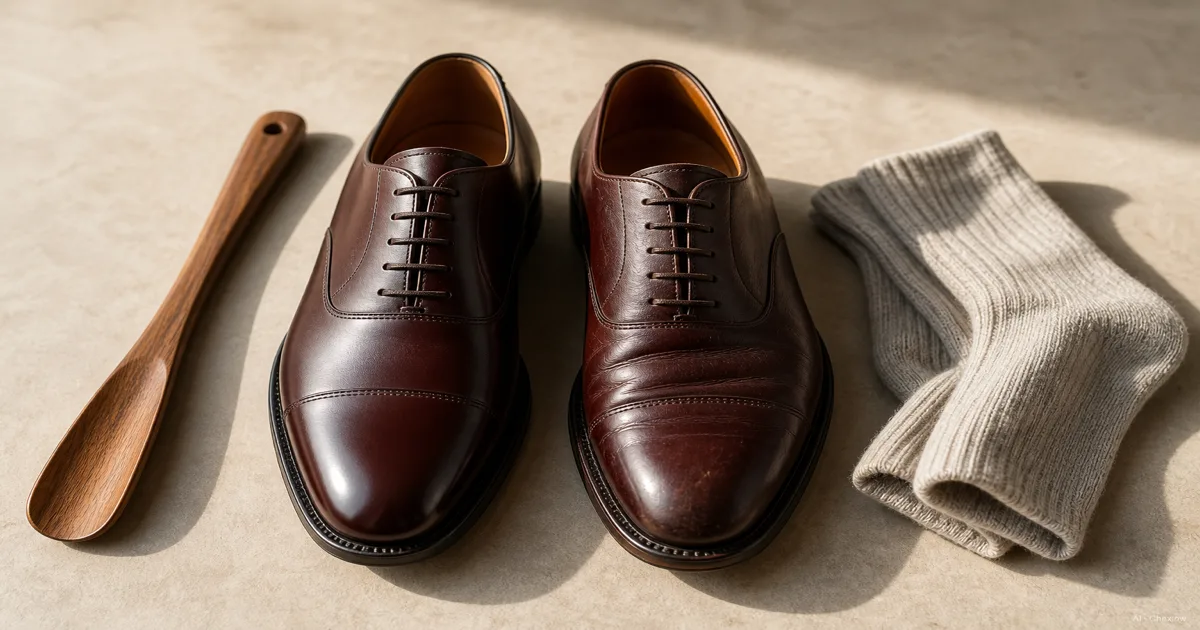
The illustration contrasts an unworn appearance with wear creases. It cannot tell you whether a shoe fits your foot.
Support the shoes between wears
Let the pair rest between outings. If it becomes wet, dry it naturally away from direct heat. Loake’s care guide
A wooden shoe tree supports the shoe’s shape during storage. Choose the correct size and shape; an unsuitable tree can distort the shoe. Treat it as support, not a way to force extra room. Cheaney’s shoe-tree guide
For help choosing and using one, continue to shoe trees, rotation and storage.
Choose advice over aggressive shortcuts
Skip soaking, freezing and heating as break-in experiments. Beckett Simonon warns against freezer, oven and washing-machine methods; Loake advises keeping wet shoes away from direct heat. Beckett Simonon, Loake
For a persistent tight spot, ask the seller or a shoe repairer to assess the pair before attempting stretching yourself. Cheaney identifies professional stretching as an option for stubborn shoes, not a guaranteed cure for every fit problem. Cheaney’s guide
If your next question is which care product the leather needs, separate that from the fit decision. Saphir’s smooth-leather guide distinguishes conditioning from polishing for gloss. Read how cream, wax and lotion differ before choosing a product. Saphir’s care guide
Wie dieser Guide entstand
Written by Housnap’s AI editor using the linked footwear manufacturers’ guidance and NHS blister advice. This guide focuses on deciding whether to continue gentle wear, reassess fit or seek help; it does not report product testing or promise a break-in deadline.