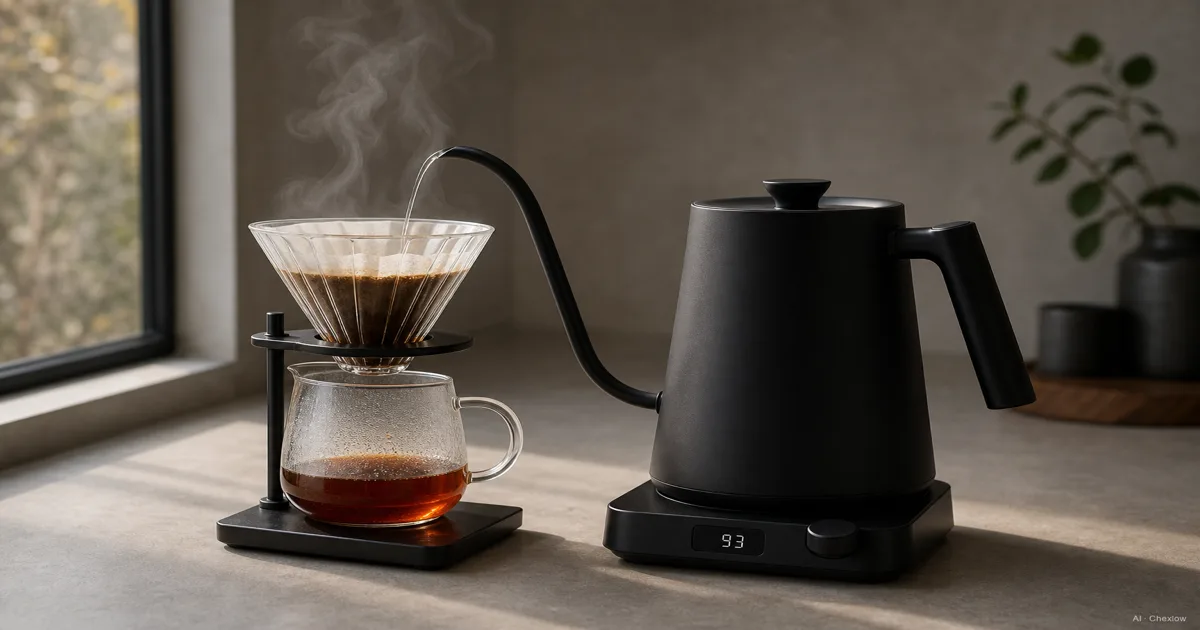
Decide which functions you will actually use
Start with two separate questions: do you want a narrow pouring spout, and do you want to select the heating temperature? Check for temperature selection and keep-warm separately; an automatic shutoff feature does not establish that either is included. Hario’s Buono Electric product page, for example, advertises controlled pouring and automatic shutoff.
- Choose variable temperature if you want to return to a recipe’s setting without a separate temperature-checking step.
- Prioritize keep-warm if you regularly pause between heating and brewing. If you pour immediately, give capacity and handling more weight.
- Keep an existing stovetop gooseneck if your heating routine already works for you. Identify the inconvenience an electric replacement would remove before buying it.
If the kettle will mainly serve cooking and ordinary hot drinks, first compare variable-temperature and fast-boil kettles. That is a different buying decision from choosing a dedicated pouring tool.
Calculate water needs before choosing capacity
Use the recipe’s total poured water, not the amount of coffee you hope to drink. Blue Bottle’s pour-over guide uses 350 g in total, including the initial 50 g bloom. Bloom means the first pour that wets the grounds; do not add it again when calculating capacity.
For a planning example, suppose you also use 100 g to rinse the filter and warm the brewer:
- One brew: 350 + 100 = 450 g of water.
- Two consecutive brews: 350 + 350 + 100 + 100 = 900 g of water.
The 100 g allowance is an example, not a prescribed rinse volume. Measure your own preparation water with a scale; for kettle sizing, these totals are approximately 450 mL and 900 mL. A coffee scale is useful here and for following a recipe by weight. Use an existing suitable scale before adding another appliance.
Check usable capacity carefully. Hario labels its VKBR-100-HSV Buono as 1L but lists 600 mL practical capacity. Read the exact model’s maximum and minimum fill instructions rather than treating the headline size as a brewing allowance. A kettle with 900 mL usable capacity leaves no extra allowance in the two-brew example.
If you have not settled on a dose and water amount, start with the pour-over ratio and recipe guide, then choose capacity.
Judge the pour and grip together
Hario describes the Buono’s slim spout as helping control pouring amount and speed. That is the useful promise to investigate. A long neck alone is not a reason to choose one kettle over another.
If a demonstration is available, ask for a cold-water pour at the amount you normally expect to lift. Check whether you can start a controlled stream, move its landing point and stop without an awkward wrist position. Compare the whole movement, not just an empty kettle’s weight.
The goal is comfortable control at your recipe’s pace, not the slowest possible trickle. If you are still choosing the brewer itself, settle its size and filter arrangement with the first pour-over dripper guide before finalizing the kettle.
Match temperature and hold behavior to your recipe
Start with your coffee supplier’s recipe. As one reference, Blue Bottle specifies 195–205°F, approximately 91–96°C. Use that as a recipe range, not a universal rule that every roast must obey.
When comparing controls, check the available settings, how you select them and whether the display distinguishes the target from the measured temperature. A selectable one-degree step is not, by itself, evidence of one-degree measurement accuracy.
Read what happens when you lift and replace the kettle. For the original Stagg EKG, Fellow describes a 60-minute HOLD period that restarts when the kettle returns to its base. Do not assume another model behaves the same way.
Choose hold behavior that fits your pauses, and follow the minimum-fill rule whenever heating continues. Keep coffee dose, grind setting and pouring routine consistent when comparing temperature settings; buying a temperature controller does not make those decisions for you.
Check the exact version before ordering
A familiar product name is not enough to confirm electrical compatibility. The Hario EVKB-80U-HSV specification lists AC120V, 60Hz, with a 150 mL minimum and 800 mL maximum. Those are specifications for that version, not the whole category.
- Power and placement: confirm that the model’s electrical rating suits your supply and that its base and cord fit the intended counter position.
- Heating limits: find the minimum and maximum marks before use. Turn heating or hold off before the remaining water falls below the permitted minimum. The Stagg EKG manual also explicitly prohibits stovetop use; an electric body is not a stovetop substitute.
- Water-contact materials: read the component description if material composition matters to you. Fellow lists a silicone ring around the temperature probe inside its stainless-steel EKG kettles. “Stainless steel” alone does not describe every component.
Your shortlist should now have a clear job: accommodate your measured water needs, offer the controls you will use and feel manageable while pouring. Compare models that meet those requirements before paying for extra features.
Wie dieser Guide entstand
This guide was written by AI for Housnap, using Hario product specifications, Fellow instructions and material disclosures, and Blue Bottle’s brewing guide. It focuses on choosing kettle capacity, controls and handling; the water-budget examples are editorial calculations, not product tests.