Dog Nail Grinder vs Clipper, What to Buy for Your First Trim
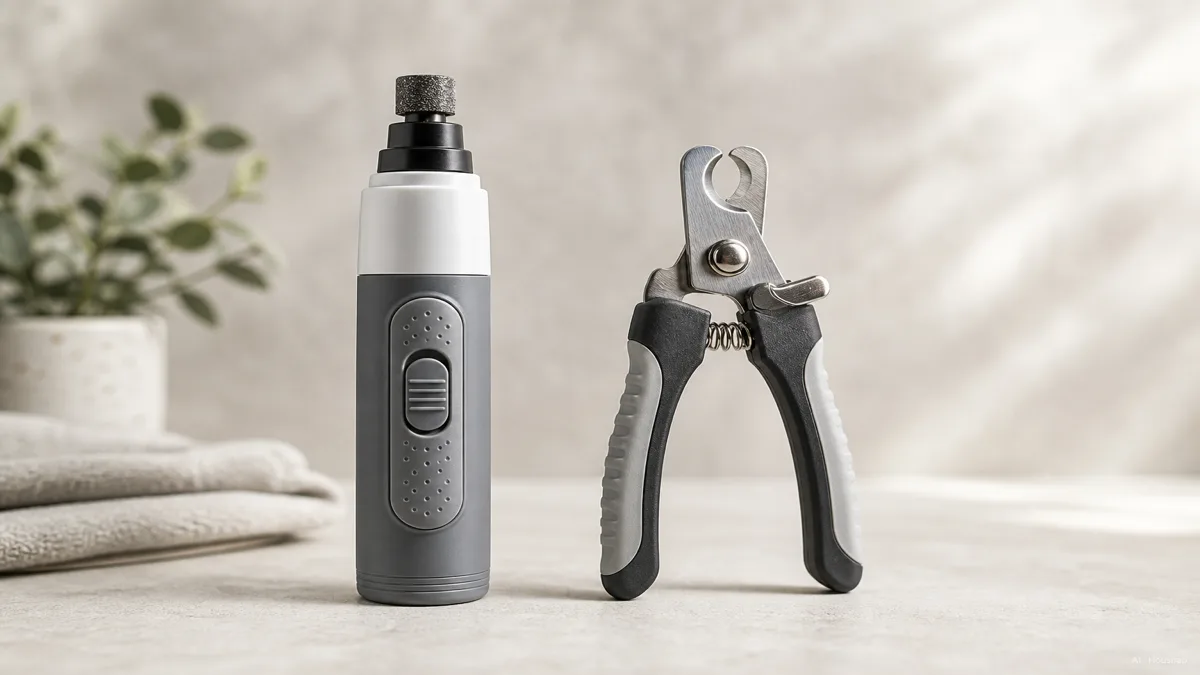
You finally decided to trim your dog's nails yourself, and now you're standing in front of two very different tools trying to guess which one you actually need. One looks like a nail clipper. The other looks like a small power drill. Both claim to shorten a nail, and neither page explains what's actually different, or which one is safer for your dog. Here's the part that matters. A clipper cuts in one motion. A grinder wears the nail down gradually. That difference between "one motion" and "gradually" turns out to matter a lot more than it sounds like it should, especially the first time you're the one holding the clipper. Every nail has a blood vessel and a nerve running partway down it. Cutting into that spot is the one thing every new owner is afraid of, and for good reason, it hurts your dog and it rattles you for the rest of the day. So the real question isn't which tool is better. It's which one gives you more room to mess up safely. This guide walks through how the two tools actually work, which one fits your dog's nails and temperament, what to check before you buy, and the combination method professional groomers actually use.

Aktuell bei einem Shop erhältlich
Diese Produkte sind derzeit jeweils nur bei einem Shop erhältlich. Der Preisvergleich öffnet sich mit weiteren Shops.

Vetoform
Dog and Cat Food supplement car sickness 30 tablets

Hugglehounds
Birch Bunny X-Brace Plush Dog Toy

Hugglehounds
HuggleFleece HuggleSnuggler Cat & Dog Beds

Buddy Brands
Deluxe Buddy Bed – Advanced Orthopedic Memory Foam Dog Bed for Joint Support
Grinder vs. Clipper: How Each Tool Actually Works
Both tools do the same job, shortening a nail that would otherwise curl into the paw or click on hardwood floors. They just get there in completely different ways, and that difference is the whole story here.
A clipper trims in one motion. Squeeze the handle, the blade closes, and a section of nail comes off in a single click. Guillotine-style clippers have a hole you thread the nail through, then a blade slides across in a straight line. Scissor-style clippers, which look closer to small pruning shears, close from the sides instead, and hold up better on nails that have grown thick or curled (K9 of Mine's grinder vs. clipper comparison).
A grinder, sometimes called a Dremel after the brand that popularized the rotary-tool crossover, wears the nail down instead of cutting it. A small spinning head sands the tip away in thin layers, so one pass removes far less material than a single clip. That's slower by nature, but it's also the reason a grinder rarely produces the sudden shock of cutting too much at once.
Neither tool is objectively better on paper. The real question for a first-time buyer is which failure mode you'd rather manage, the speed and precision a clipper demands, or the noise and patience a grinder asks for instead.

Which Is Safer for a First-Time Trim? (Quick-Cutting Risk Compared)
This is the question that actually keeps new owners up the night before a first trim, and it has a fairly clear answer.
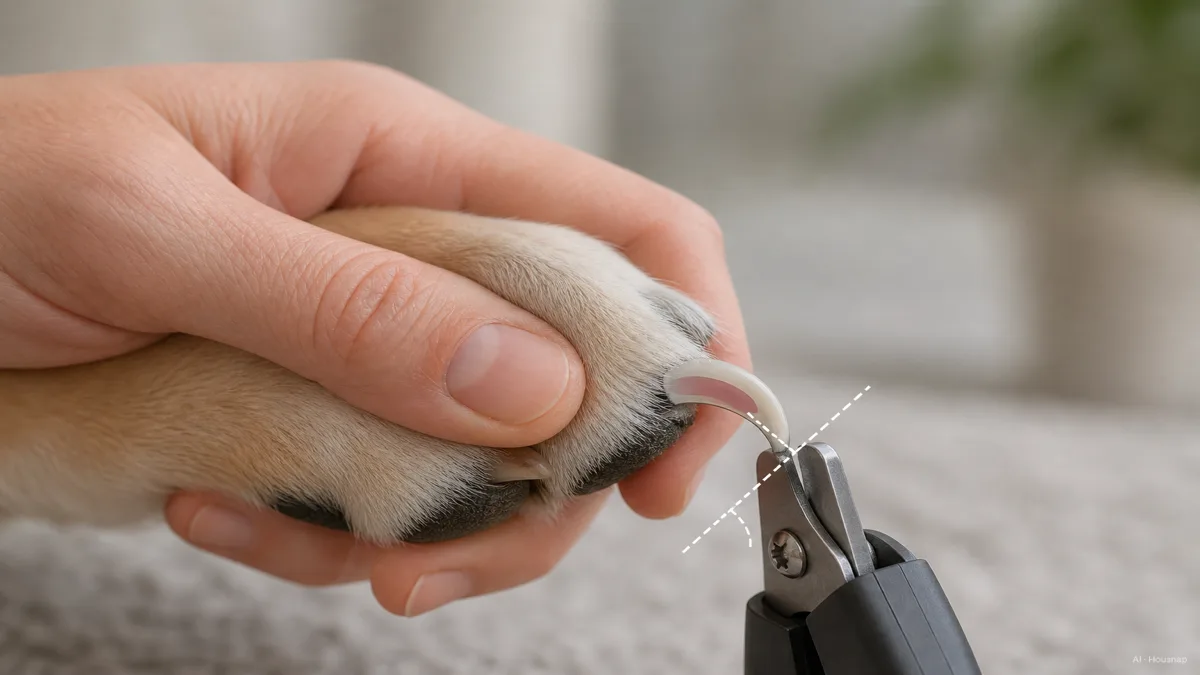
Cutting the quick, the blood vessel and nerve running partway down every nail, is the one scenario every first-time owner fears, and it's easier to do with a clipper than most product pages admit. A clipper removes nail in one motion, so a misjudged cut or a dog that wiggles mid-squeeze is the main way a nail actually gets quicked (Whole Dog Journal's grinders vs. clippers guide). Once it happens, there's no taking the cut back.
A grinder removes the same nail material more gradually, in thin passes, which is why it's widely considered the safer choice for a first-time trim. You can stop the moment the nail's core starts to look different, well before you'd reach the quick with a single clip (Whole Dog Journal; K9 of Mine).
That safety margin comes with a real trade-off, though. Grinders are noisier and vibrate against the paw, and some dogs need real, patient desensitizing before they'll hold still for one. Grinding also takes longer per nail than a single clip, so a squirmy dog has more time to object mid-pass (K9 of Mine). The American Kennel Club is direct about this trade-off, both tools are safe when used correctly, and the right one depends on your own dog's tolerance, since some dogs do better with a clipper's quiet click and others handle a grinder's buzz just fine (AKC's guide to trimming nails at home).
The technique that keeps either tool safe is the same. Approach the nail at roughly a 45-degree angle, working from underneath and curving up over the top in light passes, rather than committing to one deep cut or one long grind straight down (AKC-sourced guidance via K9 of Mine).

Best Choice by Dog Type: Puppies, Dark Nails, Anxious Dogs, and Overgrown Nails
There's no single right answer here, only the right tool for the dog and the nails actually in front of you.
Dark or black nails are the clearest case for a grinder. On a pale nail you can often see the quick as a pink line through the shell; on a black nail it's invisible, so you're guessing with a clipper. A grinder's gradual removal is far more forgiving when you can't see what you're cutting toward (Whole Dog Journal).
Puppies and first-time trimmers land in the same camp. A young dog's nails are still thin and the quick sits close to the surface, and a puppy that has a bad first experience with a clipper can carry that fear for years. The slower, gentler abrasion of a grinder is the more patient way to introduce the whole routine.
Anxious dogs are the trickiest case, because the two tools fail in opposite directions. A clipper's single click is fast, which matters for a dog with a short tolerance window, but the sudden pressure and sound can spook a nervous dog. A grinder is gentler in the moment, but the motor noise and vibration are often what an anxious dog reacts to worst, so it usually needs its own separate desensitizing sessions, letting the dog hear and feel the tool switched on nearby before it ever touches a nail.
Severely overgrown nails, the kind that have started curling back into the paw pad, are the one case where a scissor-style clipper is the safer first tool. Grinding that much material away one thin layer at a time takes far too long and risks heat buildup on the nail, so a scissor clipper's stronger cutting action through thick, curled nail is the better opening move, with a grinder brought in afterward to smooth what remains (K9 of Mine).

What to Look for When Buying: Speed Settings, Noise, LED Guides, and Clipper Styles
Once you've picked a tool type, the shopping decision comes down to a short list of specs that actually matter day to day.
For grinders, speed settings are the first thing to compare. Multi-speed, cordless rotary grinders in the 8,000 to 25,000 RPM range give you a slow setting for a first-timer or a small dog and a faster one for thicker nails, rather than forcing one speed on every dog in the house. Cordless models are the more practical everyday pick, since a cord dragging near a nervous dog adds one more thing to spook it. Noise and vibration level vary a surprising amount between models, so a genuinely low-noise motor is worth prioritizing if your dog is sound-sensitive. An LED light built into the grinder head, which lights up the nail as you work, is one of the more useful features for spotting the quick on darker nails. Interchangeable grinding heads or ports sized for small, medium, and large dogs round out the list, since one-size ports wear unevenly on very small or very large nails (2026 buying-guide roundups from Dogster, K9 of Mine, Chewy, Canine Bible, and Smart Pet Gear Lab).
For clippers, the shape decision comes first. Guillotine-style clippers are simple and precise on thinner, regularly trimmed nails, while scissor-style clippers give you more cutting force and are the better pick for thick or already-overgrown nails (K9 of Mine). A comfortable, non-slip handle grip matters more than it sounds once you're holding a wiggling dog's paw with one hand and the clipper with the other.
This is enough of a live category that multiple 2026 buying-guide roundups keep landing on the same handful of criteria above, cordless multi-speed grinders across that 8,000 to 25,000 RPM range with LED nail illumination, when they compare current top picks. Treat those criteria as your shopping checklist rather than chasing one specific model, and compare current pricing and availability before you buy.
The Combination Method Professional Groomers Actually Use
Here's the detail most first-time buyers never hear until a groomer mentions it in passing, you don't actually have to choose only one tool forever.
Many professional groomers use both, in sequence, rather than picking a side. The clipper goes first, taking off the bulk of an overgrown nail quickly, since a grinder alone would take too long to remove that much length. Then the grinder follows, smoothing the rough, sometimes sharp edge the clipper leaves behind and gently refining the shape closer to the quick than a single clip would risk (Scenthound's guide to clipping vs. grinding; Whole Dog Journal).
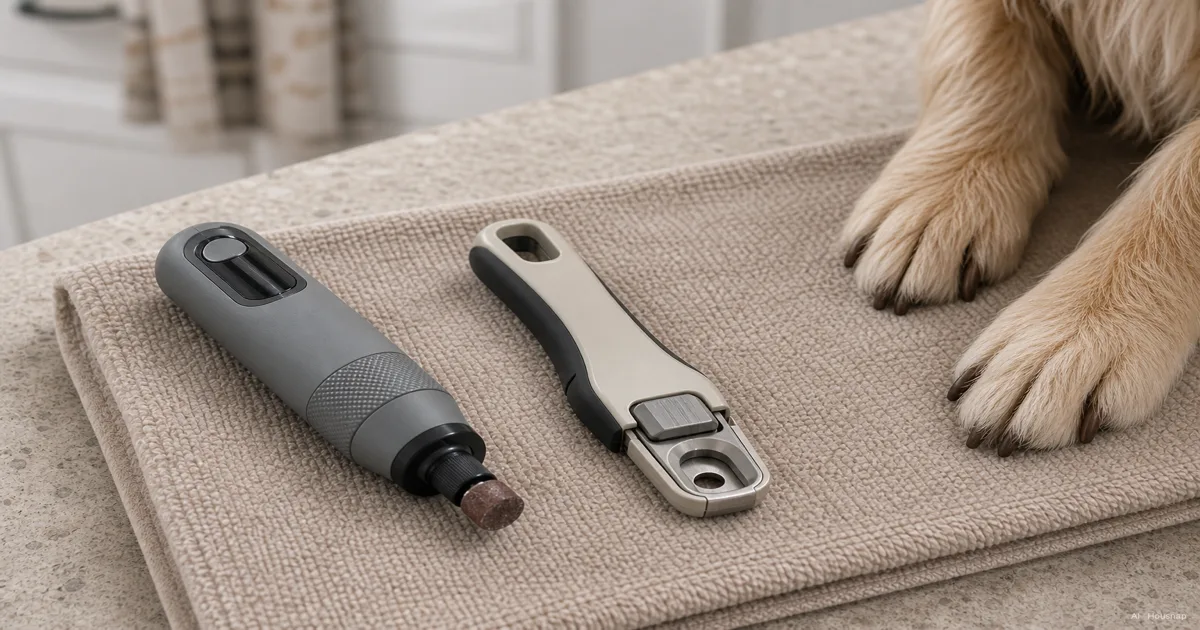
For a first-time buyer, this reframes the whole decision. You're not locked into "grinder forever" or "clipper forever." A reasonable starting kit is a clipper for the routine bulk trim plus a grinder for the finishing pass, and for the dogs, or the moods, where a single click feels too risky. One caution either way, work in short, sweeping touches rather than holding the tool against one spot, since a grinder held too long against a single nail builds up heat, and a clipper closed too slowly on a wiggling paw is exactly how a misjudged cut happens (K9 of Mine).
Sources
- Grinders vs. Clippers: What's Best for Your Dog's Nails? — Whole Dog Journal; quick-cutting risk compared, grinder safety margin, dark-nail and first-timer recommendation
- How to Trim Your Dog's Nails at Home — American Kennel Club; both tools safe when used correctly, individual dog tolerance, 45-degree trimming technique
- Dog Nail Grinder vs Clipper: Which Is Better For Trimming Dog Nails? — K9 of Mine; guillotine vs. scissor clipper styles, grinder desensitizing challenges, overgrown-nail guidance, heat buildup caution
- The 411 on Clipping vs. Grinding Dog Nails — Scenthound; the professional groomer combination method
- Best Dog Nail Clippers and Grinders — Consumer Reports; comparative buying guidance
- 5 Best Dog Nail Grinders (2026 Reviews) + How to Grind Nails 101! — K9 of Mine; speed settings, cordless design, LED illumination, and top-rated model roundup
- Dog Nail Grinder vs. Clipper: Which Is Better? 2026 Comparison Guide — Dogster; 2026 buying-guide comparison
Wie dieser Guide entstand
This piece extends the pet-accessories cluster into grooming tools, picking up right after the fork most first-time owners hit once they decide to trim nails at home instead of relying on a vet or groomer visit: grinder or clipper, and which one is actually safer to hold against a wiggling paw. The spine of the piece is the quick-cutting risk itself, comparing how a clipper's single-motion cut and a grinder's gradual abrasion behave differently around the nail's blood vessel and nerve. We anchored the safety comparison on Whole Dog Journal and the American Kennel Club, the clipper-style and buying-spec detail on K9 of Mine's comparison and grinder roundup, and the professional combination method on Scenthound. The buying criteria, speed settings, cordless design, and LED nail illumination, reflect what current 2026 grinder roundups are comparing, and catalog depth in this vertical is still being confirmed, so the guidance stays at the level of what to compare rather than naming a single product.