Baby Carrier vs Wrap, How to Choose Your First Babywearing Buy
You start shopping for a way to carry your baby and the words come at you fast. Wrap. Sling. Soft structured carrier. Stretchy versus woven. Front-facing versus inward. What looked like one purchase splits into a small genre of baby gear, each with its own fans who are very sure they are right. Here is the short version before the long one. A wrap is fabric and knowledge, a structured carrier is fabric and buckles. The wrap molds to a newborn better than anything and costs less, but it sags as the baby grows and it asks you to learn a tying technique. The carrier clips on in seconds and carries the weight on your hips instead of your shoulders, which is why it lasts longer and survives a real day out. But newborn-perfect and toddler-proof are rarely the same product. A stretchy wrap that cradles a six-week-old beautifully starts to droop once the baby crosses roughly 15 pounds, and a structured carrier that handles a toddler can feel bulky around a tiny newborn. So this guide does two things. It walks through what each type actually does at each stage, and it sorts out the safety language, TICKS, the hip-healthy M-position, the ASTM standards, so the spec sheet stops being a wall of acronyms. The goal is the carrier you will actually reach for on a hard afternoon, not the one that scored highest on a list.
Aktuelle Produkte zum Vergleichen
Diese Produkte stammen aus den Housnap-Suchergebnissen zu diesem Thema.
Wrap vs Carrier, What Is Actually Different
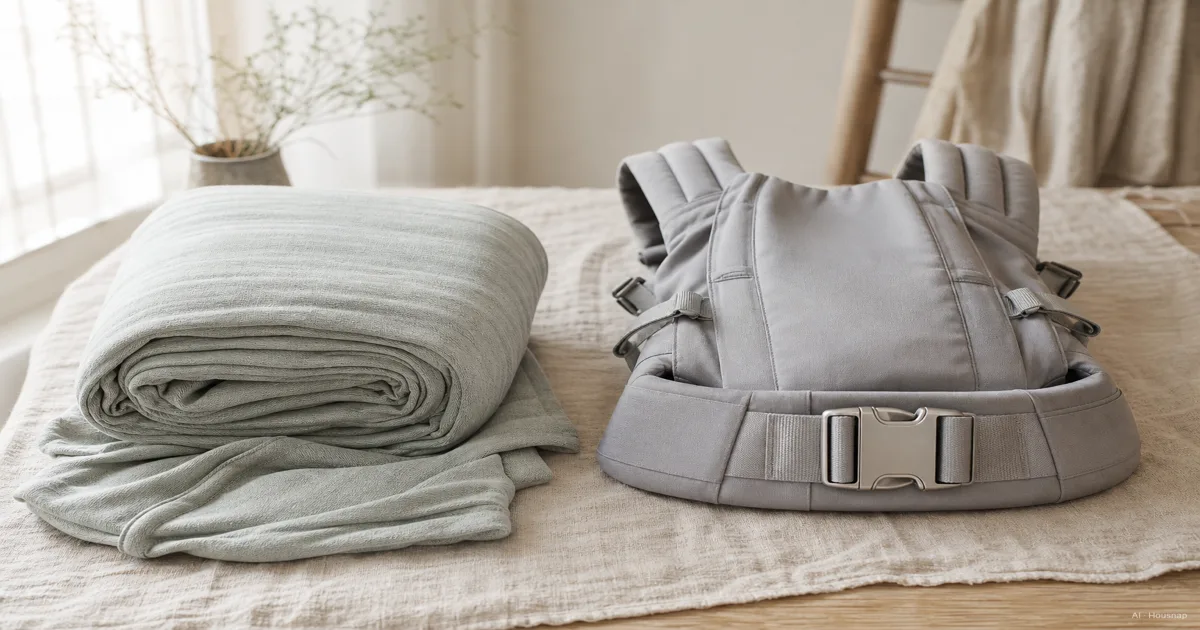
Strip away the brand pages and there are two ways to attach a baby to your body. One uses cloth and a knot. The other uses cloth and hardware.
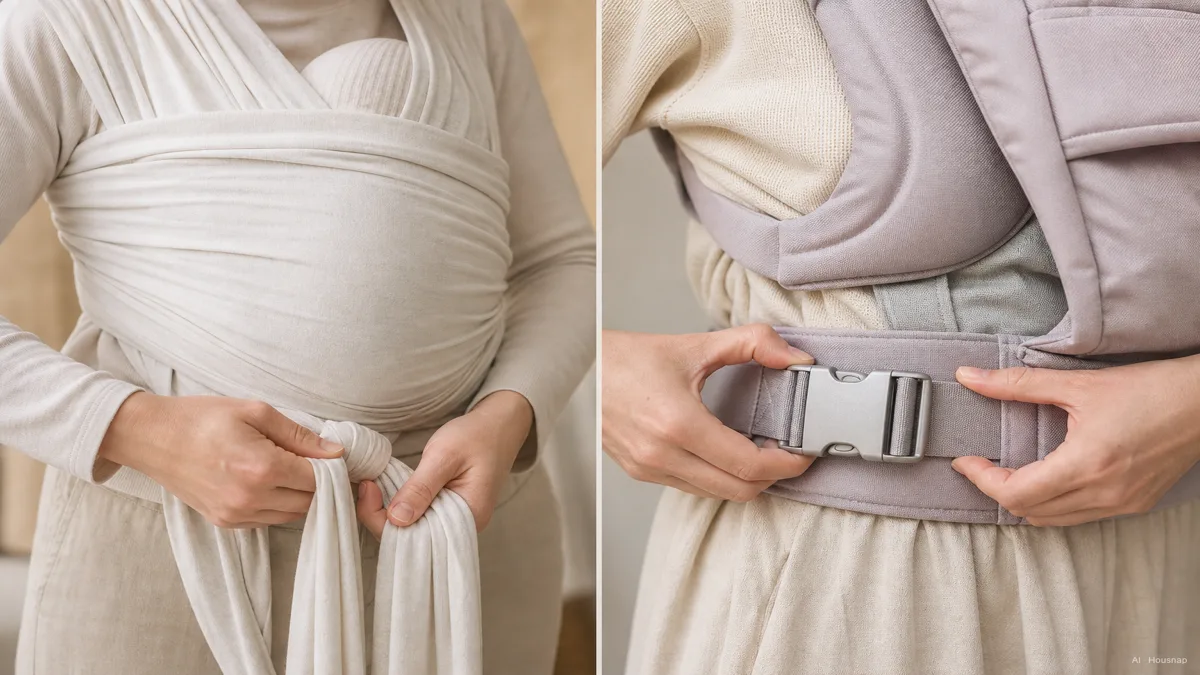
A wrap is a single long piece of fabric, usually 4 to 6 meters, that you wind around your torso and tie off. There are two kinds. A stretchy wrap, like a Moby or a Solly, has give in the fabric and hugs a newborn like a second skin. A woven wrap has almost no stretch, which lets it support a much heavier child without sagging. The wrap holds its shape because you tie it tight, not because it is built stiff.
A soft structured carrier, the thing most people picture when they say "baby carrier," does the structuring for you. It has padded shoulder straps, a wide waistband, and a buckle system, so once you have the straps adjusted to your body most parents can get a baby secured in under 30 seconds. No tying, no learning curve to speak of.
That difference, knot versus buckle, drives almost everything else. The wrap is cheaper, more compact, infinitely adjustable, and slow to put on. The carrier is pricier, bulkier in a bag, less customizable, and fast. Neither is the better object in the abstract. They are better at different moments, which is the whole reason this comparison exists.
The Newborn Window, Why Wraps Shine in the First 3 Months
For the first few months there is a real case that the wrap is not just a cheaper option but the better one, and it comes down to how a newborn body wants to be held.
A stretchy wrap distributes a tiny baby's weight evenly and pulls them in close and high, chest to chest. That closeness is not just sentimental. Skin-to-skin contact, which a wrap makes easy, helps stabilize a newborn's breathing, blood sugar, and temperature, and boosts oxytocin in both parent and baby, reduces crying, and supports breastfeeding. The wrap is, in effect, a wearable version of the thing the hospital kept telling you to do.
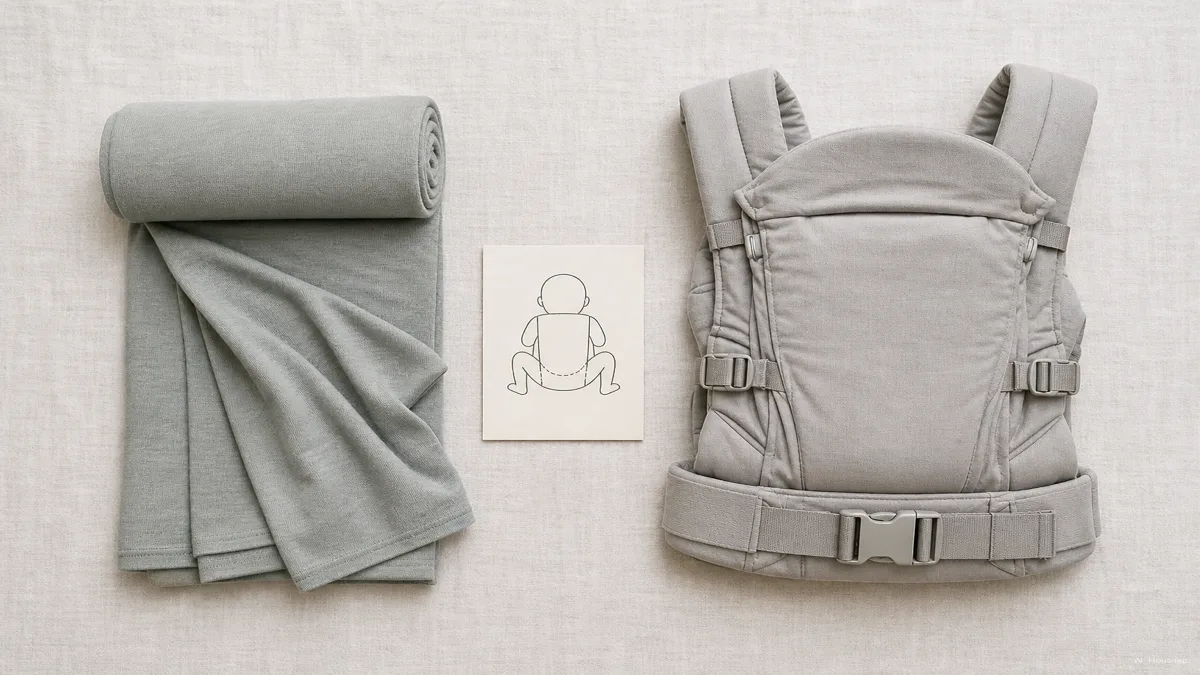
It also holds the position newborn hips need. The International Hip Dysplasia Institute recommends what is often called the M-position or spread-squat: knees higher than the bottom, thighs supported, legs spread at a healthy angle so the hip joint sits where it should. A well-tied stretchy wrap naturally cradles a baby into that shape, and the same institute recommends inward-facing carries for the first six months to keep the hips well positioned.
And a wrap fits a newborn with no extra parts. Many structured carriers need a separate newborn insert or a fiddly setting to safely hold a baby under a certain weight. A stretchy wrap simply tightens to whatever size the baby is. For the fourth-trimester stretch, those weeks when a newborn mostly wants to be on a body, that simplicity and closeness is exactly the point.

When to Switch, Weight Limits, Sag, and the Case for a Structured Carrier
Here is the catch that surprises a lot of first-time parents: the stretchy wrap that felt perfect at six weeks does not last.
Stretchy wraps begin to sag and lose support somewhere around 15 to 18 pounds, which is roughly 4 to 6 months for many babies. The same give that makes the fabric so gentle on a newborn is what fails you later. The baby gets heavier, the stretch bottoms out, and the carry that was snug becomes a slow droop that puts the weight on your neck and lower back. This is not a defect. It is the fabric doing what stretchy fabric does.
That is the moment the structured carrier earns its price. Its padded waistband does something a wrap cannot: it redistributes weight off your shoulders and onto your hips, which is the difference that matters for any carry over about half an hour or any baby on the heavier side. A good structured carrier also grows with the child. The Ergobaby Omni 360, one of the most frequently cited models for 2026, supports four carry positions from 7 to 45 pounds without a separate newborn insert, which is why it shows up so often on do-it-all lists.
So the honest pattern, the one a lot of experienced babywearers land on, is two carriers, not one. A stretchy wrap for roughly the first three months, then a structured carrier from three or four months onward. You are not buying twice because you chose wrong the first time. You are buying for two different bodies the same baby happens to have a few months apart.
Safety Essentials, TICKS, the Hip-Healthy M-Position, and ASTM Standards Explained
Whatever you carry in, the safety rules are the same, and there are three layers worth knowing by name.
The first is TICKS, a checklist that applies to wraps and carriers alike. It stands for Tight, In view at all times, Close enough to kiss, Keep chin off chest, and Supported back. The one that catches new parents is "keep chin off chest." A newborn's airway can close if the head slumps forward into the body, so you want the chin up and at least a finger's width of space under it. Pathways.org lays out the full checklist, and it is worth reading once before the first carry, not after.
The second is the hip-healthy M-position covered above. The reassuring part: the International Hip Dysplasia Institute states that "periodic short-term use of a baby carrier is unlikely to have any effect on hip development," so you do not need to panic about a brief carry in the wrong position. But for regular, daily wearing, choosing a carrier that supports the thighs and keeps the knees up is the easy way to stay on the right side of it.
The third is the standards stamp, which is quieter but real. In the United States the mandatory CPSC safety standard for soft infant and toddler carriers incorporates ASTM F2236-24, updated in late 2024. Sling-style carriers fall under a separate standard, ASTM F2907. Both require structural integrity, occupant retention so the baby cannot slip out, and testing for hazardous substances. You do not need to memorize the numbers. You just want to confirm a carrier meets the current ASTM standard before it goes near your baby.
First-Buy Decision Guide, One or Both?
Put the acronyms down for a second and start from how you actually live.
Budget and timing first, because they are the most honest filters. A stretchy wrap is the cheaper entry point and the better newborn tool, so if your baby is not here yet or is only a few weeks old, starting with a wrap costs less and serves the exact stage you are in. If you are coming in later, with a three or four month old who already wants to face out and weighs enough to sag a wrap, skipping straight to a structured carrier makes more sense.
Then think about how you will use it. A wrap rewards the parent who is home a lot, has time to learn the tie, and wears it for long calm stretches. A structured carrier rewards speed and shared use: if it gets handed between two parents, or clipped on and off a dozen times a day at the door, the no-learning-curve buckle wins. Solo, slow, and newborn leans wrap. Busy, shared, and on-the-go leans carrier.
For many families the real answer is both, in sequence, and that is not overbuying. A wrap for the fourth-trimester closeness, a structured carrier from the sag point onward, often in the same order experienced parents describe. From here, the useful next move is to filter structured carriers and wraps side by side, compare what each brand charges across stores, and check the details that map to your answer: the weight range printed on the carrier, whether it holds a newborn without a separate insert, the M-position seat, and the current ASTM standard. You'll find the names that show up most in babywearing, so the comparison is concrete rather than hypothetical.
Sources
- Baby Wrap vs Baby Carrier, Which One Is Right for You? — Ergobaby; wrap versus structured carrier trade-offs, the two-carrier strategy, and stretchy versus woven
- Baby Carriers and Other Equipment — International Hip Dysplasia Institute; the M-position spread-squat, inward-facing recommendation, and the note on short-term use
- Guide to Babywearing, When to Start, Types, and Safety Tips — Pathways.org; the TICKS safety checklist applied to all babywearing types
- Soft Infant and Toddler Carriers Business Guidance — CPSC; the mandatory ASTM F2236-24 standard and the separate F2907 sling standard
- Best Baby Carriers of 2026, Tested and Reviewed — Mommyhood101; structured carrier speed, the Ergobaby Omni 360 weight range and positions