Glass vs Plastic Baby Bottles, How to Choose Your First Set
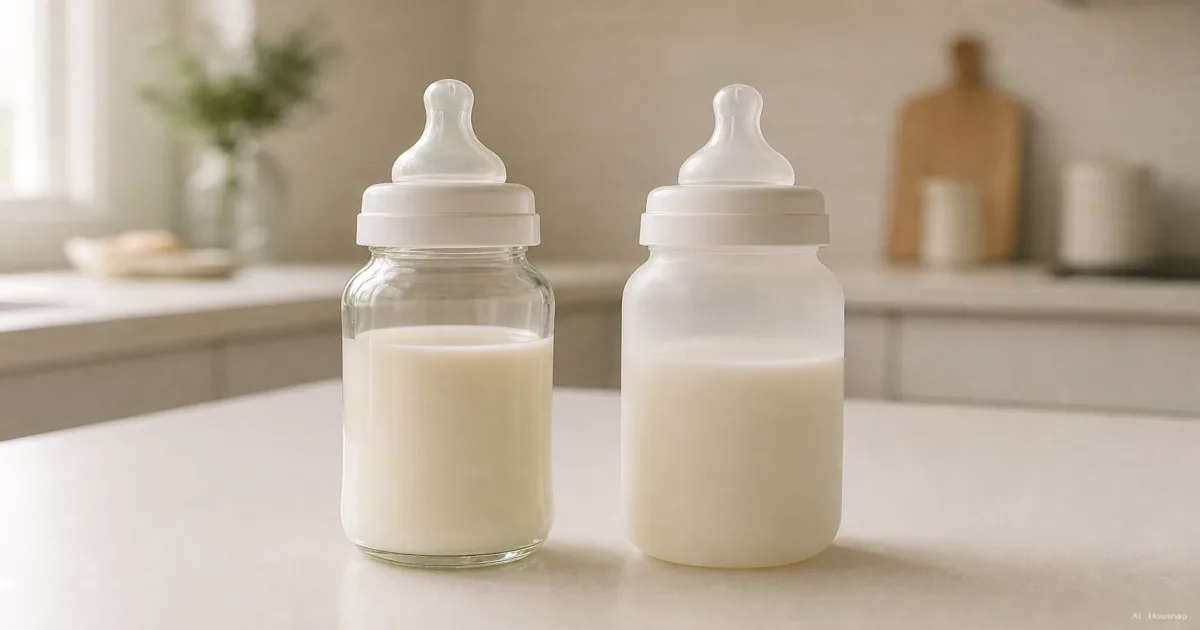
You start shopping for a first baby bottle and the choice looks simple until you read one ingredient label too many. Glass. Plastic. Now PPSU, silicone, and something called a hybrid bottle. What started as a five-minute purchase turns into a rabbit hole about chemicals you have never heard of. Here is the short version before the long one. Glass is the inert material. It does not leach anything into the milk, ever, at any temperature. Plastic is lighter, cheaper, and unbreakable, but it is a polymer, and polymers shed tiny particles when you heat them. That single difference sits underneath almost every glass-versus-plastic argument you will read. But inert is not the same as practical. A glass bottle is heavy, it breaks on a tile floor, and a lot of daycares will not accept it. A first feeding set has to survive a real day, not a lab. So this guide does two things. It walks through what each material actually does to the milk and to your routine, and it sorts out the newer terms, BPA-free, PPSU, borosilicate, so the label stops being a wall of chemistry. The goal is a set you will still be reaching for at 3 a.m., not the one that scored highest on paper.
Aktuell bei einem Shop erhältlich
Diese Produkte sind derzeit jeweils nur bei einem Shop erhältlich. Der Preisvergleich öffnet sich mit weiteren Shops.
Why Material Matters: Glass, Plastic, and What Touches Your Baby's Milk
The whole conversation comes down to one question. When warm milk sits against the bottle wall, does anything move from the wall into the milk?
With glass, the answer is no. Glass is non-porous and chemically inert, the same reason it is used for lab and medical equipment. It does not leach compounds at any temperature, it does not absorb the smell of formula or breast milk, and it does not stain. A glass bottle that held formula on Monday is genuinely clean on Friday, not just clean-looking.
Plastic is a different kind of material. It is a polymer, a long chain of molecules, and under heat and repeated washing those chains shed microscopic fragments. The plastic in modern bottles is also a hardening story: for years that hardener was BPA, until the FDA banned BPA from baby bottles and sippy cups in 2012. Every bottle sold today is BPA-free by law.
Here is the part the label does not tell you. BPA-free does not mean chemical-free. Manufacturers replaced BPA with substitutes like BPS and BPF, and early research suggests those replacements raise some of the same hormonal-disruption questions BPA did. So BPA-free is a floor, not a finish line. Glass simply sidesteps the entire question, because there is no hardener to replace.
That is the real reason material matters. It is not that plastic is dangerous and glass is virtuous. It is that glass removes a category of question entirely, and plastic asks you to keep reading the label.
The Microplastics Question: What Science Says About Polypropylene Bottles
This is the section most parents actually came for, so let's be precise rather than alarming.
Polypropylene, usually shortened to PP, is the plastic in roughly 82% of the world's baby bottles. It is light, cheap, and shatterproof, which is exactly why it dominates. But in 2020, a peer-reviewed study in Nature Food from Trinity College Dublin put numbers on something parents had only worried about vaguely.
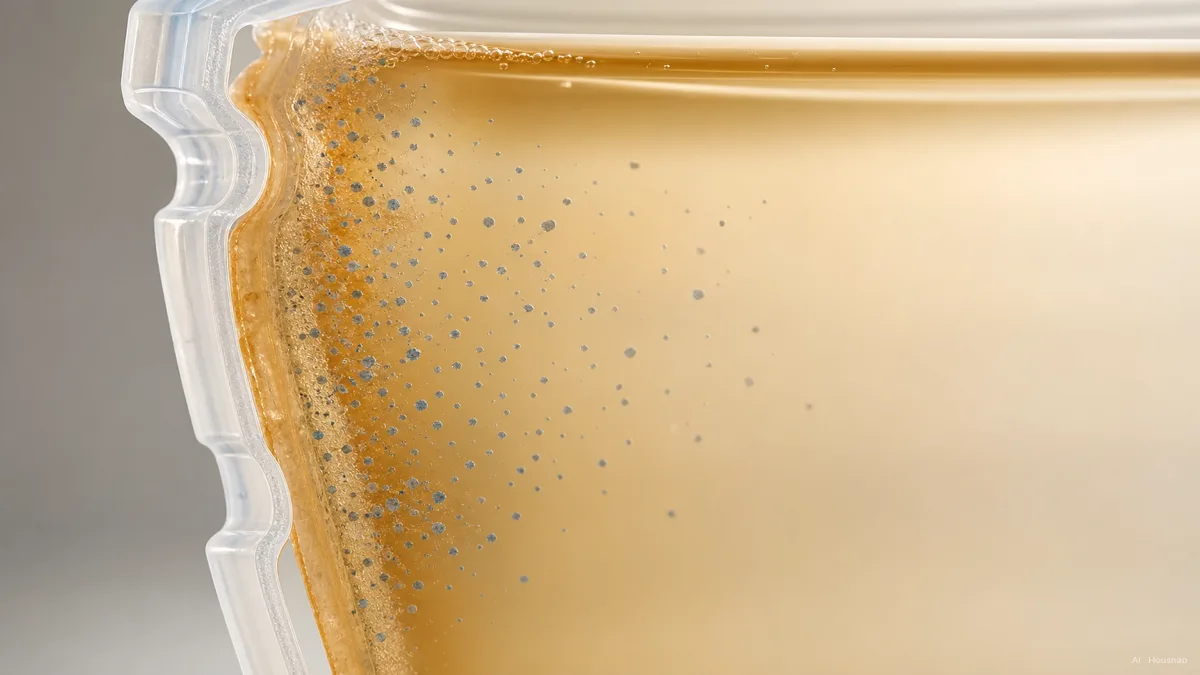
The researchers prepared formula in ten new PP bottles using the WHO's recommended steps and measured what came off the plastic. The bottles released between 1.3 and 16.2 million microplastic particles per liter of liquid. At the WHO-recommended 70°C formula temperature, release sat at the high end of that range. Sterilizing with boiling water pushed it higher still.
Two practical things fall out of that study. First, heat is the trigger. The hotter the water touching the plastic, the more particles come off, which is why boiling-water sterilization is the worst case. Second, scratches make it worse. Micro-scratches that build up inside a well-used plastic bottle give bacteria a place to hide and release significantly more particles than a smooth, new bottle.
What this does not mean is that plastic bottles are unsafe in some settled, proven way. The long-term health effect of ingested microplastics is still being studied, and millions of babies are raised on PP bottles. What it does mean is that the research gives you concrete levers: prepare formula slightly cooler where safe to do so, avoid prolonged boiling-water sterilization of plastic, and retire plastic bottles once the inside looks scratched. If avoiding the question altogether matters more to you than weight and price, that is the honest case for glass.
Glass Bottles at Home, Plastic on the Go: A Practical Split Strategy
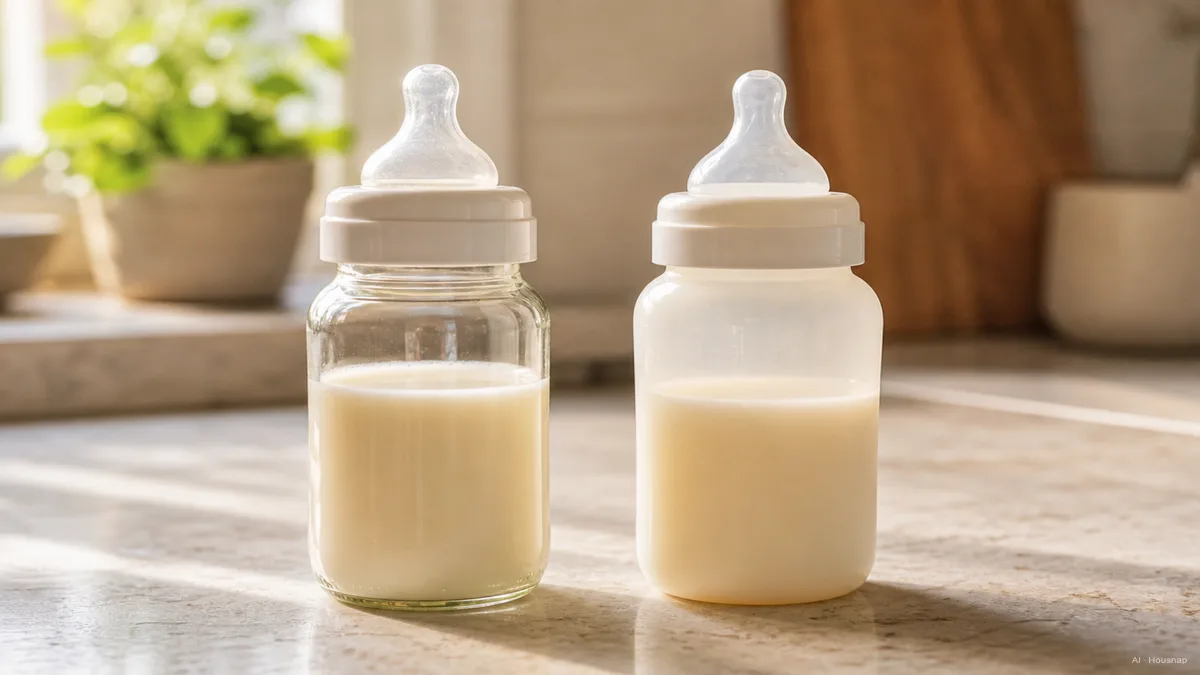
The thing nobody tells first-time parents is that you do not have to pick one material for everything. The most common setup among parents who think it through is a split: glass where it is easy, plastic where glass is a liability.
Start with weight, because it is the constraint people underestimate. A 4 oz borosilicate glass bottle weighs roughly 160 to 200 grams empty. The equivalent plastic bottle weighs 30 to 60 grams. Full of milk and held by a parent at 3 a.m., that gap barely registers. Held by a six-month-old learning to grip their own bottle, it is the difference between a baby who can self-hold and one who cannot. Heavier glass also matters in a diaper bag you carry all day.
Then there is breakage, and the place it bites hardest is daycare. Many centers simply prohibit glass bottles outright because of breakage and liability, which means that for out-of-home feeding, plastic or silicone is not a preference but a requirement. No amount of material idealism changes a daycare policy.
So the practical split writes itself. Use glass at home, where you control the floor, the routine, and the sterilizing, and where the chemical inertness pays off every feeding. Send plastic to daycare and pack it for travel, where weight and shatter-resistance are the whole point. You are not compromising on safety so much as matching the material to the room.
A small note that saves money: buy your home glass and your on-the-go plastic in the same brand line where you can, so nipples, collars, and lids interchange. Mixing brands is how people end up with a drawer of bottles that no longer have matching parts.
Reading the Label: BPA-Free, PPSU, Borosilicate, What the Terms Actually Mean
The label has gotten crowded. Here is what each word is doing.
BPA-free. Legally required on every baby bottle since 2012, so it is reassurance, not a differentiator. Treat it as a baseline. The open question lives in what replaced the BPA, which the label rarely tells you.
Polypropylene (PP). The default plastic, recycling code 5, food-grade and BPA-free. It is the lightweight, affordable, shatterproof standard, and it is the material in the microplastics study above. A perfectly normal choice with the heat and scratch caveats already covered.
PPSU (polyphenylsulfone). A premium plastic, more heat-resistant and more durable than PP, which is why it survives repeated high-temperature sterilization better. The catch worth knowing: PPSU is manufactured using BPS, one of the BPA substitutes still under early-stage safety study. So PPSU buys you durability, not a clean exit from the chemistry question.
Borosilicate glass. The good glass. It is the same thermal-shock-resistant glass used in labs, and it handles the swing from freezer to boiling water, up to around 149°C (300°F), without cracking the way ordinary soda-lime glass can. If you buy glass, borosilicate is the type that tolerates real sterilizing routines.
One label trap on glass. A consumer investigation using XRF testing found that 91% of painted or printed glass baby bottles carried detectable lead, not in the glass itself but in the exterior logo or measurement markings. The glass body is inert; the decorative paint is the risk. Plain, unpainted glass bottles sidestep this entirely, so if you go glass, lean toward minimal exterior printing.
How to Choose Your First Set: Budget, Lifestyle, and Safety Priorities
Put the chemistry aside for a second and start from how you actually live.
Budget first, because it is the most honest filter. PP is the cheapest entry point by a wide margin. A glass Dr. Brown's Options+ bottle runs roughly $10 to $14, while the comparable PP version from the same brand is around $5 to $6. Across a starter set of six bottles, that is a real gap. If money is tight, an all-PP set with careful heat habits is a legitimate, common choice, not a corner being cut.
If safety is your top priority and budget allows, glass is the cleanest answer, with one caveat: choose borosilicate, choose minimal exterior paint, and accept the weight. For most safety-first parents this is the home bottle, paired with a few plastic bottles for daycare and travel under the split strategy above.
There is also a growing third category worth knowing. Hybrid glass-lined bottles, like the Chicco Duo, put an inner glass liner inside an outer plastic shell, so only glass touches the milk while the plastic absorbs the drops. Silicone bottles are the other emerging option: soft, light, shatterproof, and free of both BPA and BPS, though they cost more than plastic and have less long-term microparticle testing behind them. Both are real choices; both are typically thinner on the shelf and pricier than mainstream PP or glass.
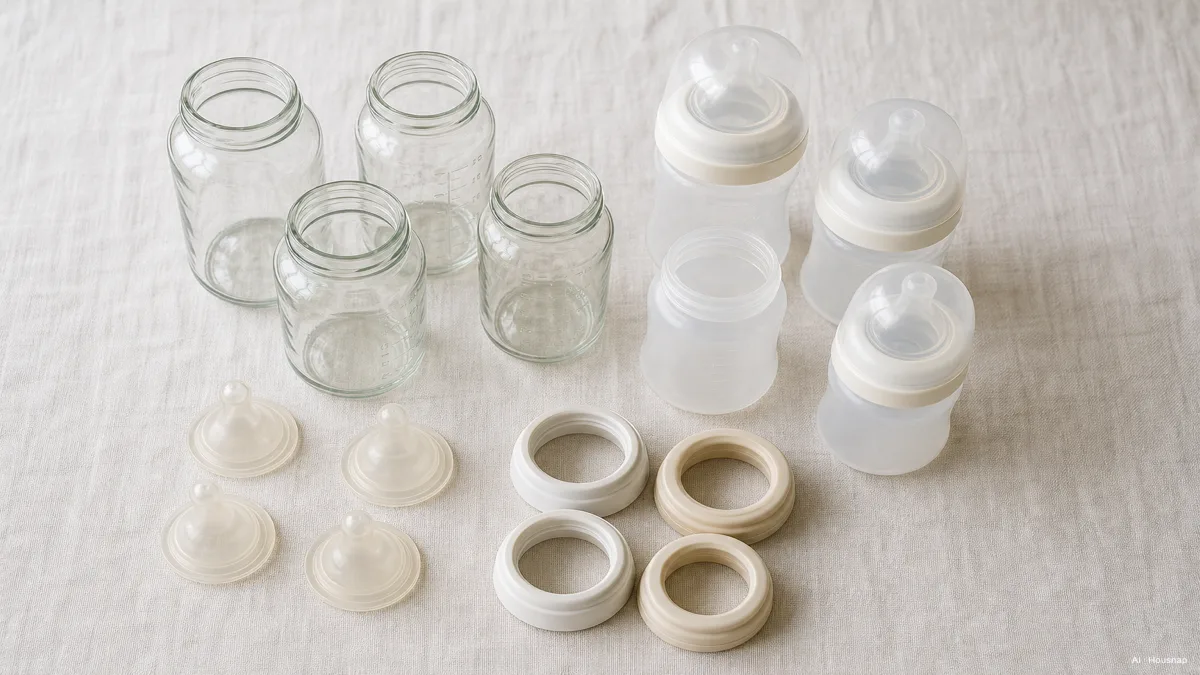
So the first-set decision, in one breath: PP if budget rules and you mind your heat and scratches; borosilicate glass at home plus plastic for daycare if safety leads; hybrid or silicone if you want a middle path and will pay for it. From here, the useful next move is to filter glass and PP bottles side by side, compare what each brand charges across stores for a starter set, and check the details that map to your answer, borosilicate versus soda-lime for glass, plain versus painted exterior, and whether parts interchange across the line. You'll find the names that show up most in baby feeding, so the comparison is concrete rather than hypothetical.
Sources
- Best Baby Bottles: Glass vs. Plastic — WebMD; the 2012 FDA BPA ban, glass versus plastic trade-offs, and why daycares often require plastic
- Microplastic release from the degradation of polypropylene feeding bottles during infant formula preparation — Nature Food (2020), Trinity College Dublin; the peer-reviewed microplastics study and its particle-release range
- High levels of microplastics released from infant feeding bottles during formula prep — Trinity College Dublin; press summary, the 82% polypropylene market share, and the role of temperature
- Baby Bottles With No Detected BPA, Lead, or Phthalates — Consumer Reports; independent contaminant testing across popular bottles
- Safest Baby Bottles Sans Lead and Microplastics — Mamavation; XRF lead testing of painted glass bottle exteriors and the 91% finding