Stand Mixer vs Hand Mixer: Which One Does Your Kitchen Actually Need
The question usually surfaces when a recipe calls for stiff bread dough, or when you've spent ten minutes holding a hand mixer over a bowl of egg whites and your arm is still not done. At that point the upgrade starts to feel obvious. But before spending $300 or more on a stand mixer, it helps to know exactly what changes and what stays the same. Both appliances mix, whip, and cream. The difference is in the kind of work each handles well, how much space and money you're willing to commit, and how often you actually bake. A home baker who pulls out the mixer once or twice a month is in a different position than someone who makes bread on weekends and layers cakes for every birthday in the family. This guide covers what each type actually does well, where the boundary is, and how to decide without overbuying.
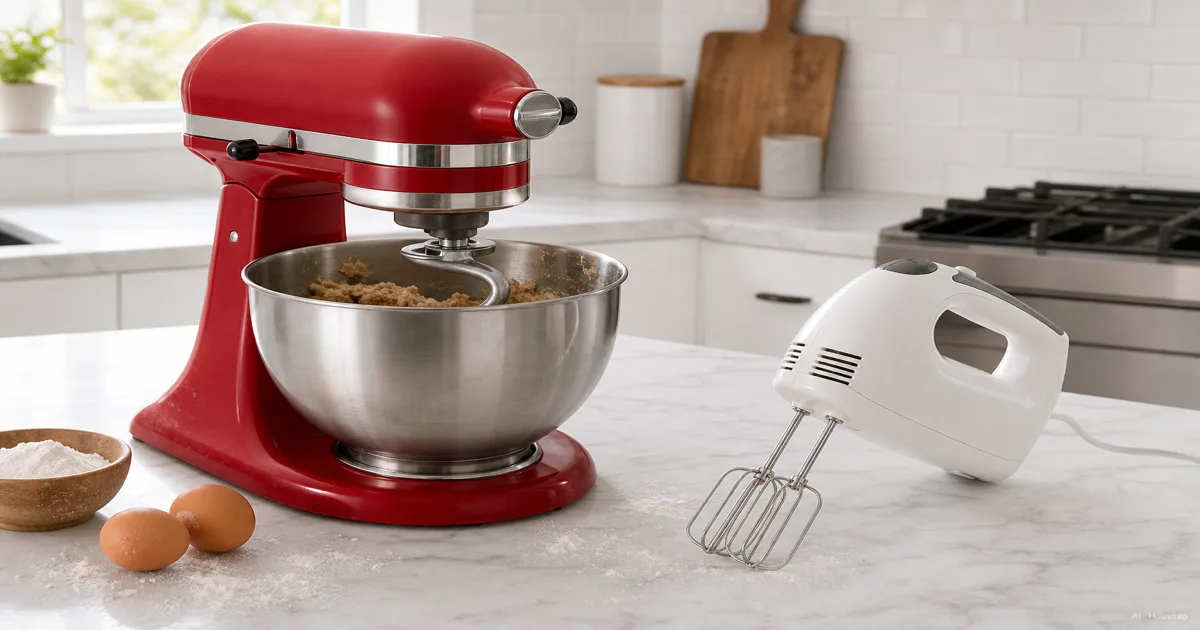
What a hand mixer does well — and where it runs out
A hand mixer is a motor mounted on a handle, with two removable beaters that spin into a bowl you hold or set on the counter. Most models run between 150W and 300W and come with three to five attachments: standard beaters, a whisk, and often a dough hook (KitchenAid hand mixer buying guide).
For most common baking tasks, a hand mixer is genuinely enough. Whipping cream, beating butter and sugar until pale, mixing cake batter, making frosting — all of these land firmly in hand mixer territory. The results are identical to what a stand mixer produces, and the cleanup is easier because there's no large bowl to wash.
Where a hand mixer hits a wall is bread dough. Stiff, elastic dough puts lateral force on the beaters that a handheld motor isn't built to sustain. You can attempt it, but the motor overheats, the dough climbs the beaters, and the experience is miserable. Stiff Italian meringue and Swiss meringue — where egg whites must be whipped continuously for eight to twelve minutes — will exhaust your arm even if the motor is fine. You're the stand.
Hand mixers also require constant attention. You hold the device throughout, move it around the bowl, and can't walk away mid-mix. That's not a problem for a three-minute butter cream; it becomes a problem when you're trying to do anything else in the kitchen at the same time.
Price range: $30 to $80 covers most home bakers well. Models at the lower end (around $30 to $45) handle light tasks reliably. For frequent use or denser batters, $50 to $80 gets you more consistent motor torque and better speed control (Consumer Reports).
What changes when you add a stand mixer
A stand mixer fixes the motor and bowl to a base and drives the attachment from above. You load the ingredients, set the speed, and walk away. This single design difference is what makes a stand mixer worth the counter space and cost for certain baking patterns.
The dough hook attachment is the clearest case. A stand mixer's hook turns bread dough for eight to ten minutes continuously, building gluten structure that hand kneading takes twice as long to develop. A 4.5-quart KitchenAid can knead dough for two standard loaves at once without stopping (KitchenAid make bread with a stand mixer). A hand mixer cannot do this at all.
The flat beater (paddle attachment) handles thick cookie doughs that would overwork a hand mixer. The wire whip builds volume faster than hand mixer beaters and can run ten minutes of meringue without anyone holding anything. Whipping stiff cream to firm peaks while you pipe and fill — that's where stand mixers earn their place in a baker's kitchen.
Multitasking is the other real advantage. With a stand mixer running, both hands are free. You can prep the next component, manage the oven, or line tins while the butter and sugar cream. That time savings compounds across a morning of baking.
Stand mixer attachments can expand beyond baking. Most KitchenAid models share a power hub that accepts pasta roller sets, meat grinders, and ice cream makers — turning the mixer into a multi-purpose base appliance (Breville hand vs stand mixer comparison).
Capacity: matching bowl size to your batch size
Stand mixer bowl sizes run from 3.5 quarts up to 7 quarts. For most home bakers, the practical range is 4.5 to 5 quarts (What size stand mixer do I need, Mirabake).
A 4.5-quart bowl handles two standard loaves of bread dough, a batch of cookies from one standard recipe, or one large layer cake's worth of batter. That covers most home baking without excess.
A 5-quart bowl adds meaningful room: enough capacity for nine dozen cookies, four loaves of bread, or large double-batch recipes in a single run. If you regularly bake for groups or double your recipes, 5-quart is worth considering over 4.5.
Six and 7-quart bowls are designed for high-volume baking — multiple-loaf bread days, caterers, or serious baking hobbyists who batch-freeze. At home, they're often more mixer than most people need, and the footprint is noticeably larger.
The Artisan-class KitchenAid (4.5 to 5 quarts) is the reference point for home baker stand mixers. That's the range where most people start, and for most, it's where they stay.
Tilt-head vs bowl-lift: the design decision that matters
Stand mixers come in two head designs, and the difference matters if you bake bread regularly.
A tilt-head mixer has a hinged top that swings back so you can swap attachments and access the bowl. The bowl locks onto pegs on the base. This design is lighter, more compact, and easier to store — some tilt-head models fit under standard cabinet shelves. Most home kitchen stand mixers, including the KitchenAid Artisan, are tilt-head (KitchenAid tilt-head vs bowl-lift).
The limitation shows up with stiff dough. When a tilt-head's attachment encounters dense bread dough, the hinge can develop a slight wobble or bounce. It's not catastrophic, but it's noticeable and can affect the evenness of kneading over a long mix.
A bowl-lift mixer has a stationary head, and a lever raises the bowl up to meet the attachment. The connection is rigid, which makes it significantly more stable for bread doughs and heavy batters. Bowl-lift models start at larger capacities (5 quarts and up) and higher prices ($500 and above). If you bake bread frequently — more than once a week — a bowl-lift is worth the extra investment. For occasional bread, a tilt-head 4.5-quart handles it fine (Prudent Reviews tilt-head vs bowl-lift).
Price reality: what you're actually paying for
A hand mixer at $30 to $80 gets you full baking capability for most tasks.
A stand mixer is a different category of spend. Entry-level off-brand stand mixers start around $70 to $100, but motor quality and durability vary significantly. The KitchenAid Artisan (4.5 to 5-quart tilt-head) runs $300 to $400 and is the standard home baker reference point — it's backed by decades of parts availability and a large attachment ecosystem. The KitchenAid Professional 600 class (bowl-lift, 6-quart) runs $500 to $700.
The used market is a legitimate option. KitchenAid stand mixers from the 1990s and early 2000s often still work. Metal gears, available replacement parts, and simple design make them resaleable and repairable. A used Artisan in good condition at $150 to $200 is a reasonable starting point if you want to try stand mixing before committing at full price.
Noise is worth mentioning. Stand mixers are significantly louder than hand mixers — the motor is fixed to the counter and vibrates the surface. If you bake early in the morning in a shared space, this is a real consideration.
Weight and space are also real. A KitchenAid Artisan weighs around 26 pounds (12 kg). It's not something you move in and out of a cabinet regularly. If you don't have dedicated counter space, a stand mixer creates friction every time you want to use it.
Which one is right for your kitchen
If you bake once or twice a month, make cakes, cookies, and quick breads, and you're working in a small kitchen or on a limited budget — a hand mixer is the right tool. It covers the work, costs a fraction of the price, and stores easily. There's no meaningful benefit a stand mixer adds for that use pattern.
If you bake weekly, make yeast breads, or regularly bake large batches for groups — a stand mixer pays for itself in time and effort within a few months. The dough hook alone changes what's feasible to make on a weeknight. Whipping meringue without arm fatigue, creaming large batches of butter without standing over the bowl — these matter when baking is a regular practice.
Bread is the clearest dividing line. If you want to bake yeast bread regularly, a stand mixer is not optional — it's the right tool for the job. A hand mixer cannot substitute.
Having both is also reasonable. A hand mixer is useful for small tasks where pulling out the stand mixer is unnecessary — frosting a single layer, whipping a cup of cream, mixing a small batch of muffin batter. Many bakers who own a stand mixer still reach for the hand mixer regularly.
Sources
- Your guide to hand mixers vs. stand mixers — KitchenAid
- Hand mixer vs. stand mixer — Breville
- Mixer Buying Guide — Consumer Reports
- Bowl-lift vs. Tilt-head stand mixer — KitchenAid US
- What Size Stand Mixer Do I Need? — Mirabake