
Nu verkrijgbaar bij één winkel
Deze producten zijn momenteel elk bij één winkel verkrijgbaar. Prijsvergelijking opent zodra meer winkels zijn toegevoegd.

Choose the attention you want to give it
You don't have to earn your first watch by choosing the more involved mechanism. Start with a practical question: would winding and setting it feel enjoyable, or like another job before leaving home?
- Choose quartz for convenience. Put accurate time and less frequent adjustment ahead of interest in the mechanism.
- Choose automatic for the mechanism itself. Keep it on your shortlist if you want a mechanical watch and accept the extra interaction.
- Wear a watch only occasionally? Start by comparing quartz options. If you prefer an automatic, include restarting it in your decision rather than assuming it will always be running.
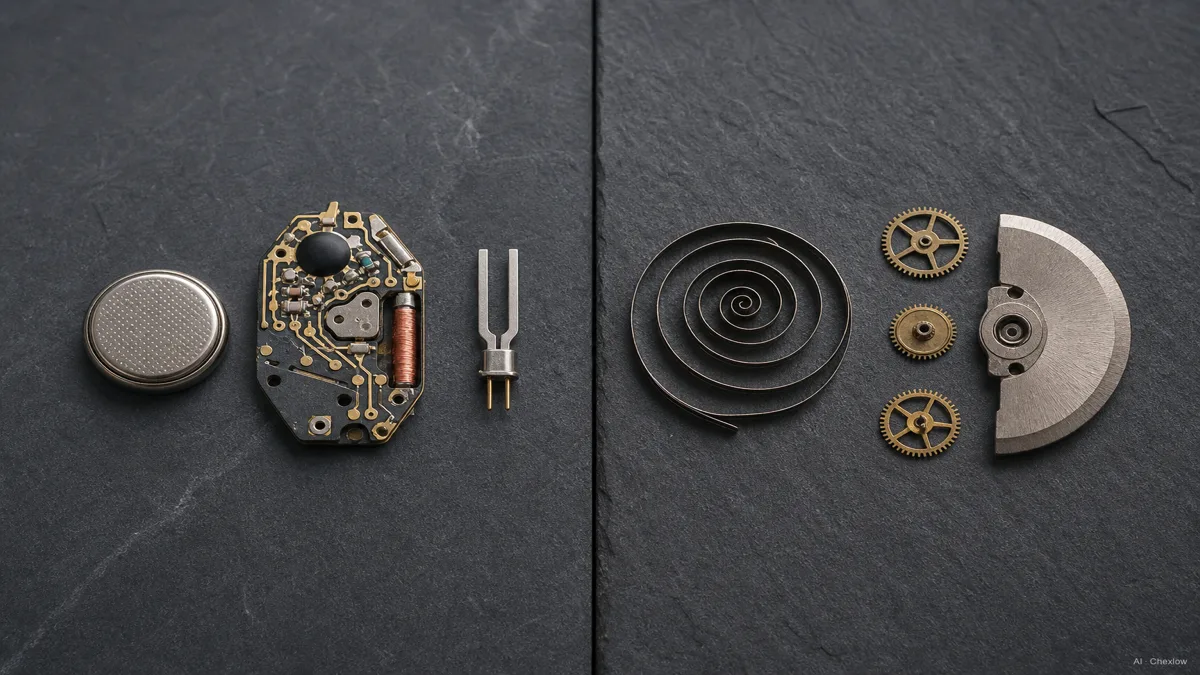
The illustration shows the useful distinction: quartz uses a crystal and electronic circuitry for timekeeping; a conventional mechanical automatic stores energy in a wound spring. Seiko documents the electronic components in its 3X22 quartz specifications, while its 4R instructions explain how arm movement winds the mainspring. Those 4R movements also allow winding by hand. “Automatic” describes winding, not automatic correction of the time.
Compare the units, then check your weekend
An accuracy figure is incomplete without its time unit. These two manufacturer specifications show why that matters:
- Quartz example. Seiko's SUR468 with caliber 6N52 is rated at ±15 seconds per month.
- Automatic example. Seiko's SCVE061 with caliber 4R35 is rated at −35 to +45 seconds per day.
These are specifications for those references, not averages for every quartz or automatic. If regular time correction would annoy you, use the stated tolerance to eliminate candidates before comparing their appearance.
Then check power reserve, the running time available from a fully wound spring. The SCVE061 specifies approximately 41 hours. Friday at 18:00 to Monday at 08:00 is 62 hours, so that reserve cannot cover the whole break without further winding. A different movement may offer a longer reserve; check its own specification rather than assuming all automatics stop after two days.
For a first automatic, decide whether restarting after a break is acceptable before adding a watch winder to your shopping list.
Ask about servicing before deciding your budget
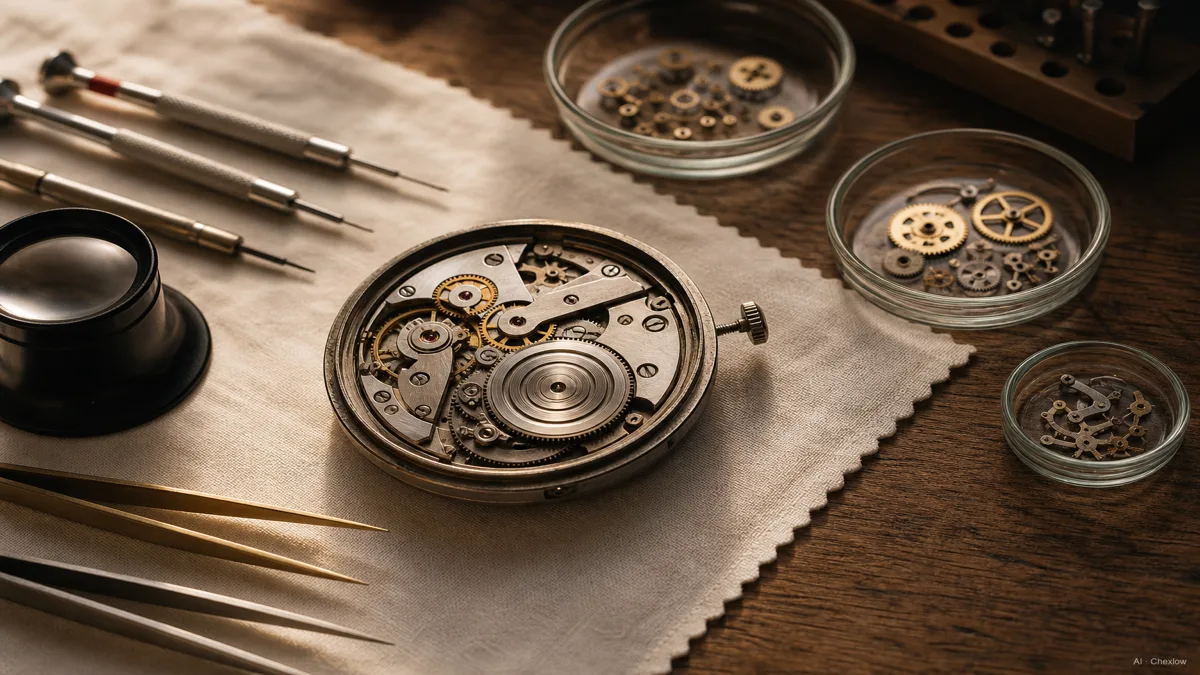
The bench illustrates professional movement servicing, not a tool kit you need to buy. Seiko describes inspection, cleaning and lubrication, with service frequency affected by conditions. It also warns that water resistance is not permanent. Follow the guidance for your chosen watch rather than applying one service interval to every movement.
For conventional battery-powered quartz, ask what battery replacement includes. Citizen advises using a watch shop or authorized service center; opening the case yourself can admit debris or compromise water resistance.
If battery changes are your main objection, consider light-powered quartz. Citizen Eco-Drive converts light into energy. Its rechargeable cell does not need routine replacement, but Citizen's maintenance guidance still calls for servicing. Check the model's charging instructions before choosing it.
Before paying, request a model-specific service estimate and ask about parts, water-resistance checks and where repairs are handled. Compare those answers with your ownership budget. Neither movement label alone promises a lifetime of repairability or makes a watch disposable.
Check the exact reference, then choose fit and style
Use the reference number and manufacturer's movement description to identify the watch. A smooth seconds hand is not enough: Grand Seiko Spring Drive combines mainspring power with quartz regulation and a gliding hand. It needs its own assessment rather than being treated as a conventional mechanical automatic.
For each remaining candidate, make three checks:
- Operation. Read its instructions for restarting, winding and setting the date. Ask for a demonstration if the crown positions are unclear.
- Ownership. Confirm that its accuracy tolerance, time away from the wrist and service arrangements suit you.
- Wearability. Try it on, move your wrist and check it with the sleeve you normally wear. Keep a comfortable watch ahead of a movement you admire in an uncomfortable case.
If case dimensions are the remaining uncertainty, use the watch case size and wrist-fit guide. If you're deciding between a sporty watch and a slimmer formal style, continue with dive watch versus dress watch for a first purchase. These are the next decisions once the movement's everyday demands make sense to you.
Hoe deze gids is opgebouwd
This guide was written by AI for Housnap, using Seiko specifications and instructions, Citizen maintenance and Eco-Drive documentation, and Grand Seiko's explanation of Spring Drive. It turns those sources into a first-purchase comparison of attention, accuracy and ownership requirements; the selection advice is editorial judgment, not a product test.