Instant-Read Thermometer, Probe vs. Infrared and What to Check Before Buying
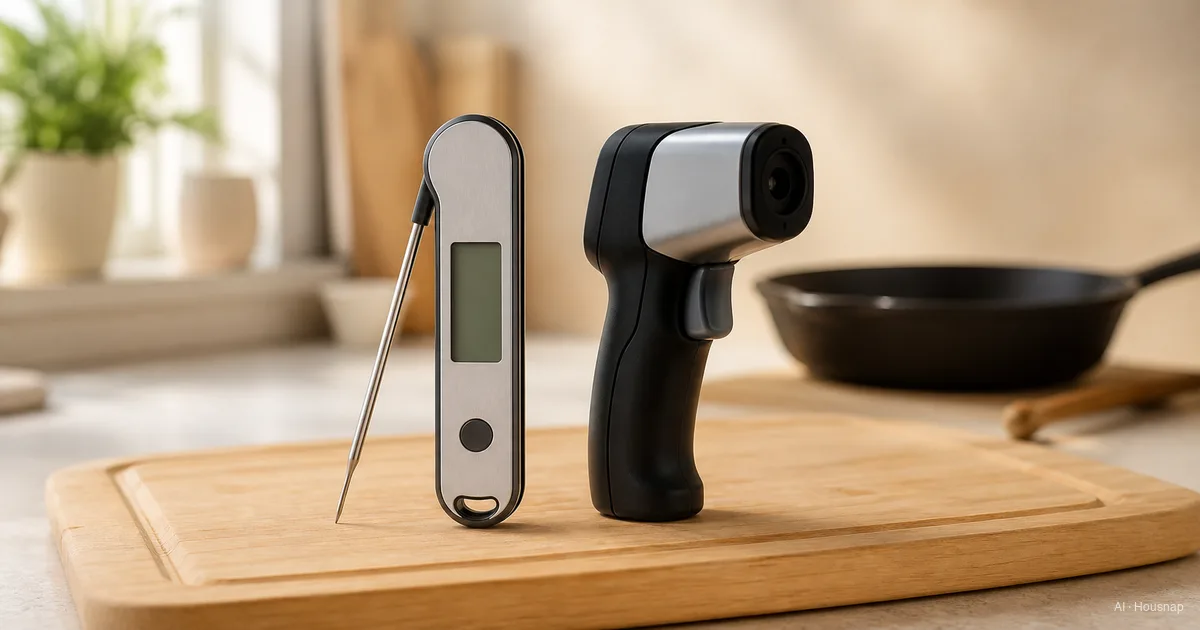
A thermometer is the one tool in a kitchen that turns guesswork into measurement. You can learn to judge a steak by touch, but you cannot learn to sense the exact temperature of chicken thigh near the bone, or know whether your sugar syrup is at soft-ball or hard-crack stage, without a number. The problem is that not all instant-read thermometers read the same thing in the same way, and buying the wrong type means the tool sits in the drawer after the first use that did not work out. The core choice is between a probe thermometer, which measures temperature by inserting a metal tip into food, and an infrared thermometer, which reads surface temperature from a distance without contact. These are not two versions of the same tool. They are different instruments that answer different questions. Understanding which question you are trying to answer is what makes the difference between a thermometer you use every day and one that disappoints you the first week. Beyond type, the temperature range and response time printed in the specification sheet determine which cooking tasks the tool can handle. A thermometer that reads to 200°C and takes five seconds to stabilize is not suitable for candy work. One with a two-second response time and waterproof housing will survive real kitchen use in a way that a non-waterproof model will not. These details are worth understanding before opening your wallet.
Nu verkrijgbaar bij één winkel
Deze producten zijn momenteel elk bij één winkel verkrijgbaar. Prijsvergelijking opent zodra meer winkels zijn toegevoegd.
Most people buy a thermometer when they overcook a piece of meat and decide they have had enough of guessing. That is a perfectly reasonable moment to buy one, but the purchase decision made in that moment tends to be rushed, and a rushed purchase is how people end up with a thermometer that works for meat but nothing else.
What "instant-read" actually means
Instant-read is a marketing term, not a specification. The phrase refers to thermometers designed to give a reading quickly as opposed to leave-in thermometers that stay in the food throughout cooking. But "quickly" is not "instantly," and the variation between models is significant enough to matter.
The specification you are looking for is response time: how many seconds it takes for the display to settle on a stable reading after the probe contacts the food. Good probe thermometers fall in the two-to-three second range. Budget models may take five to seven seconds, which is long enough that your hand will drift slightly, pulling the probe away from the hottest or coolest point you were trying to measure (Kenji López-Alt, The Food Lab, Serious Eats).
A true instant-read thermometer also requires that you leave the probe in the food for long enough to get an accurate reading. The "instant" part means the display responds quickly once the thermocouple at the tip reaches the food's temperature — not that a one-second touch tells you everything. Technique: probe in, wait for stabilization, read, pull.
Thermocouple thermometers are faster than thermistor designs, common in cheaper models. The thermocouple's junction sits right at the probe tip, allowing fast response. Thermistors measure temperature at a point slightly behind the tip, introducing error if the probe is not fully inserted.
Probe (insertion) vs. infrared: when each type is right
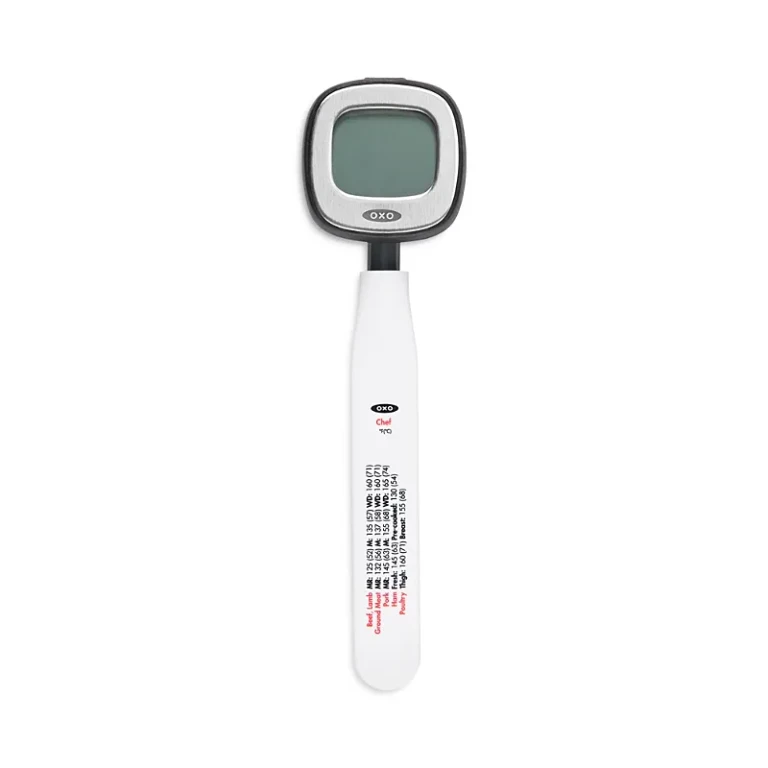
A probe thermometer measures the temperature at the tip of a metal rod inserted into food. This is the tool for internal temperature: center of a steak, thickest part of a chicken breast, inside of a loaf of bread, butter you are bringing to room temperature, custard at the moment of pulling from heat.
An infrared thermometer measures surface temperature from a distance without contact. It reads infrared radiation emitted by any surface above absolute zero. This is the tool for checking whether a pan is hot enough before adding food, whether a pizza stone is at temperature, whether a griddle has hot and cool spots (The Best Instant-Read Thermometers, America's Test Kitchen).
What an infrared thermometer cannot do is measure internal temperature. Infrared reads only the first few micrometers of a surface. A chicken breast that reads 75°C on the surface may have a center temperature of 55°C. Relying on an infrared reading to judge doneness of thick proteins is dangerous and inaccurate.
The two tools complement each other in a well-equipped kitchen. If you have to choose one, choose the probe thermometer. Internal temperature is the measurement that determines food safety and doneness.
Temperature range matters for what you cook
Every thermometer has a rated range. For meat alone, 0°C to 200°C is enough. But cooking extends beyond meat.
Candy and sugar work requires reading temperatures up to 115°C for soft-ball stage and close to 150°C for hard-crack. The critical issue is accuracy and stability at those temperatures, which change quickly during sugar cooking. Deep-frying oil reaches 175°C to 190°C. Caramel work reaches 170°C. Tempering chocolate requires precision at 28°C to 32°C — a range where one decimal place matters. Bread baking requires readings of around 93°C to 99°C at the crumb's center (How to Calibrate a Thermometer, Serious Eats).
If you plan to do any of these tasks, a thermometer rated to at least 250°C and accurate to within one degree across that range is worth the additional cost.
The lower end of the range matters for cheesemaking (milk warming to 30–35°C) and tempering chocolate. A thermometer that bottoms out at 0°C covers these uses.
Waterproofing, storage, and everyday durability
A thermometer that lives in a kitchen will get wet. Steam will condense on it. Sauce will splash. You will rinse it after testing raw chicken. A probe thermometer that is not rated as waterproof will fail when any of these happens.
The waterproof rating you are looking for is IP67 or better. IP67 means the device can be submerged in up to one meter of water for thirty minutes without damage. This means rinsing the probe under a running tap is completely safe (What is IP67 waterproof rating, Wirecutter).
Storage matters more than most buyers consider. Many probe thermometers fold in half — the probe folds back into the body when not in use, protecting the tip, reducing stored length, and often activating the auto-off function when folded. This design is far better for daily use than a thermometer with a fixed probe that needs a separate cover.
Battery life is rarely a problem if the thermometer has an auto-off feature. Models that power on when the probe is opened and power off when it is closed are well-designed for how kitchens actually work.
Calibration and testing accuracy
The number a thermometer displays is only as useful as its accuracy. Most quality instant-read thermometers are accurate to within ±1°C out of the box. Cheaper models may drift after a few months.
The simplest way to check accuracy is the ice water test. Fill a glass with ice, add cold water until the ice is floating, stir for thirty seconds, and insert the probe. A calibrated thermometer should read 0°C within plus or minus one degree. If it reads 2°C, it reads two degrees high across the entire range — you can compensate for that. If it reads 5°C, the thermometer needs replacement or recalibration (How to Calibrate a Thermometer, Serious Eats).
A boiling water test at sea level confirms calibration across a wider range, but atmospheric pressure affects boiling point. At 1,000 meters altitude, water boils closer to 96°C than 100°C.
Some thermometers have a calibration adjustment feature. This is useful for minor drift correction, not for fixing a fundamentally poorly calibrated sensor.
Quality signals when buying
Response time is the most meaningful technical specification. Two seconds or faster means the display is useful when you are holding the probe in meat at the grill. Five seconds means you are waiting and the reading is less reliable.
Probe length matters for what you are measuring. A probe shorter than 10cm cannot reach the center of a large roast. Most quality models have probes of 11 to 15cm. Longer probes are useful for deep-frying, where your hand needs to stay far from hot oil.
Backlit displays are useful in kitchens. A display that is readable in low light, and especially one that auto-rotates so you can read it whether the probe is pointing up or down, saves real effort during cooking.
Auto-off and IP67 waterproofing are the two practical durability features. A thermometer that dies because someone left it on after cooking, or fails after six months because steam got inside, is not useful regardless of its other specifications.
What a meat thermometer cannot do that a candy thermometer can
A standard clip-on candy thermometer does something an instant-read probe thermometer cannot: it stays in the liquid continuously while you cook. When making caramel or hard candy, the temperature climbs steadily toward the target and you need to act at the right moment. If you have to pull out an instant-read probe every thirty seconds to check, you are letting heat escape and introducing delay.
A clip-on candy thermometer attaches to the side of the pot, hangs its probe in the syrup, and gives continuous readings without interruption. Traditional glass candy thermometers are less accurate than a good instant-read probe model. Newer digital candy thermometers that clip onto pots address the accuracy problem and offer continuous digital readings.
The practical answer for most home cooks: a good instant-read probe thermometer handles meat, poultry, fish, bread, and most common cooking tasks. If you make candy, jam, or caramel more than occasionally, a dedicated candy thermometer that can stay in the pot is worth owning as a second tool.
Sources
- Kenji López-Alt, The Best Instant-Read Thermometers, Serious Eats — head-to-head testing of response time, accuracy, and usability
- The Best Instant-Read Thermometers, America's Test Kitchen — equipment testing focused on real cooking tasks
- How to Calibrate a Thermometer, Serious Eats — ice water and boiling water calibration methods
- Thermometer, Wikipedia — instrument types, thermocouple vs. thermistor comparison