Check what your fan actually lets you remove
Dust behind the grille does not mean the whole fan needs taking apart. Find the cleaning instructions for your exact model and check two permissions separately: what can come off, and what can get wet. A removable grille does not automatically mean removable or washable blades.
Switch off and unplug before starting. Honeywell Store’s TurboForce tutorial explicitly starts with unplugging before grille removal.
Vornado’s tutorial is for the 660: it removes the front grille and wipes the blades in place. It calls for a long Phillips screwdriver, but that does not establish the correct tool, screw count or opening method for your fan. Use a screwdriver only where your model’s user-cleaning instructions require it, and reuse one that already fits.
If the instructions do not authorize blade removal, leave the blades attached. If the opening method is unclear or a part will not release as described, stop and ask the maker rather than opening the motor housing.
Wipe first; rinse only the specified detached parts
A soft cleaning cloth is the useful starting tool. You do not need a new kit if you already have a suitable cloth. The Vornado 660 tutorial says a dry cloth is sufficient, with dampening optional; it also describes wiping the inside and outside of the grille. Honeywell’s tutorial likewise cleans both sides of the removed grille.
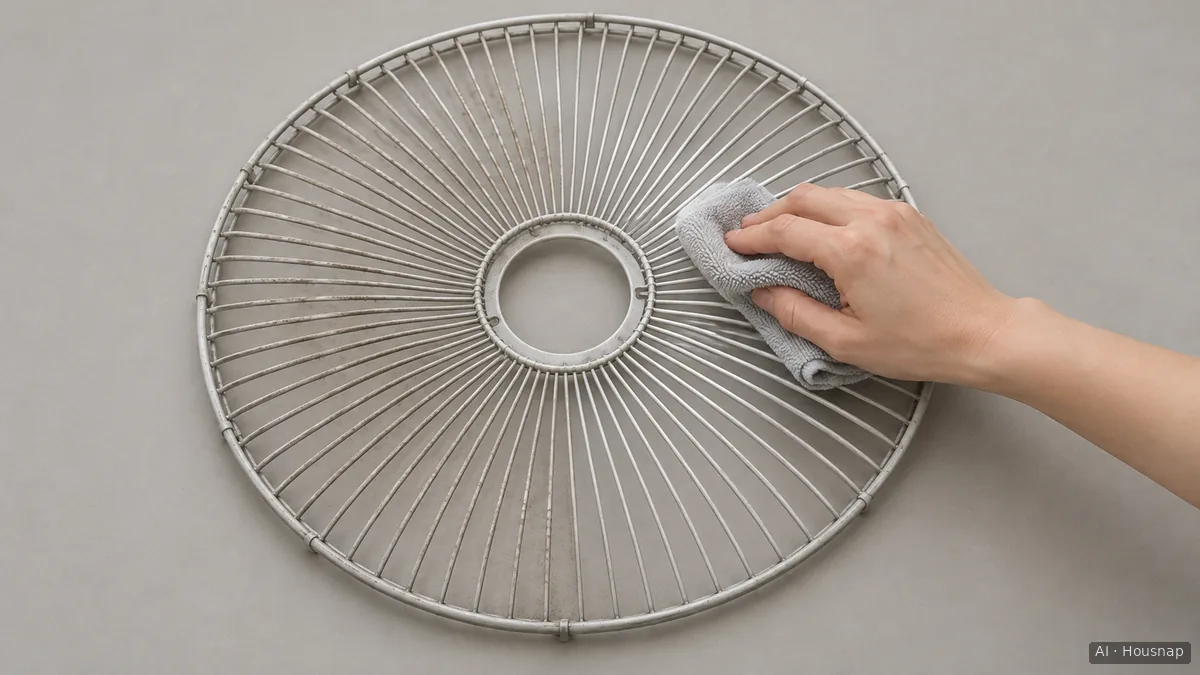
The illustration shows wiping a detached grille, not how to remove it or whether your model permits washing. Follow the same part-by-part distinction when cleaning the blades.
DREO’s guide naming CF315 and CF312 makes the distinction concrete:
- Wipe the outer surface with a soft, dry cloth.
- After the specified removal steps, clean the cap, blades and grille under running water or with a clean, damp cloth.
- Do not immerse the fan or let water enter the motor housing, and avoid chemical cleaning agents.
Those rinsing instructions apply to the parts covered by that guide. Do not extend them to an assembled fan or to another model simply because its grille comes off. If your own instructions specify wiping only, keep to wiping.
Dry the parts, then complete reassembly
DREO requires all cleaned parts to be dried before reinserting the blade assembly. Leave power disconnected while drying and reassembling; this guide does not assign a universal drying time.
Use your model’s assembly instructions for blade orientation, any retaining cap and the grille fasteners. The DREO guide describes a particular shaft alignment, while Honeywell’s TurboForce tutorial describes a grille notch and screws. Neither is a universal fastening sequence.
Before reconnecting power, check that every part you removed has been refitted and the grille is secured as the manual specifies. Honeywell explicitly places reconnection after secure grille attachment. Do not run the fan with the grille off to check your cleaning work.
Know when cleaning is finished—and when to stop
For this guide, visible damage, a missing fastener or a grille that will not attach correctly is the point to stop home cleaning and contact the maker. A remaining fault is not a reason to dismantle the motor housing or keep removing parts.
If cleaning and correct reassembly are complete but the fan still behaves abnormally, leave further diagnosis to model-specific support. If you subsequently decide to replace it, or discover that the airflow does not suit how you use the room, continue with choosing between a fan and an air circulator. Dust alone is not a reason to buy another machine.
Hoe deze gids is opgebouwd
AI wrote this guide for Housnap using Vornado Australia’s 660 tutorial, Honeywell Store’s TurboForce instructions and DREO’s CF315/CF312 cleaning article. It distinguishes model-specific removal and washing permissions from the editorial boundary of user cleaning only. No hands-on product testing was performed.