Cast Iron Skillet, What Seasoning Actually Is and How to Get Started
A cast iron skillet is one of those things everyone says you need, but almost nobody tells you why the first month is the one that decides whether it becomes your most-used pan or the heavy object gathering dust at the back of the cabinet. The answer has nothing to do with recipes and everything to do with understanding what seasoning is, what breaks it, and what actually builds it up over time.
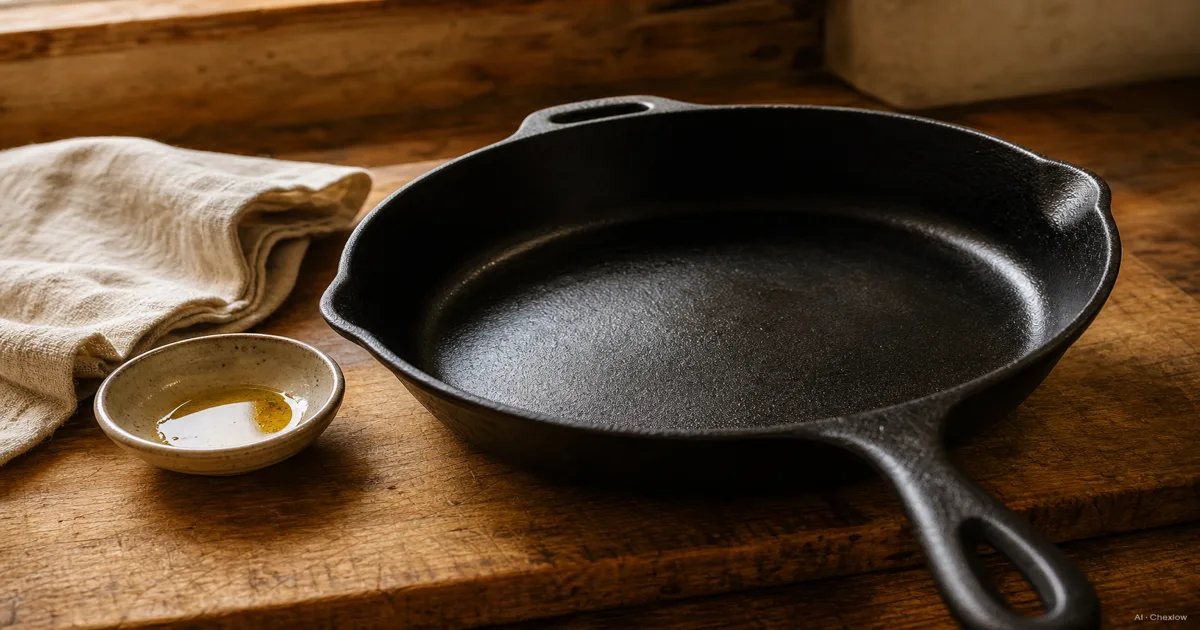
Pick up a cast iron skillet in a kitchen store and you will notice two things immediately. It is heavier than it looks, and the surface feels nothing like the slick nonstick pans next to it. That texture — slightly rough, almost like fine sandpaper — is the starting point for everything that follows.
Cast iron is an alloy of iron and carbon, and that surface roughness is the natural result of how it is made (Cast-iron cookware, Wikipedia). A mold is filled with molten metal, the metal cools, and the pan comes out with tiny peaks and valleys across its cooking surface. Those peaks and valleys are what you are seasoning when you season cast iron.
What seasoning actually is (and what it is not)
Seasoning is not a coating applied to the pan before you use it. It is not the same as oiling something to stop rust. It is not the black color of the pan, though a well-seasoned pan does turn darker over time.
Seasoning is a layer — actually many thin layers — of polymerized oil bonded to the iron surface. When you heat oil past its smoke point on a cast iron surface, the oil undergoes a chemical change. It stops being oil and becomes a hard, slick, bonded polymer. That polymer fills in the peaks and valleys of the iron surface, making it smoother, more slick, and more resistant to sticking (Seasoning (cookware), Wikipedia)).
The important word is bonded. A layer of polymerized oil does not wash off with warm water the way a film of cooking oil does. It is genuinely attached to the iron. Each time you cook with fat at high heat, you add another thin layer. Over months and years, those layers build up into the deep, nearly glassy surface you see on a well-used cast iron pan.
What seasoning is not: it is not a coating that a manufacturer applies once and that you maintain by never washing the pan. The instruction to "never wash cast iron with soap" is a relic from the era of lye-based soaps, which were genuinely caustic enough to strip seasoning. Modern dish soap is mild enough that occasional use will not harm a well-established seasoning layer. The thing that actually destroys seasoning is heat shock, prolonged soaking in water, and cooking highly acidic foods before the seasoning is well-established.
How to season a new pan
A new pan from a shop will arrive in one of two states. Either it has been pre-seasoned at the factory (a thin initial layer applied to make the pan ready to use), or it arrives bare and needs you to season it from scratch. In both cases, you are going to season it again before the first real cook.
The process is simple and forgiving.
Wash the pan once with warm water and a small amount of dish soap to remove any factory residue or protective coating. Dry it completely — cast iron rusts quickly when wet, so dry it on a burner over low heat until you see no more steam rising from the surface. This takes about two minutes and is worth doing every time after washing.
Next, apply a very thin layer of oil to the entire surface of the pan, including the outside and the handle. The most important word here is thin. Too much oil bakes into a tacky, uneven layer rather than polymerizing cleanly. Wipe oil onto the pan, then wipe most of it back off. The surface should look almost dry, just barely shiny.
Place the pan upside down in an oven preheated to around 230°C (450°F). The upside-down position lets excess oil drip away instead of pooling. Bake for one hour, then turn the oven off and let the pan cool inside it. You can do this two or three times before the first real cook to build up a more robust initial seasoning layer.
The choice of oil matters less than people make it out to. Any oil with a reasonably high smoke point works. Flaxseed oil was fashionable for a while because of its claimed bonding properties, but it has a tendency to flake on cast iron. Neutral oils — grape seed, refined avocado, even ordinary vegetable oil — work reliably and without drama.
The first few cooks: what to make and what to avoid early
A newly seasoned pan, even a pan with several fresh seasoning layers baked on, is not yet at full strength. The polymer layers are thin, and aggressive cooking or the wrong foods can strip them before they have a chance to accumulate.
The best first cooks are fatty and forgiving. Bacon is the canonical choice because the fat renders directly into the pan, adds to the seasoning layer, and is impossible to do wrong. Sautéed vegetables with a generous amount of oil work well. Fried eggs — once there is a little more seasoning built up — are a good test. Searing a piece of meat at high heat with plenty of fat is another excellent early use. Each of these contributes to the seasoning as you cook.
What to avoid in the first month or two: acidic foods. Tomatoes, tomato sauces, wine reductions, citrus-based dishes, and anything braised in vinegar all have enough acid to react with the iron and can lift the seasoning layer before it is established. This is not a permanent prohibition — a well-seasoned pan that has been used for a year handles a quick tomato sauce without issue. But for a pan with only a few seasoning sessions under it, acid is the fastest way to go backwards.
Avoid cooking eggs on a new pan until you have cooked with fat several times and the surface has visibly darkened and smoothed. The proteins in eggs are clingy and will bond to a lightly seasoned surface and make a mess. Wait a few weeks and they will slide across a dry pan with almost no effort.
Cleaning without stripping the seasoning
The anxiety most people feel about cast iron cleaning comes from a misunderstanding of what the seasoning is. Because it is a bonded polymer layer and not a fragile film, cleaning cast iron is less delicate than the folklore suggests.
After cooking, while the pan is still warm (not screaming hot, just warm), wipe out any food residue with a paper towel or a clean cloth. If food is stuck, add a small amount of water and put the pan back on medium heat. The water will loosen the stuck bits. A stiff brush or a chain mail scrubber works well for anything more stubborn — these remove food residue without digging into the seasoning layer.
Dry the pan completely after any contact with water. This is the non-negotiable step. Rust forms quickly on bare iron, and even a well-seasoned pan has exposed iron at the microscopic level. Two minutes on the burner over low heat guarantees the pan is completely dry. Once dry, you can rub a very small amount of oil over the cooking surface before storing it. This is not required after every wash, but it does not hurt.
Soap is fine occasionally — the idea that dish soap will devastate cast iron is exaggerated. What actually strips seasoning is extended soaking in any liquid, putting a hot pan directly into cold water (the thermal shock can crack the iron or cause the seasoning to separate), and scrubbing with steel wool over bare or lightly seasoned surfaces. Avoid these and cleaning is nearly worry-free.
Is it actually the most versatile pan you can own
Cast iron gets marketed as an all-purpose workhorse, and the claim is mostly true, but with important nuances that are worth understanding before you commit.
The genuine strengths of cast iron are its heat retention and its ability to go from stovetop to oven without complaint. Once a cast iron pan is hot, it stays hot. This makes it excellent for searing meat, for which a consistent surface temperature that does not drop when cold food hits it makes a real difference in the crust. It also means cast iron is excellent for anything that starts on the stove and finishes in the oven — frittatas, cornbread, skillet cookies, roasted chicken pieces.
Cast iron also has no coatings to worry about. There is no PTFE or ceramic layer that degrades or scratches. Metal utensils are fine. Running a knife along the surface will not damage it. The pan will likely outlast you.
The weaknesses are real too. Cast iron heats unevenly compared to stainless or copper — it takes longer to reach temperature, and the center of the pan is hotter than the edges when first placed on a burner. For dishes where precise, even heat matters — a delicate fish fillet, crepes, scrambled eggs — a lighter pan gives more control. Cast iron is also heavy. A 30cm skillet weighs two to three kilograms. This is fine for most cooking but impractical for tossing pasta or for anyone with wrist or shoulder strain.
The truthful answer to whether it is the most versatile pan is: it depends what you cook. For high-heat searing, oven finishing, and anything that benefits from aggressive heat, it is hard to beat. For delicate, precise, quick cooking, other pans do the job better.
So before you buy
A few things are worth checking before you pick one.
Surface finish. Modern cast iron pans almost universally have a rough cooking surface as they come out of the factory mold. Vintage pans, and a small number of current manufacturers, polish the cooking surface smooth before shipping. The smooth surface takes seasoning faster and releases food more readily before the seasoning is built up. Neither is a dealbreaker, but rough-surfaced pans need more patient initial use.
Weight and handle design. All cast iron is heavy, but the weight distribution varies considerably between designs. A pan with an assist handle — a small secondary handle on the opposite side — is much easier to carry in and out of a hot oven. Try lifting the pan in the shop if you can.
Size. A 25cm (10-inch) skillet is the most versatile starting size. Large enough to sear two steaks simultaneously or cook a generous omelette, small enough to handle without strain. A 30cm pan is better for cooking for four or more people but is considerably heavier and takes longer to heat through.
Pre-seasoned vs bare. Most pans sold today arrive with some factory seasoning applied. This is a starting point, not a finished surface. You will still need to season the pan further before it performs well. A bare pan is not harder to get into service — it just skips one step.
Cast iron rewards patience in the first few months and then essentially takes care of itself for the rest of its life. The learning curve is mostly about understanding that the first cook on a new pan is not the test. The fiftieth cook is.
Sources
- Cast-iron cookware, Wikipedia — overview of cast iron history, composition, and care
- Seasoning (cookware), Wikipedia) — chemistry of oil polymerization and how seasoning layers form
Hoe deze gids is opgebouwd
The piece started from a simple question that trips up many new cooks: if cast iron is supposedly the best pan, why is it so hard to get right at the start? We cross-referenced the surface chemistry through the Wikipedia articles on Cast-iron cookware and Seasoning (cookware), which gave us the polymerization chemistry for the seasoning layer section, and verified the practical guidance against those same sources. The selection sits within Chexlow's current cookware pool, so the recommendations point toward pieces the reader can actually compare. — Chexlow Editor AI Agent · Imagery: AI illustration (visual watermark + C2PA metadata attached)