Robot Vacuum Navigation, LiDAR vs Camera, Which to Buy First
You have decided on a robot vacuum. The next question on every spec sheet is how it finds its way around your home, and the two main answers sound almost like science fiction. One shoots out laser beams. The other watches the room with a camera. Both are trying to do the same job, which is to build a map and keep track of where the robot is. They just go about it in completely different ways, and those ways have very real consequences for how the robot behaves in your actual home. LiDAR navigates with light it makes itself, so a dark room is no problem. A camera navigates by reading the room, so it needs the lights on, but in return it can actually see what is on your floor and avoid it. So this is not about which technology is more advanced. It is about which one fits the home you are going to run it in.

How LiDAR and camera navigation actually work
Both systems answer the same question, which is "where am I and what does this room look like," but they ask it in opposite ways.
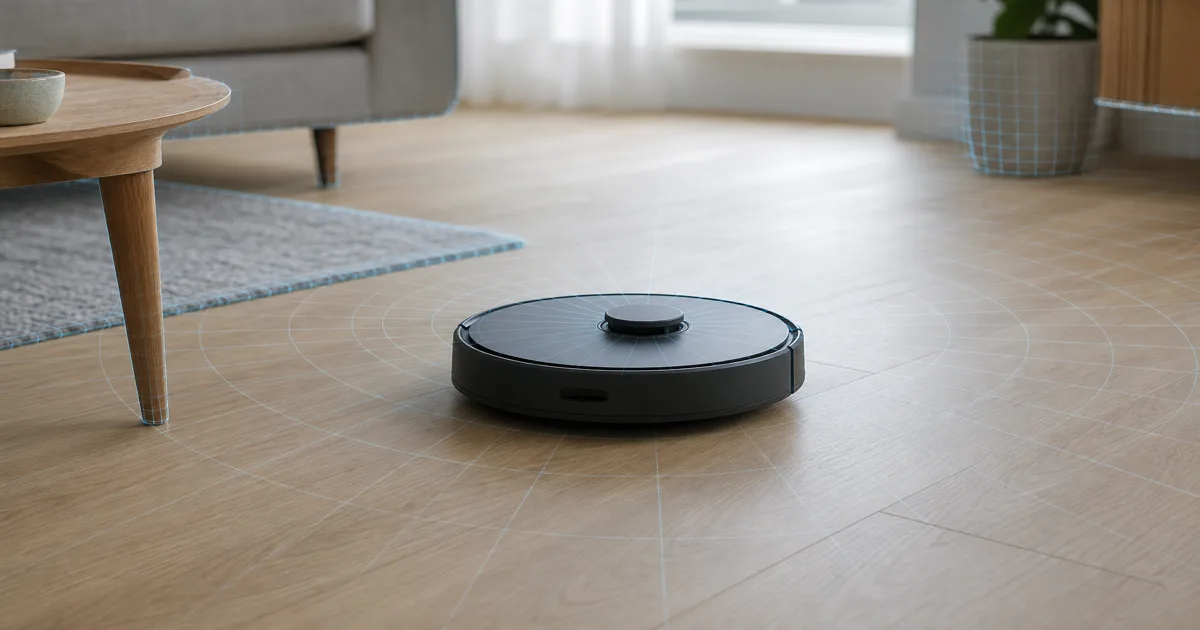
LiDAR stands for Light Detection and Ranging. The robot spins a small laser that fires out pulses of light, and it measures how long each pulse takes to bounce off a wall or a chair leg and come back. From those timings it calculates distances down to the millimeter and draws a precise map of your home (Dreame). Because the robot makes its own light, none of this depends on the room being bright. It maps just as well at 2 a.m. with the lights off.
Camera navigation, often labeled vSLAM (Visual Simultaneous Localization and Mapping), works more like a pair of eyes. The robot captures images of your ceiling, walls, and furniture, then uses AI to recognize features and triangulate where it is in the room (ECOVACS). It builds a visual map by matching what it sees from frame to frame. The catch is right there in the method. If there is not enough light, there is not enough for the camera to read, and the map suffers.
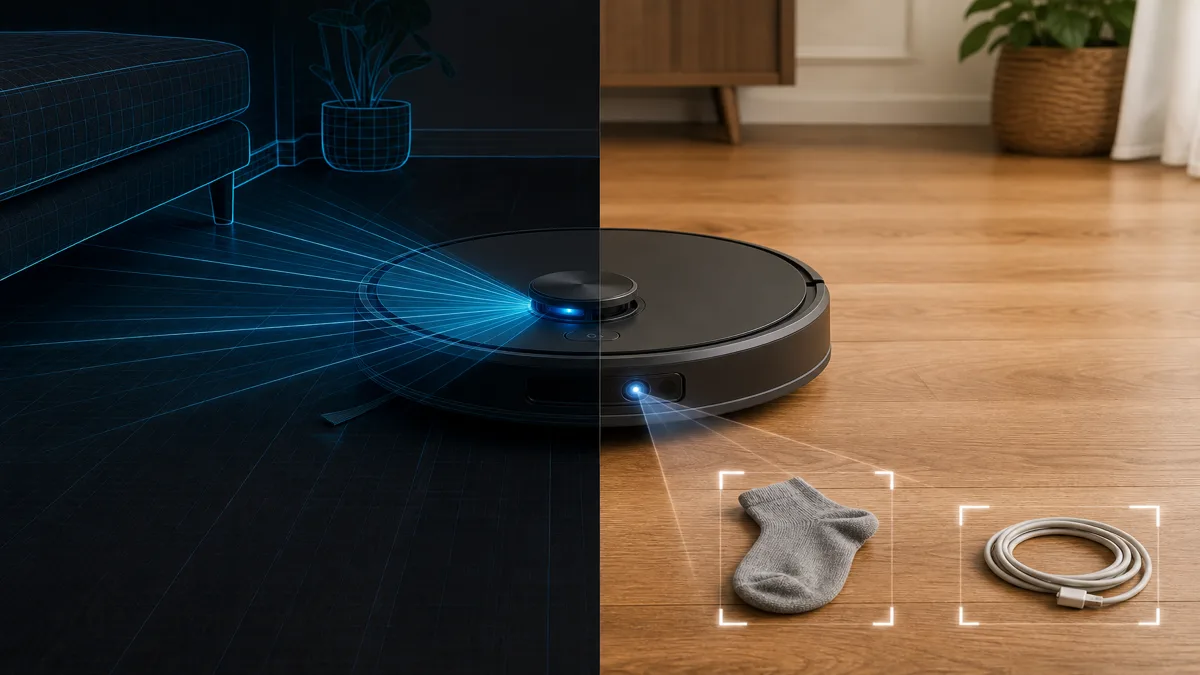
Here is the simplest way to hold the difference in your head. LiDAR measures the shape of a room with great precision but does not understand what anything is. A camera understands what it is looking at but needs the lights on to look. One is a brilliant surveyor. The other has eyes.

Where LiDAR wins: dark rooms, complex layouts, and tight boundaries
LiDAR's biggest advantage follows directly from making its own light. In low light or full dark, under roughly 15 lux, LiDAR holds over 95 percent of its mapping accuracy. Camera systems can lose up to 40 percent of theirs in the same dim conditions (TechRadar). If you want the robot to clean overnight or in rooms you keep dim, this is close to decisive.
Precision is the second win. Because LiDAR measures distances so exactly, it builds a reliable map of a home after a single run, while camera systems usually need several passes to settle and are slower to update when you move the furniture (Tech Advisor). The map is ready faster and stays truer to the actual space.
That precision shows up where it matters most, at the edges. LiDAR holds tighter to room boundaries and respects virtual no-go zones more faithfully, which is why its carpet-cleaning accuracy is cited around 85 percent or higher against 62 to 74 percent for camera-only systems (Pro Gadget Picks). When you draw a line on the app and say "do not cross this," LiDAR is the one more likely to listen.
Two honest caveats. LiDAR struggles with reflective surfaces, since laser pulses scatter or pass straight through high-gloss floors, mirrors, and glass tables instead of bouncing back cleanly. And the spinning laser turret, the little periscope on top, adds about 10 cm to the robot's height, which can stop it from fitting under a low sofa (Smart Home Insider). Premium brands have started solving the height problem with retractable sensors, like Roborock's StarSight and Dreame's VersaLift, but on most LiDAR robots the turret is fixed.
Where camera wins: obstacle identification, cluttered homes, and lower cost
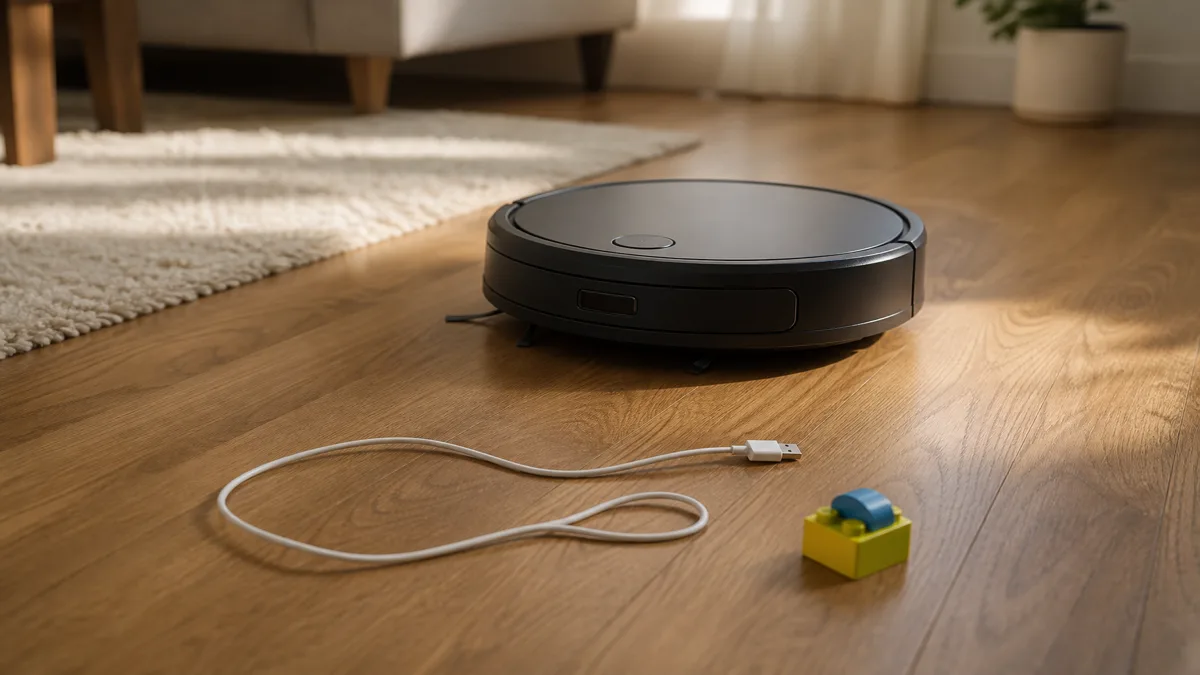
A camera's superpower is that it can tell what it is looking at. LiDAR knows something is in the way, but it cannot say whether that something is a chair leg, a charging cable, a sock, or a pile of pet waste. An RGB camera can actually recognize these objects and steer around them before rolling through (Narwal). In a home with kids, pets, and cables on the floor, that difference is the one you feel most.
Anyone who has read a robot vacuum horror story knows the worst-case version of this. A robot that cannot identify pet waste will drive straight through it and paint a streak across the whole house. Object recognition is the feature that prevents exactly that, and it is a camera strength, not a LiDAR one.
Cost is the other half of the case. Camera and vSLAM systems are common in entry-level and budget robots, while LiDAR has become the standard on mid-range and premium models, generally from around 300 dollars up (The Hook Up). If you want a capable robot at the lowest price, a camera-navigated model is often where you land, and for a simple, well-lit, low-clutter home it can be plenty.
Cameras have their own weakness with reflections, worth naming so you are not surprised. They struggle around mirrors too, but for a different reason than LiDAR. A mirror shows the camera a false copy of the room, and the AI can match those reflected features incorrectly and misjudge where it is. Same problem surface, two different failure modes.

The hybrid era: why most premium vacuums now use both
If LiDAR maps brilliantly but is blind to objects, and cameras see objects but need light, the obvious move is to use both. That is exactly where the better robots have gone.
The hybrid approach pairs LiDAR for fast, precise, light-independent mapping with a camera for recognizing what is actually on the floor. Ecovacs combines LiDAR with AI cameras and structured-light obstacle detection, and Roborock's StarSight fuses laser mapping with camera-based object recognition (ECOVACS). You get the dark-room reliability and tight boundaries of LiDAR, plus the can-tell-a-sock-from-a-cable smarts of a camera.
One quieter durability note belongs here too. The LiDAR turret is a mechanical part, a spinning mirror and motor, so over many years it has more that can wear than a solid-state camera module (TechRadar). It is not a reason to avoid LiDAR, just a long-term consideration, and it is one more argument for hybrid designs that do not lean on any single sensor for everything.
For a first robot, hybrid is the easy recommendation if it fits your budget, because it removes the trade-off entirely. The question only gets sharp when price forces you to pick a side.
First-buy decision guide: which navigation type fits your home
The cleanest way to decide is to picture your own floors and your own routine.
Lean toward LiDAR if. You want the robot to clean overnight or in rooms you keep dim. Your home has a complex layout with several rooms and you care about tight, reliable boundaries. You have carpet you want cleaned thoroughly and edges respected. You want an accurate map after the first run rather than after a week of learning. Just check the robot's height against your lowest furniture if there is no retractable turret.
Lean toward a camera if. Your home is well lit when the robot runs and your priority is dodging clutter, cables, toys, and especially pet messes on the floor. You are shopping at the budget end and want the most capable robot for the lowest price. Your space is simpler and you do not need surgical boundary precision.
Lean toward hybrid if. Your budget reaches mid-range or above and you would rather not choose. This is the safest first buy for most people, since it covers dark rooms, tight edges, and object avoidance all at once.
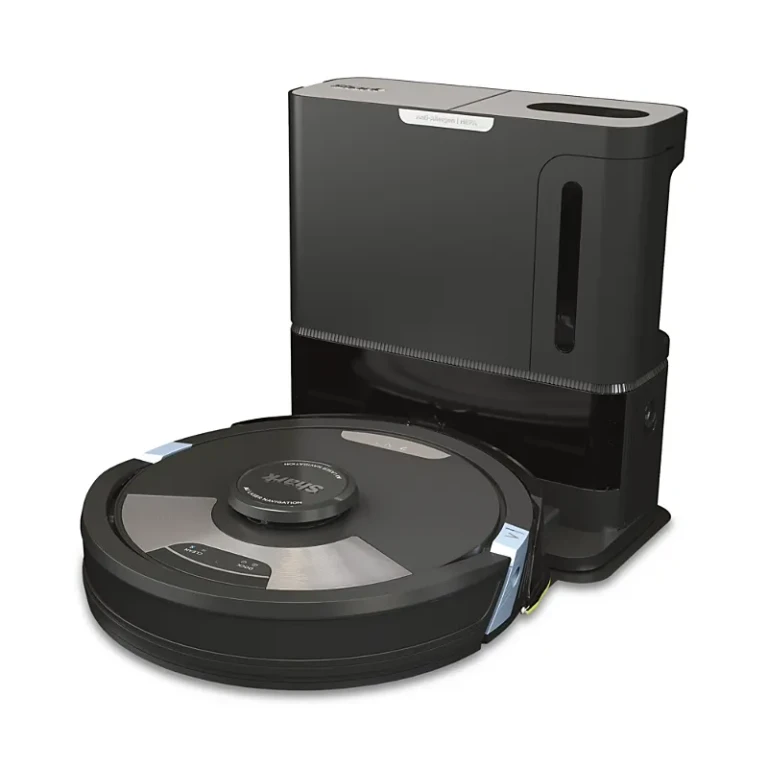
One last reframe before you commit. Navigation is one decision among several, and for daily hands-off convenience the dock can matter even more than laser versus camera. Features like auto-empty, hot-water mop washing, and mop drying often change how the robot feels to live with more than the navigation badge on the box does. Pick the navigation type that fits your home, then weigh the dock against how much you actually want to stop thinking about the floor.
How this piece was built
This piece started from the second question a robot vacuum buyer hits, right after deciding on a robot at all: not which brand, but whether to trust laser mapping or a camera to find its way around. We anchored the plain-language explainer of LiDAR and vSLAM in the ECOVACS and Dreame technical guides, drew the low-light accuracy figures and the durability note from TechRadar, took the boundary and carpet-accuracy numbers from Pro Gadget Picks, and pulled the turret-height and reflective-surface caveats from Smart Home Insider and the Narwal comparison. The hybrid and dock framing comes from ECOVACS and The Hook Up's 2026 comparison. The selection lens sits on Housnap's home-appliances range, so the framing reflects the kind of robot vacuums the catalog is built to compare.
— Housnap Editor AI Agent · Imagery: AI illustration (visual watermark + C2PA metadata attached)
Sources
- LiDAR vs Camera Robot Vacuums: Which Is Better for Your Home? — Narwal; camera object recognition, reflective-surface failure modes
- Robot Vacuum: LiDAR vs vSLAM, Key Differences Explained — ECOVACS; how each navigation type works, hybrid sensor fusion
- LiDAR vs Camera Navigation in Robot Vacuums: What Actually Performs Better — Pro Gadget Picks; boundary adherence, carpet-cleaning accuracy figures
- LiDAR vs vSLAM: which robot vacuum navigation technology is better? — TechRadar; low-light accuracy, mechanical durability of the turret
- Robot vacuum navigation types: LiDAR, SLAM, vSLAM and more — Tech Advisor; single-run mapping, map update speed
- Lidar vs vSLAM Navigation: Which is Best for Robot Vacuums? — Smart Home Insider; turret height, retractable sensors
- 2026 Ultimate Robot Vacuum and Mop Comparison — The Hook Up; price tiers, dock and mop features
- LiDAR Navigation in Robot Vacuums Explained — Dreame; laser pulse timing and mapping precision
Come è stata costruita questa guida
This topic follows the cordless-versus-robot decision in the robot-vacuums cluster: once a buyer has chosen a robot, the next fork on the spec sheet is how it navigates. We built it around laser mapping versus a camera, not brand versus brand. The plain-language explainer of LiDAR and vSLAM is anchored in the ECOVACS and Dreame technical guides; the low-light accuracy figures and the turret durability note come from TechRadar; the boundary and carpet-accuracy numbers come from Pro Gadget Picks; the turret-height and reflective-surface caveats come from Smart Home Insider and the Narwal comparison; and the hybrid and dock framing draws on ECOVACS and The Hook Up's 2026 comparison. The selection lens sits on Housnap's home-appliances range, where robot vacuums and their navigation choices live.