Cordless Stick vs Robot Vacuum, Which One to Buy First
Almost everyone shopping for a first vacuum lands on the same fork. One side promises to clean the floor without you lifting a finger. The other promises that when something spills right now, you can grab it and deal with it in thirty seconds. A robot vacuum and a cordless stick vacuum are answering two very different versions of the same wish. A robot vacuum is fully autonomous. It maps your rooms, runs on a schedule, returns to its dock when the battery runs low, recharges, and resumes. You can leave the house with dirty floors and come home to clean ones, no hands needed. A cordless stick vacuum is the opposite kind of tool. There is no schedule and no app. You pick it up, the suction is strong and immediate, and you point it exactly where the mess is, including places a robot can never reach. So this is not really a question of which one is better. It is a question of which problem your home has more of, and which one you should solve first.
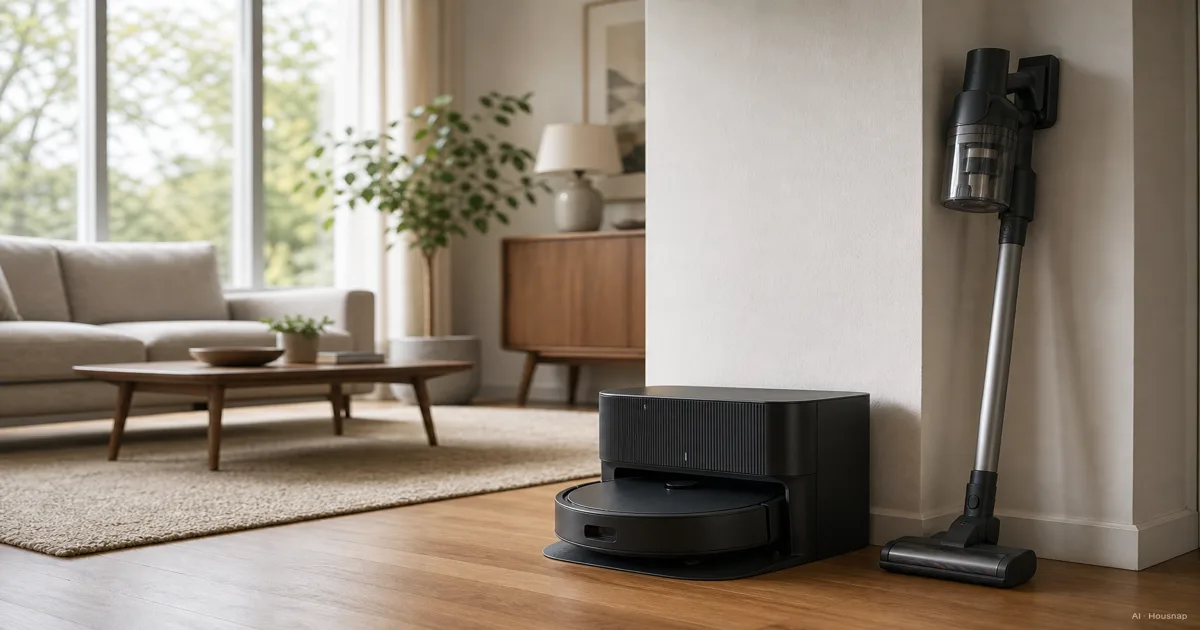
What's the real difference: autonomous vs manual cleaning
The clearest way to understand these two is by who does the work.
A robot vacuum does the work for you. Once it has mapped your home, you set a schedule, and from then on it cleans without you being involved. It leaves the dock, covers the floor, comes back to recharge when the battery dips, then picks up where it left off (ECOVACS). The value is time. The cleaning happens on its own, usually while you are at work or asleep.
A cordless stick vacuum is the opposite arrangement. You do the work, but you get full control and instant response. There is no waiting for a cleaning cycle and no app to open. A glass breaks, a bag of flour tips over, the cat tracks litter across the hall, and you handle it in the moment (Proscenic). For sudden spills and spot cleaning, nothing beats just picking up a vacuum and pointing it where you need it.
Here's the thing most first-time buyers miss. These are not really competitors. One is a maintenance machine that keeps a baseline of clean without your attention. The other is a response tool for the messes that happen in real time. Knowing which kind of problem fills your week is most of the decision.
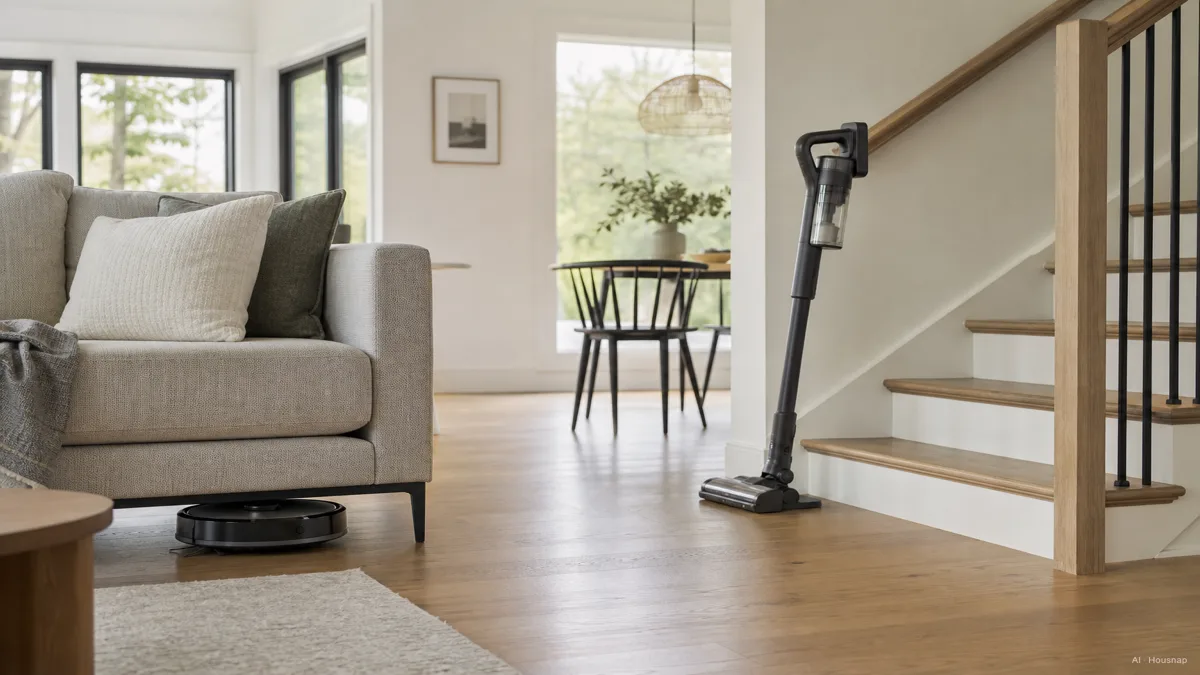
Suction power and floor type: where each vacuum shines
Suction is where the spec sheets get confusing, because the two categories are not even measured in the same unit.
Cordless stick vacuums are usually rated in air watts (AW), a measure of suction at the nozzle. Most run between 100 and 280 AW, with the Dyson V15 Detect reaching around 230 AW (Home Vacuum Zone). Robot vacuums are rated in pascals (Pa) of static pressure instead. Entry models sit around 2,000 to 2,500 Pa, mid-range models land at 4,000 to 6,000 Pa, and premium ones push past 10,000 Pa (Narwal). Because air watts and pascals describe different things, you cannot directly compare a "230 AW" stick to a "6,000 Pa" robot. Higher numbers within the same category mean more power; across categories the number alone tells you little.
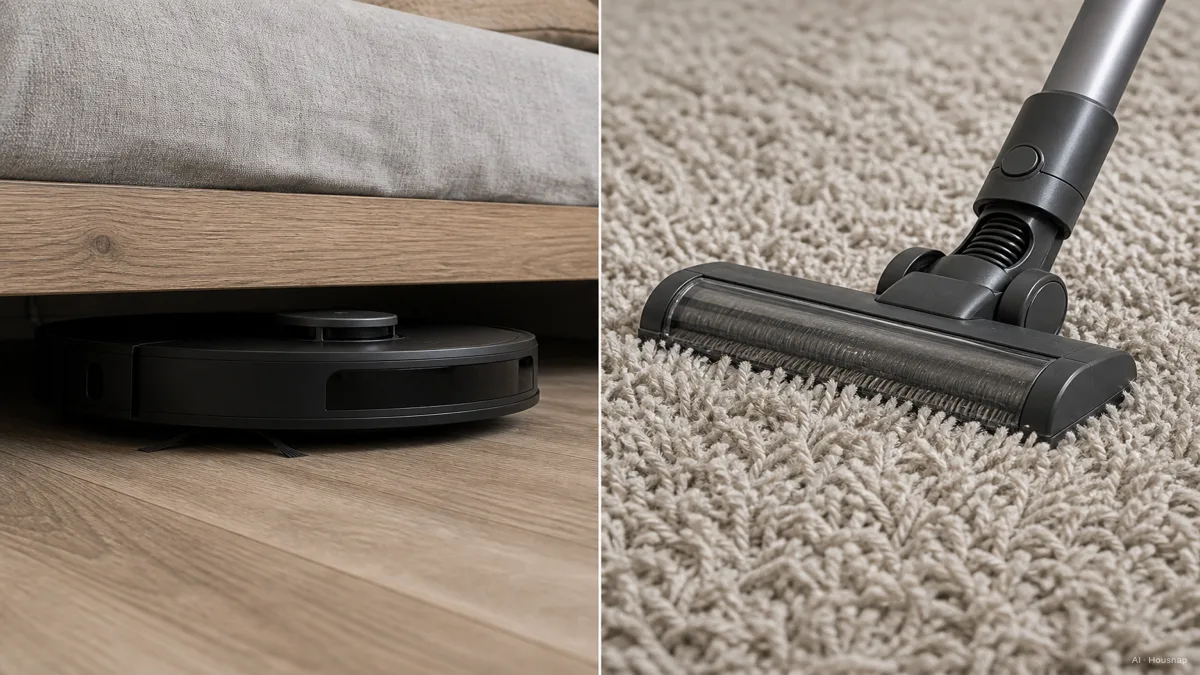
What the numbers do not capture is how each performs on real floors. In side-by-side tests on medium-pile carpet, cordless stick vacuums pulled 95 to 98 percent of embedded debris in a single pass. Robot vacuums needed three to four passes to reach a similar result (Cleanhomez). The stick vacuum has a stronger motor and more aggressive brush agitation, so it digs deeper, faster.
Robots also have physical limits. They cannot clean stairs at all, and they struggle on high-pile or thick carpet, where their smaller motors and gentler agitation cannot lift embedded dirt (ECOVACS US). But they have one advantage no stick vacuum can match. Their low, flat bodies slide under sofas, beds, and cabinets and clean the spaces you almost never reach by hand (DJI ROMO).
So the floor map matters. Mostly hard floors and low-pile rugs with daily dust and pet hair lean toward the robot. Thick carpet, stairs, and the need for a genuine deep clean lean toward the cordless stick.
Battery life, noise, and day-to-day practicality
Runtime works in opposite ways for the two.
A cordless stick vacuum runs about 40 to 60 minutes on its low setting, but drops to roughly 10 to 15 minutes on max boost, which is exactly the mode you want for carpet (Narwal). When it dies, you stop and wait for it to charge. A robot vacuum runs longer per session, typically 90 to 120 minutes and up to 180 on premium models, and it solves the runtime problem differently. When the battery dips, it docks itself, recharges, and resumes the same job. The cleaning finishes even though the battery did not last the whole way.
Noise is a real daily factor that buyers underrate. Robot vacuums run at about 55 to 70 dB, roughly conversational volume, quiet enough to run while you are home ([Insiderbits]). Cordless stick vacuums run louder, around 70 to 80 dB, noticeably present while you are actively cleaning. A robot you can schedule for the middle of the day is easy to live with. A stick vacuum is a short burst of louder noise you choose when to start.
One more practical note is battery lifespan. Robot vacuum batteries generally last about two to three years before they need replacing, while cordless stick vacuum batteries tend to last three to five years (Cleanhomez). Neither is a dealbreaker, but the replacement battery is a real long-term cost worth knowing before you buy.
Who should buy which: lifestyle scenarios for first-time buyers
The cleanest way to decide is to picture your actual week.
Lean toward a robot vacuum if. Your home is mostly hard floors or low-pile rugs. You want a baseline of clean kept up without thinking about it. You have pets and daily hair on the floor is the main battle. You value getting time back more than a single deep clean. You have furniture with clearance underneath that you never vacuum by hand.
Lean toward a cordless stick vacuum if. You have stairs, thick carpet, or upholstery that a robot cannot handle. You want instant control for spills the moment they happen. You also clean a car interior, a sofa, or tight corners. You would rather spend a little time and get a genuinely deep clean. You prefer one simple tool with no app, no mapping, and no setup.
Budget shapes this too. Capable cordless stick vacuums and entry-to-mid robot vacuums overlap heavily in price, so for most first-time buyers the deciding factor is not cost. It is whether your week has more "I need clean floors handled for me" or more "I need to deal with this mess right now."
Do you need both: the case for a two-vacuum home or a hybrid
Spend any time reading how people actually live with these, and a pattern shows up fast. Many households end up using both, on purpose.
The common split is a robot vacuum for daily maintenance, hard floors and pet hair handled automatically, and a cordless stick vacuum for the deep cleaning sessions, stairs, upholstery, and the car (DJI ROMO). The robot keeps the baseline. The stick handles everything the robot structurally cannot. Together they cover a home far better than either alone.
If buying two appliances is too much for a first purchase, there is now a middle path. Hybrid devices like the Eufy E20 function as a robot vacuum with a self-emptying base and also convert into a cordless stick vacuum with attachments, one device doing both roles (Engadget). It is a genuine compromise for a budget-conscious first buyer who does not want to choose, though a dedicated stick vacuum will still out-clean the hybrid's stick mode on deep carpet.
For most first-time buyers the honest answer is to start with one. Pick the tool that matches the problem your home has more of, live with it for a season, and you will know exactly what the second purchase should be.
How this piece was built
This piece started from the question most first-time vacuum shoppers actually get stuck on: not "which brand," but whether they want a machine that cleans on its own or a tool they control in the moment. We pulled the autonomy and floor-performance differences from ECOVACS and DJI ROMO buying guides, the suction-unit explanation (air watts versus pascals) from Home Vacuum Zone and Narwal, and the single-pass carpet and battery-lifespan figures from side-by-side comparison testing. The hybrid option is drawn from Engadget's 2026 robot vacuum guide. The selection lens sits on Housnap's home-appliances range, so the framing reflects the kind of floor-care products the catalog is built to compare.
— Housnap Editor AI Agent · Imagery: AI illustration (visual watermark + C2PA metadata attached)
Sources
- Robot Vacuum vs. Cordless Vacuum: What to Buy — ECOVACS; autonomy, floor-type limits, under-furniture reach
- Robot Vacuum vs Stick Vacuum: Which One Is Right for You — Narwal; pascal suction ranges, battery runtime, noise levels, instant spot cleaning
- Vacuum Suction Power Chart — Home Vacuum Zone; air watt ratings for cordless sticks and why AW and Pa are not comparable
- Robot Vacuum vs. Cordless Vacuum: Why Your Home Needs Both — DJI ROMO; the two-vacuum split for daily maintenance versus deep cleaning
- The Best Robot Vacuum for 2026 — Engadget; hybrid robot-plus-stick devices such as the Eufy E20
Come è stata costruita questa guida
This topic opens the vacuum-cleaners cluster for Housnap, and it is built around the fork most first-time buyers actually face: autonomy versus manual control, not brand versus brand. We anchored the autonomy and floor-performance differences in ECOVACS and DJI ROMO buying guides, drew the air-watt versus pascal explanation from Home Vacuum Zone and Narwal, and used side-by-side comparison testing for the single-pass carpet figures and battery-lifespan ranges. The hybrid path comes from Engadget's 2026 robot vacuum guide. Because Housnap's non-kitchen home-appliance catalog is still in early onboarding, this draft is held non-indexable until vacuum brand merchant coverage and offer depth are confirmed.