Map one opening and the space behind it
Start on the side you will actually use. Sketch the bed legs, centre supports and nearby furniture, then mark one uninterrupted space for a box. Do not count space on the other side of a support as part of the same usable bay.
Use an existing tape measure; a metric measuring ruler can help with a short vertical gap. Record every measurement in the same unit, with the mattress and floor coverings in their normal positions.
- Height. Measure from the surface the box will travel on to the lowest obstruction above it. Check the entrance and several points farther underneath, including brackets or rails.
- Opening width. Measure between the inward-facing edges of the legs or other obstacles at the chosen entrance. Check whether the space narrows farther in.
- Usable depth. Measure inward from that entrance to the first obstruction the box cannot pass. A centre support can end this measurement well before the far side of the bed.
For enclosed storage beds, Furl’s measuring guidance uses the closed-bed configuration with the mattress in place, takes readings at the head, middle and foot, and uses the smallest. Here, that minimum-clearance approach becomes a check of the entire sliding route. This guide covers loose boxes under an open bed, not access through a lifting mechanism.
Compare the complete box, not its capacity
For bed fit, ask for the assembled external length, width and height, including the lid, wheels and projecting handles. Keep those separate from the measurements used to check whether your belongings fit inside.
The Sterilite 60 Qt. Wheeled Underbed Latch Box lists an exterior of 35 1/2 × 18 7/8 × 7 inches, while its interior-at-bottom dimensions are 31 3/4 × 16 3/4 × 6 1/8 inches. The smaller figures are not the box’s outside footprint.
The 56 Qt. Wheeled Latching Box has a different exterior footprint, 33 7/8 × 18 3/4 inches, despite the same listed 7-inch height. These are specification-reading examples, not recommendations for your bed.
Write down which dimension faces the opening and which runs underneath the bed. Do not accept an exact numerical match as proof of easy movement; resolve missing dimensions and verify usable clearance before buying.
Rehearse pulling it out and opening it
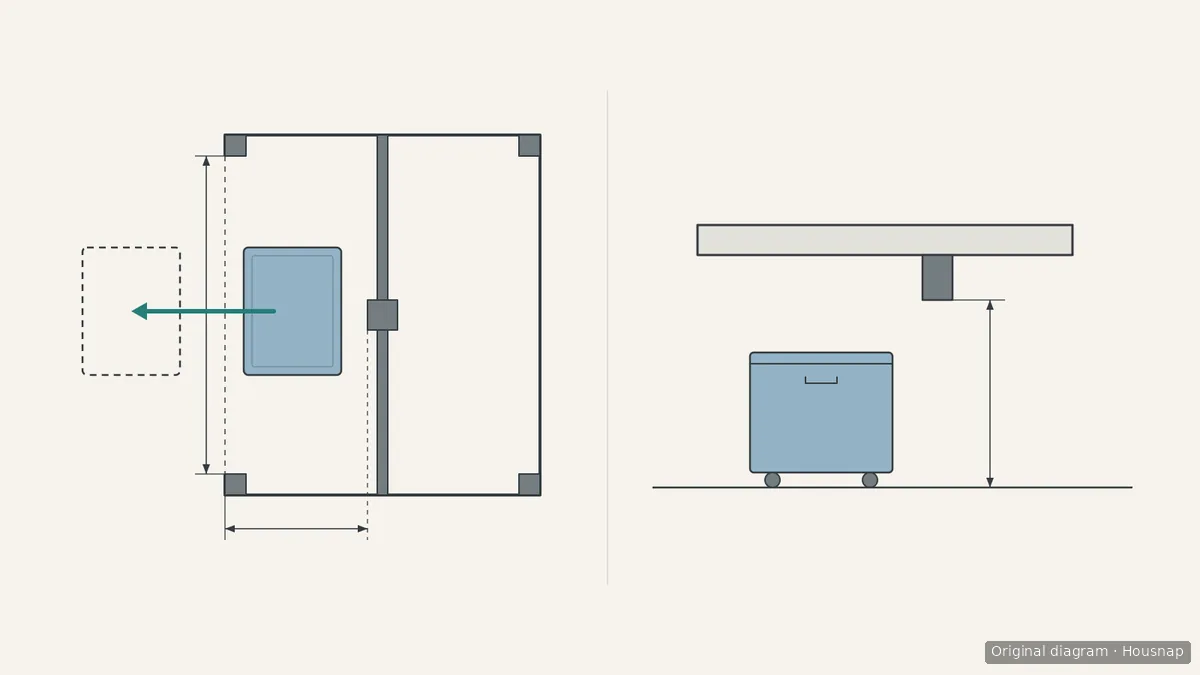
Make a paper or cardboard outline of the candidate’s external footprint and move it through the proposed route. This checks the floor plan only; use an existing box of known dimensions to check height where possible. Neither exercise proves how a new box will move when loaded.
For a simple example, a box extending 70 cm underneath the bed, with its front flush with the opening, needs to travel 70 cm straight outward for its rear edge to clear. A 55 cm gap to a wardrobe is insufficient for that full straight withdrawal. Turning might change the route, but it needs a separate check with the whole outline, not just one corner.
Check where you will grip the box, stand or kneel, release its fastenings and lift the lid. Sterilite describes wheels and lid-securing latches on its 56 Qt. model; those features do not specify the working space beside your bed. If the lid cannot open underneath, plan to withdraw the box far enough to use it outside.
Keep, resize or choose another location
- Keep the arrangement when the box clears the whole route and you can retrieve its contents without rearranging the room.
- Try a shorter or narrower box when a support or nearby furniture interrupts the route. Check each smaller box separately; two boxes do not automatically make access easier.
- Choose another location when access depends on shifting bed supports or repeatedly moving heavy furniture. Do not alter the bed’s structure to make a box fit.
Before buying several, check one candidate with its intended contents and the lid closed, within the maker’s stated limits. Record the usable bay, opening and removal space separately so the same mistake does not recur.
If the container fits but bulky textiles still exceed its usable interior, first check whether those items permit compression, then read the vacuum storage bag selection guide. Compression is a separate contents decision; it cannot make a rigid box pass a bed leg.
Comment ce guide a été conçu
This guide was written by AI for Housnap, using Sterilite’s box specifications and Furl’s storage-bed measuring guidance. Mapping obstructions, rehearsing removal and deciding whether to keep a box are editorial procedures, not results from hands-on product testing.