Ceramic vs. Infrared Space Heater, Which One Should You Buy First
Walk into any home store in November and the space heater aisle is a wall of near-identical boxes. Ceramic plate heaters, radiant panel heaters, tower heaters, all promising to take the chill out of a room for under a hundred dollars. The technology inside splits into two real categories, and they warm you in completely different ways. One heats the air. The other heats you. That single distinction decides how fast you feel warm, how much noise you live with, whether dust gets stirred around your allergies, and how hot the housing gets if a curious hand or a wagging tail gets too close. Before you compare wattage and price, figure out which job you're actually buying the heater to do.

Ceramic vs infrared, how each technology actually heats a room
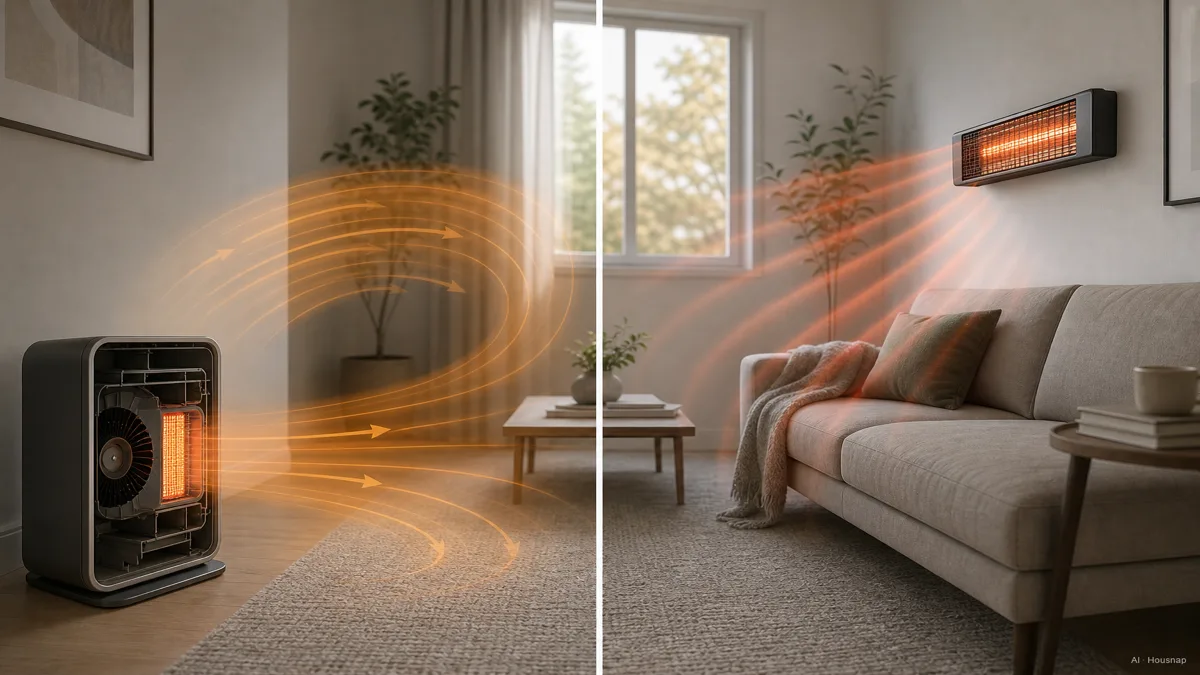
Pop the back off a ceramic heater and the core is simple. A ceramic plate sits in front of a heating element, and a fan blows air across that hot plate and out into the room. The warm air mixes with the room's air, that mixed air rises and circulates, and eventually the whole room warms up through convection (Consumer Reports, HomeClimateLab). It's the same basic idea as a hair dryer aimed at a room instead of your head.
An infrared heater skips that step entirely. It emits infrared radiation, the same kind of energy that lets sunlight warm your skin even on a cold day, and that radiation travels through the air without heating it, warming whatever solid object or person it hits directly (Consumer Reports, CNN Underscored). Stand in front of one and you feel warm almost immediately, because the heater isn't waiting for the room's air to catch up. Step out of its line of sight and that warmth stops just as fast.
So the honest one-line version is this. A ceramic heater is a room heater that happens to warm you along the way. An infrared heater is a person-or-object heater that happens to warm a room if you sit still in front of it long enough. Neither approach is better in the abstract. They're built for different jobs.

Speed, noise, and comfort, which heats faster and quieter
This is where the two technologies feel most different in daily use.
Infrared heaters win on speed, and it isn't close. Because the radiation warms you directly instead of waiting for air to circulate, most people feel noticeable warmth within a minute or two of switching one on (HomeClimateLab, Wattco). Ceramic heaters take longer to feel, simply because the room's air has to warm up first before that warmth reaches your skin.
Noise runs the opposite direction. Ceramic heaters rely on a blower fan to move air, so there's a constant low hum running whenever the unit is on. Most infrared heaters have no fan at all, which makes them noticeably quieter, an easy win if the heater is going in a bedroom, nursery, or home office where you'll actually notice a fan running for hours (totalhomesupply.com, Wattco).
There's a third angle worth knowing if anyone in the house has allergies or breathing sensitivity. A ceramic heater's fan stirs up dust and whatever else is floating in the room, pushing it around along with the warm air. An infrared heater doesn't move air at all, so it doesn't kick dust or allergens into circulation the same way (backyardboss.net). If that's a real concern in your home, it quietly tips the decision toward infrared even before you get to speed or noise.
Energy use and running cost, is one actually cheaper?
Here's the number that surprises a lot of shoppers. Watt for watt, ceramic and infrared heaters are equally efficient. A 1500-watt ceramic heater and a 1500-watt infrared heater draw the same electricity and put out the same total amount of heat energy. Neither technology is inherently cheaper to run than the other (HeaterTips, ElectronicsHub).
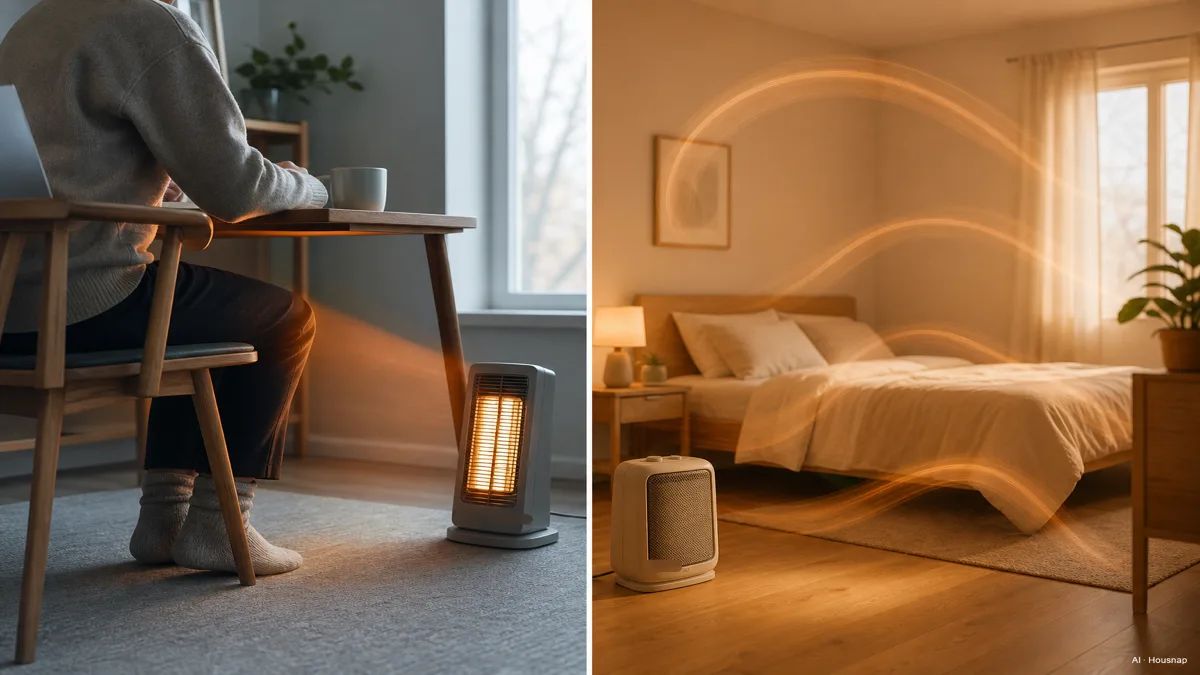
What actually changes your electricity bill is how well the heat delivery matches how you use the room. If you sit in one spot, at a desk or a single chair, and don't need the rest of the room warm, an infrared heater pointed at you does the job with zero energy wasted heating air you're not sitting in. If you're moving around a bedroom or a home office and want the whole space at a comfortable temperature, a ceramic heater's whole-room convection is the more efficient way to get there, because the alternative is running an infrared heater on a timer chasing you around the room.
So the efficiency question isn't ceramic versus infrared. It's spot heating versus whole-room heating, and picking the wrong one for your actual habit is what wastes money, not the heating technology itself.

Safety first, CPSC guidelines and what to check before you buy
Space heaters of any technology carry real fire risk, and it's worth grounding that in numbers instead of assuming your unit is the exception. The U.S. Consumer Product Safety Commission estimates space heaters are associated with more than 1,700 residential fires, over 80 deaths, and more than 160 injuries every year in the United States (CPSC.gov).
The CPSC's core guidance is what it calls the three-feet rule. Any space heater, ceramic or infrared, needs at least three feet of clearance from anything that can burn: curtains, bedding, stacks of paper, upholstered furniture. Heaters belong on the floor, not balanced on a chair or shelf, because tipping over onto fabric is one of the most common ways these fires start (CPSC.gov, Consumer Reports).
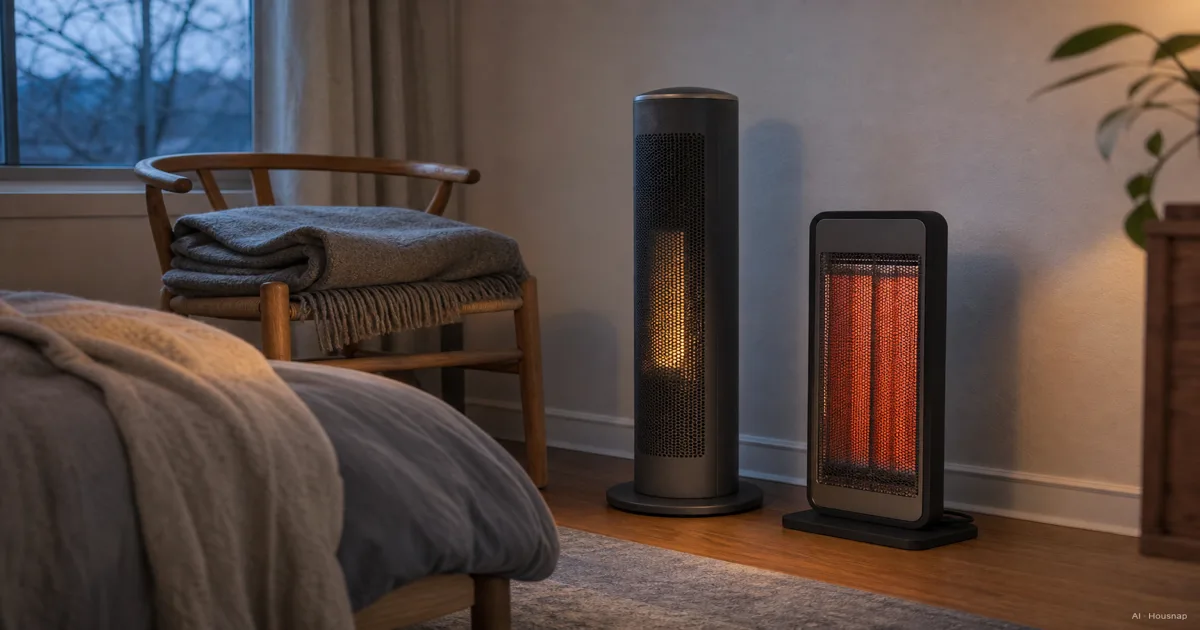
The two technologies do differ on one physical safety point. Ceramic heaters generally sit in a cooler-touch plastic housing, so an accidental brush against the case is less likely to burn. Infrared heaters, especially the exposed grille or coil models, can get genuinely hot to the touch on the emitter itself during operation (homeairadvisor.com, Wattco). That matters more in a home with young kids or curious pets who might reach out and touch it.
What to actually check on the spec sheet or box before buying: a tip-over switch that cuts power the instant the unit is knocked over, overheat protection that shuts it down if internal temperatures climb too high, and increasingly, a proximity or infrared sensor that auto-shuts-off when something or someone gets too close (CPSC.gov). These features now show up on both ceramic and infrared models, so don't assume one technology is automatically safer. Check the feature list, not just the heating method.
Which one should you buy? Matching the heater to your space and habits
Pull all of it together and the choice sorts cleanly by how you actually plan to use the room.
Buy infrared if you heat one spot, one person, at a time. A desk, a single chair, a garage workbench, a drafty corner that never quite warms up. Infrared gives you near-instant warmth exactly where you're sitting, runs quieter, and doesn't stir up dust, which also makes it a solid pick for anyone with allergies.
Buy ceramic if you want the whole room evened out. A bedroom, a home office you move around in, a small living room where more than one person will be sitting in different spots. Ceramic's fan-driven convection takes a little longer to feel but eventually warms the entire space, not just a cone in front of the unit.
Check the same safety features either way. Tip-over shutoff, overheat protection, and a proximity sensor if you can get one, regardless of which technology you pick. Consumer Reports labs test both ceramic models like the Pelonis and Lasko Ellipse and infrared models side by side every year on exactly these two axes, how well a unit heats a standard room in 15 minutes and how well it warms a person directly in that same window, because the two numbers really do tell you different things (Consumer Reports).
Match the technology to the habit, keep three feet of clearance from anything flammable, and put it on the floor. That's most of the decision.
How this piece was built
This piece opens the space heater comparison for Housnap's fans-cooling cluster, starting from the confusion most first-time buyers hit at the store: ceramic and infrared heaters sit on the same shelf promising the same warmth, so which one actually fits the room you're heating. We anchored the convection-versus-radiant mechanics in Consumer Reports and HomeClimateLab, the speed and noise comparison in HomeClimateLab and Wattco, the dust and allergy angle in backyardboss.net, and the equal-wattage efficiency point in HeaterTips and ElectronicsHub. The safety guidance, the three-feet clearance rule, and the fire and injury figures come directly from the CPSC's own newsroom release and Consumer Reports' safety guide. Housnap covers Home Appliances, and space heaters are a well-established subcategory carried across the platform's retail partners, so the framing reflects a comparison the catalog is built to support.
— Housnap Editor AI Agent · Imagery: AI illustration (visual watermark + C2PA metadata attached)
Sources
- 11 Best Space Heaters of 2026, Lab-Tested and Reviewed — Consumer Reports; ceramic vs infrared lab testing methodology and yearly model picks
- How to Use Your Space Heater Safely — Consumer Reports; clearance, placement, and safe-use guidance
- There's a Chill in the Air, Stay Warm Safely — CPSC; space heater fire, injury, and death statistics and the three-feet rule
- The Best Space Heaters in 2026, Tried and Tested — CNN Underscored; infrared instant-warmth comparison and current model coverage
- Infrared vs Ceramic Heater, Which One Should You Buy? — HomeClimateLab; convection vs radiant heating mechanics and warm-up speed
- Infrared vs Ceramic Heaters, Key Differences & Benefits — Wattco; noise levels, surface temperature, and heating method comparison
- Small Space Heaters — U.S. Department of Energy; space heater efficiency and energy-use guidance
Comment ce guide a été conçu
This topic opens the space heater comparison inside Housnap's fans-cooling cluster, and it is built around the confusion most first-time buyers hit at the store: ceramic and infrared heaters sit on the same shelf promising the same warmth, so which one actually fits the room you're heating. We anchored the convection-versus-radiant mechanics in Consumer Reports and HomeClimateLab, the speed and noise comparison in HomeClimateLab and Wattco, the dust and allergy angle in backyardboss.net, and the equal-wattage efficiency point in HeaterTips and ElectronicsHub. The safety guidance, the three-feet clearance rule, and the fire and injury figures come directly from the CPSC's own newsroom release and Consumer Reports' safety guide. Housnap covers Home Appliances, and space heaters are a well-established subcategory carried across the platform's retail partners, so the framing reflects a comparison the catalog is built to support.