Check the surface before calling it bloom
Look up the boot’s material and care instructions first. This guide concerns the rubber exterior; it does not extend the same treatment to leather, fabric panels or linings. If the mark is on smooth leather, use the guide to water and salt marks on leather shoes.
Bloom is a surface phenomenon. GEAR AID explains that changes in temperature or humidity can bring insoluble particles in rubber to the surface, including on new boots. Le Chameau describes occasional powdery bloom on its rubber boots as normal and says it does not compromise their durability or performance. That reassurance concerns bloom, not every white mark or damaged boot.
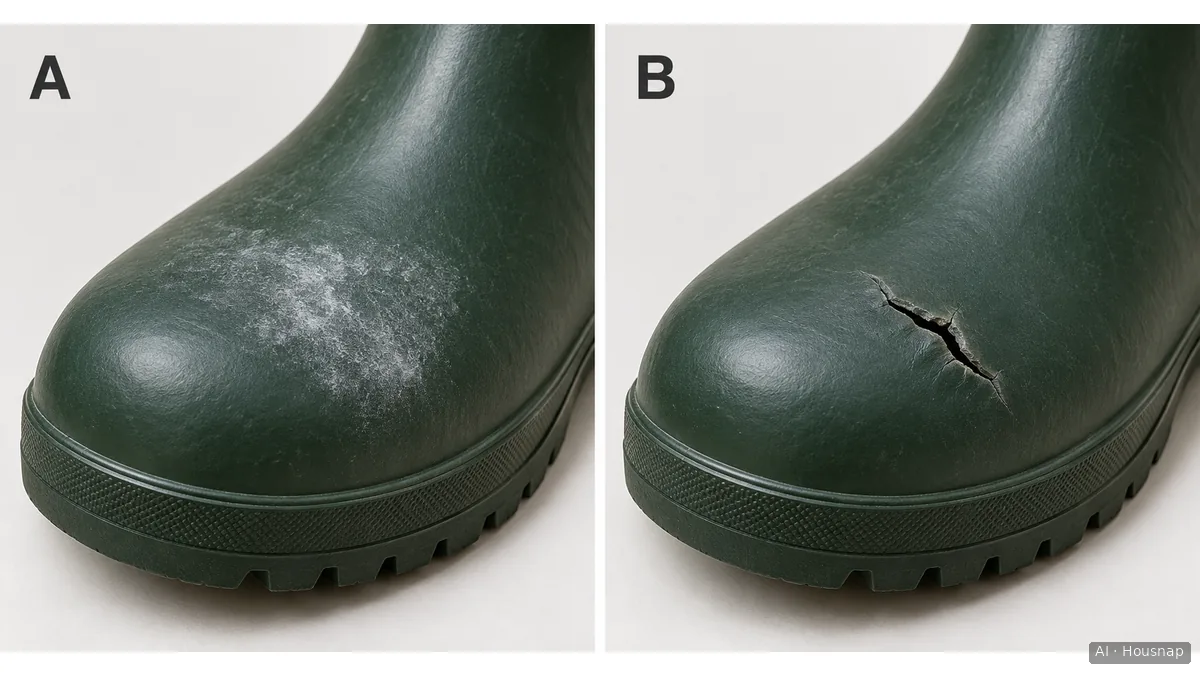
A shows a surface appearance worth checking against the maker’s bloom guidance. B shows a physical opening: stop cosmetic treatment and ask the maker to assess it. These are illustrative examples, not before-and-after results or a visual test that can diagnose your boots. Photograph the mark before applying anything.
Start with the cleaning method for your boots
Use a clean cloth you already own if the maker’s instructions call for one. Merry People recommends a cloth and warm water for routine cleaning. Le Chameau specifies water and a brush, with a little soap for stubborn residue. Follow the instructions for the material you are touching, then let the boots dry before judging the remaining mark.
Do not transfer a household recipe between brands. Merry People’s bloom advice includes leaving dishwashing liquid on its boots overnight. Le Chameau warns against aggressive products such as detergents. Those instructions are not interchangeable; this guide does not turn either into a universal cleaning recipe. If your boot’s guidance is missing or unclear, ask its maker before adding a cleaner.
Choose a treatment only when the maker permits it
If a white film remains on an otherwise intact rubber surface, check whether the maker specifies a rubber-care product. Le Chameau calls for silicone spray and a soft, dry cloth for its particular rubber blend. That is a useful example of a permitted treatment, not approval of every silicone spray for every boot.
A rubber boot care spray is therefore a conditional supporting purchase. Check both the boot instructions and the product label for the relevant material, finish and application area. Do not assume the same permission covers the sole, lining or other panels. Use the stated method and amount; ask the maker if the two sets of instructions do not agree.
Already have the specified product and a suitable cloth? Use those. There is no reason to assemble a complete care kit just because bloom appeared.
Recheck after drying, then decide whether to stop
Le Chameau advises natural drying and storage in a dry, ventilated place away from sun and heat. It also says not to store boots damp or folded. Do not put them against a radiator or fireplace to speed up the result.
Once dry, inspect the surface again. If the appearance is acceptable and the surface is intact, stop rather than chasing a perfectly uniform colour. If the marks persist, ask for advice instead of escalating to stronger products; Merry People explicitly directs owners to its support team when its suggested treatment does not remove them.
For a crack, separation or reported leak, pause this cosmetic-care routine and send the maker photos, the model name and a list of products already used. Ask whether the pair needs repair assessment. A cleaner-looking surface does not answer that question.
Comment ce guide a été conçu
Written by Housnap’s AI editor using public guidance from GEAR AID, Merry People and Le Chameau. The article separates explanations of bloom from each maker’s treatment permissions; the inspection and stopping points are editorial guidance, not original testing or a diagnosis of an individual pair.