Find the exact model and regional specification
Write down the full model name and the market you would buy it in. Open that model’s regional page and find the footnote attached to its threshold claim.
A general FAQ can describe a different set of machines. Roborock’s threshold FAQ gives 2 cm for named models including S6 MaxV, S6 Pure and S5, and 1.5 cm for S4. Don’t turn that into a 2 cm limit for every current Roborock: the US Qrevo Edge 3 Pro page gives its own conditions.
Keep this check separate from navigation. If you also need to choose how the robot maps rooms and recognizes obstacles, continue with LiDAR versus camera navigation; neither label answers the doorway measurement question.
Sketch the doorway and measure each part
Use a ruler or tape measure you already own. Draw the floor transition from the side, along the route the robot would take, and mark each vertical rise separately from the horizontal distance between rises.
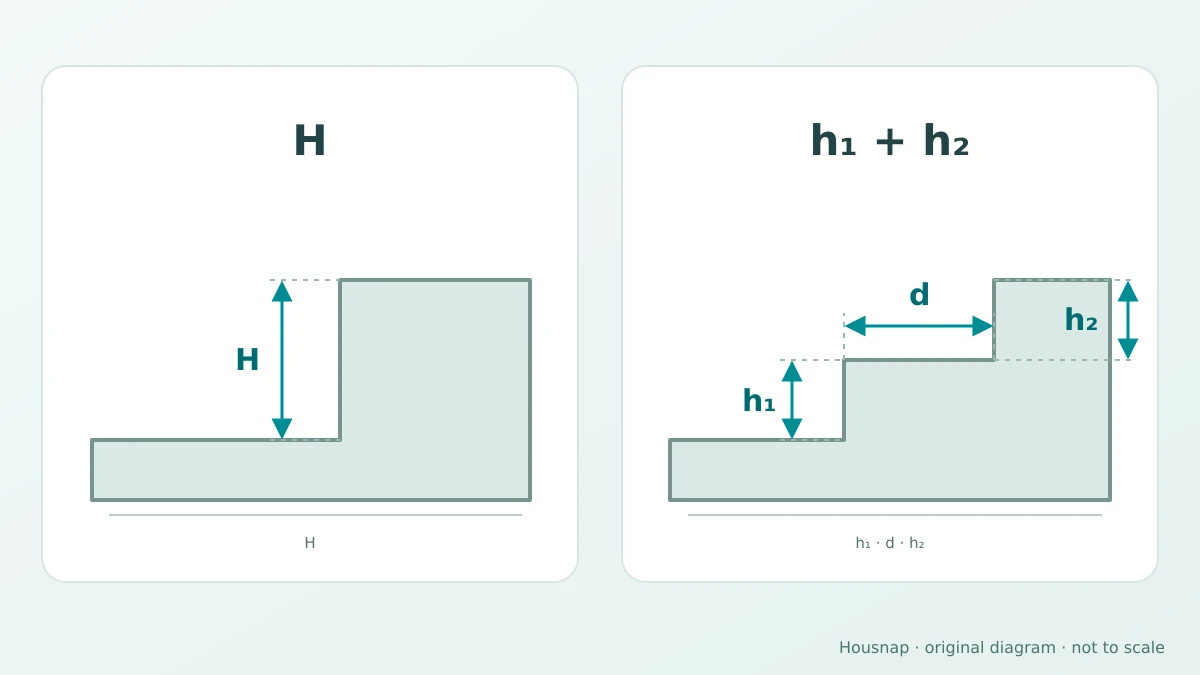
- One rise. Record H from the lower floor to the top of that rise. Do not split one vertical face into two imaginary steps.
- Two successive rises. Record h1 from the lower floor to the intermediate level, then h2 from that level to the upper one. Record d as the horizontal depth between the two rises, not the width of the doorway.
- A different shape. Draw the actual slopes, edges or intervening space. If you cannot identify the same dimensions in the manufacturer’s diagram, leave the comparison unresolved.
Write the unit beside every measurement. Only consider buying a measuring tool if you lack a suitable one; check that its scale uses the units you need and can reach the surfaces you want to measure. The drawing explains what to record, not a successful crossing test.
Compare the footnote, not just the headline
The US Qrevo Edge 3 Pro page describes a combined double-layer crossing height of up to 3.46 inches, about 8.8 cm. Its two rises are 1.77 inches plus 1.69 inches. This is a specification-reading example, not a recommendation to buy that machine or a claim that it climbs a single 3.46-inch wall.
Footnote 2 gives all three conditions together:
- The first rise is at most 1.77 inches.
- The horizontal gap depth between rises is greater than 4.72 inches and at most 5.51 inches.
- The second rise is at most 1.69 inches.
For scale, those rise limits are approximately 4.5 cm and 4.3 cm; the gap endpoints are approximately 12 cm and 14 cm. These are rounded conversions. Use the inch conditions for the boundaries: exactly 4.72 inches is excluded, while exactly 5.51 inches is included. A total below 3.46 inches alone is not enough to match the stated conditions.
Roborock identifies this as internal testing and says performance varies with conditions and use. Matching the dimensions does not prove that the robot will cross your doorway. Nor does a launch report settle that: Vacuum Wars’ IFA report relays manufacturer claims and says Saros 20 Flow performance still needs independent evaluation.
Resolve the fit before paying
Put your sketch, measurements and exact regional model name together. If the shapes are comparable, check every dimension against that model’s documentation. If a condition is outside the stated range, or a measurement point is unclear, ask the manufacturer or seller to clarify your specific doorway before relying on the claim.
Treat an unanswered question as unresolved, not as a reason to buy and force a crossing. This guide does not establish that a ramp or replacement part would solve it.
Also separate an upward threshold from a drop. Roborock’s support page describes cliff sensors for detecting drops; that does not establish stair-cleaning ability or guarantee fall prevention in your home. Do not disable sensors or set up a climbing experiment near stairs.
If the robot cannot cover the route you need, check whether your existing cleaner already handles the remaining work. If you still need a first machine, use the cordless versus robot vacuum guide to reconsider what it must clean. Once route fit is resolved, check the exact dock’s installation instructions as a separate task.
Sources
Comment ce guide a été conçu
Written by Housnap AI using Roborock’s US Qrevo Edge 3 Pro page, its threshold and cliff-sensor FAQs, and Vacuum Wars’ IFA launch report. We organized the guide around identifying the model, measuring the doorway and comparing documented conditions; that sequence is our editorial guidance, not a manufacturer test procedure. We have not tested crossing performance in a home.