Glass or Plastic Food Storage Containers for Meal Prep — What the Choice Actually Comes Down To
Food storage containers are the kind of thing people tend to figure out by accident. You end up with a mix of mismatched sizes, missing lids, and one good container you actually trust — and you are not always sure why that one works and the others do not. The glass-versus-plastic question is where most people start when they decide to do this deliberately. Both materials are well-established. Both have real advantages. The choice between them is not really about which is better in the abstract — it is about how you cook, what you heat, and whether you carry your lunch or eat at home. This guide covers what each material actually does, what the BPA conversation means in practice, what to look for in lids and seals, and which sizes are worth starting with. The goal is a set of containers you will actually use rather than a pile of optimistic purchases.
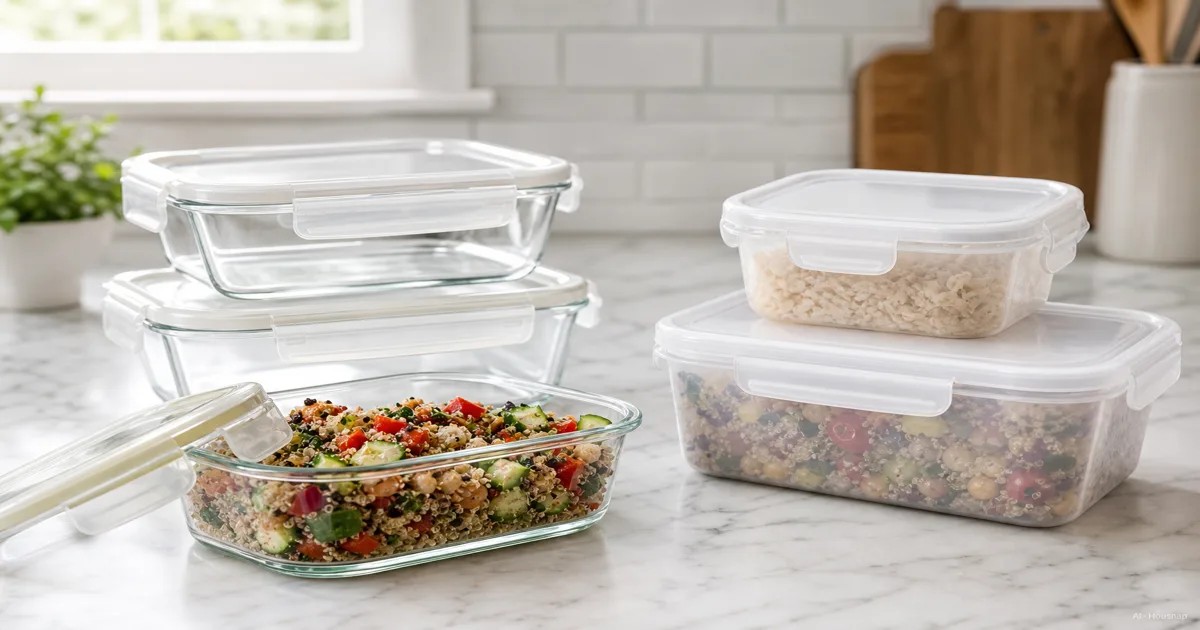
If you have been living with a random collection of containers, the decision to buy a proper set usually happens after one too many stained lids or cracked corners. This guide is for that moment — and for the question that comes right after it: glass or plastic?
Glass: what you actually get
Glass containers do a few things that plastic cannot. They do not absorb odors or stain. A glass container that held tomato sauce on Monday can hold plain rice on Friday with no flavor transfer and no discoloration. That sounds like a small thing until you have scrubbed a stained plastic lid for the fourth time.
Most glass food storage containers are oven-safe — typically up to 450°F (230°C), though some borosilicate glass models go higher. This means you can assemble something directly in the container, refrigerate it, and bake it the next day without transferring to a separate dish. The lid, almost always plastic or silicone, comes off before it goes in the oven.
Glass is also microwave-safe without the lid, which is the standard way to reheat food. The container heats evenly and does not warp or off-gas during the process.
One practical note on glass and temperature changes: moving a glass container directly from the freezer to a hot oven is the scenario to avoid. Most manufacturers recommend letting the container come to room temperature first — or using containers specifically rated for thermal shock (borosilicate glass handles this better than soda-lime glass). Fridge to microwave is fine for all glass containers.
The real tradeoffs with glass are weight and breakability. A glass container is heavy, and if you carry lunch daily, you feel it by Thursday. Glass breaks if dropped on hard floors. These are real constraints, not edge cases.
Glass costs more upfront. But a glass container that does not stain, warp, or degrade lasts indefinitely with basic care — which makes the cost-per-use calculation work out in its favor over time.
Plastic: where it makes sense
Plastic containers are lighter, cheaper, and harder to break. For situations where you are carrying food somewhere, handing containers to kids, or you simply do not want to be careful, plastic is the honest answer.
Good quality plastic containers — specifically those made from Tritan (a copolyester) or food-grade polypropylene — resist cracking and hold up well in the freezer. Glass can crack if it is not given time to come to temperature before going from freezer to a warm environment; plastic handles freezer storage without that concern.
Plastic is not oven-safe. This is the clearest functional limit. If you want to go from refrigerator to oven in the same container, plastic does not work.
Over time, plastic stains and absorbs odors. A container that held curry for a few weeks takes on a yellow cast that does not wash out. Scratches accumulate, and scratched plastic surfaces are harder to clean thoroughly. When the surface looks visibly worn or discolored, it is time to replace the container — the surface has degraded enough that cleaning it properly is no longer realistic.
The cost advantage of plastic is real at the start, but replacement cycles even it out. Glass containers you buy once and keep; plastic you replace periodically.
BPA and what to look for in plastic containers
BPA stands for bisphenol A, a chemical compound used in some plastics as a hardening agent. The concern is that BPA can leach from containers into food, particularly when the container is heated — either in the microwave or with hot food placed directly inside. Research has linked BPA exposure to hormonal disruption at sufficient levels ([FDA on BPA](https://www.fda.gov/food/food-additives-petitions/bisphenol-bpa-use-food-contact-application)).
The FDA has concluded that BPA is safe at low levels currently found in food, but has also acknowledged that reducing exposure where easily possible is a reasonable approach. Most reputable food storage container brands now manufacture BPA-free plastic as the default.
What to look for: containers marked BPA-free and made from Tritan, food-grade polypropylene (recycling code 5), or food-grade polyethylene (codes 2 or 4). Avoid containers with recycling codes 3, 6, or 7 unless specifically marked BPA-free, and avoid heating food in any container not explicitly rated for microwave use.
Tritan is the most common material in premium plastic containers. It is clear, durable, scratch-resistant compared to standard plastic, and resists odor and stain better than polypropylene. It is not perfect — some odor absorption still occurs over time — but it is the better end of the plastic spectrum.
One note: BPA-free does not automatically mean completely inert. Some BPA substitutes (BPS, BPF) are under ongoing study. If you want to completely sidestep the question, glass eliminates it.
Lids and seals: the overlooked part of the purchase
Most people focus on the container and treat the lid as an afterthought. The lid is usually what determines whether a container is actually useful for transport or just for storing things in the refrigerator.
There are three main seal types:
**Snap-on lids** fit over the rim of the container. They seal reasonably well for solid foods and refrigerator storage, but they are not reliable for transporting liquids or wet foods like soups or stews. A bag that gets tipped will leak.
**Airtight lids with a silicone gasket** create a tighter seal by pressing a silicone ring against the container rim. These are what you want for soups, dressings, sauces — anything with significant liquid content. The silicone gasket needs occasional cleaning to prevent odor and mold buildup in the groove.
**Locking tab lids** add one or more latch mechanisms on the sides that press the lid down and hold it in place. The best containers for transport combine a silicone gasket seal with locking tabs — the locking tabs hold the lid under pressure from a full bag, and the silicone seal handles the liquid containment.
For meal prep specifically, where you are usually packing a full container and transporting it, locking lids with a silicone gasket are worth the extra few dollars. For pantry or refrigerator-only storage, snap-on lids are sufficient.
Lid longevity is also worth considering: lids outlast containers, or the reverse. Buying containers in a set from the same brand means replacement lids are available. Mixing brands across a collection means you will eventually end up with containers without matching lids — which is how most people end up in the random pile situation to begin with.
Meal prep sizing: matching container volume to how you cook
Container size is where most starter sets go wrong. A set with four different sizes sounds versatile; in practice, you end up using two of them constantly and the others almost never.
Standard meal prep sizing that works for most people:
**1-cup (240 ml)**: Dressings, dipping sauces, small portions of fruit or nuts. Useful but not the main container. One or two is enough.
**2-cup (480 ml)**: The most versatile size. A single serving of soup, a portion of grains or salad, a standard lunch side. If you are starting from scratch, this is the size to get most of.
**4-cup (960 ml / approximately 1 liter)**: A main meal portion — a full serving of pasta, a protein with sides together, or a large salad. This is the second size to prioritize.
**Larger (6-cup / 1.5 liter and up)**: Useful for batch cooking storage — a full pot of soup, a large batch of grains, a roasted vegetable mix. These are fridge containers more than transport containers.
For a practical starting set, four 2-cup containers and two 4-cup containers covers most meal prep scenarios. The 1-cup size can be added later for dressings and snacks when you have a sense of how you actually use the larger ones.
Silicone containers: a brief note
Silicone containers deserve a mention as a third option. They are collapsible, light, and flexible, which makes them good for travel and for spaces where rigid containers do not fit well. They are not oven-safe (silicone can go in the oven for baking but silicone food storage containers are not rated for the same temperatures), and they do not stack with the same rigidity as glass or hard plastic.
Silicone works well as a supplement for specific use cases — a collapsible bag for packed snacks, a small container for liquids — rather than as a primary meal prep container. For everyday use, glass or plastic will be more useful.
What to buy first
For someone starting a proper container collection:
**Primary recommendation**: 2-cup glass containers with an airtight silicone-gasket lid. Glass at this size is not prohibitively heavy, it handles microwave reheating and oven baking in the same container, and it does not stain or absorb odors from a rotation of different foods. Start with four of these.
**Add if you batch cook**: Two 4-cup glass containers for the larger portions — a full serving of grain bowls, pasta, or a protein with sides.
**For packed lunches where weight or breakage matters**: A set of BPA-free Tritan plastic containers in the same 2-cup size, with locking lids. Carry these; leave the glass at home for reheating.
Glass for home use and the oven. Plastic for the bag. That division of roles is the practical answer for most people.
Sources
- [Glass vs. Plastic Meal Prep Containers Compared, JollyChef](https://jollychef.com/blogs/practical-tips/glass-vs-plastic-good-meal-prep-containers-comparison) — practical comparison of both materials for meal prep use
- [Glass vs. Plastic Food Storage Containers, Mess Brands](https://www.messbrands.com/inspiration/glass-vs-plastic-containers-for-food-storage/) — material properties, tradeoffs, and use-case guide
- [FDA on Bisphenol A (BPA) in Food Contact Applications](https://www.fda.gov/food/food-additives-petitions/bisphenol-bpa-use-food-contact-application) — regulatory position on BPA safety and current status
- [How to Tell If a Glass Container Is Oven Safe, Alibaba Wellness](https://wellness.alibaba.com/nutrition/oven-safe-glass-containers-guide) — temperature ranges and oven-safe identification guide
- [Meal Prep Containers Guide, I Hate Meal Prep](https://ihatemealprep.com/meal-prep-containers/) — sizing and practical container selection for meal prep