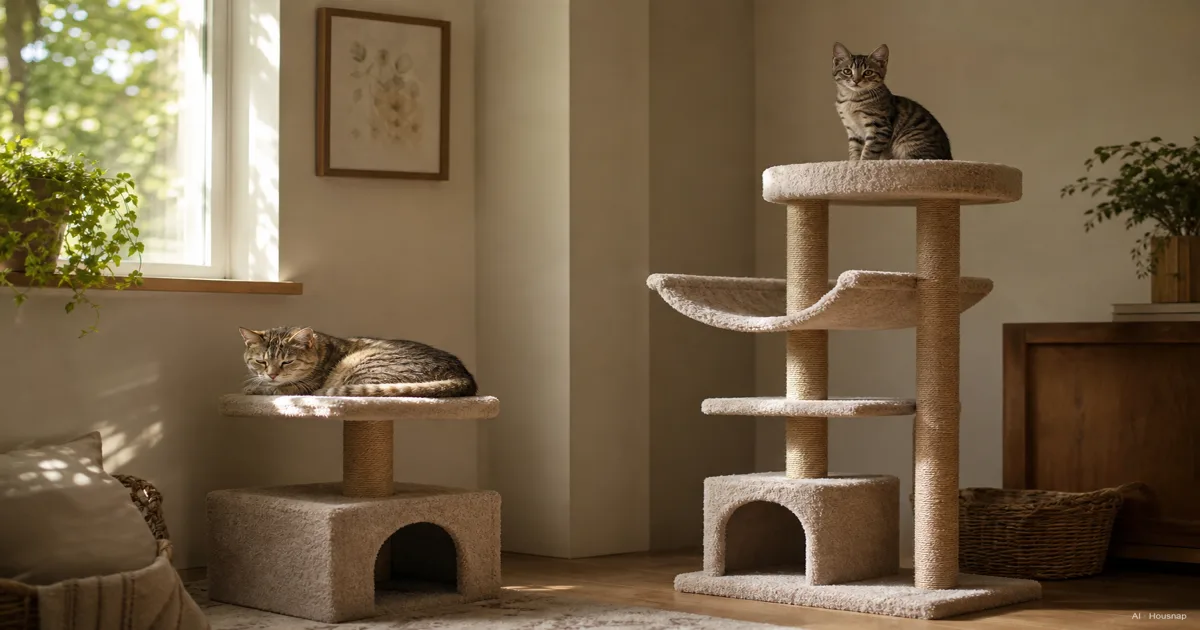
Choose the layout around how your cat moves
Look at the places your cat already reaches and rests. Use those observations to choose between a compact tree with accessible platforms and a taller tree with a usable route up and down. Trace that route in the product photos; a high bed is little help if the platforms below it do not provide suitable access.
If jumping has become difficult, smaller steps or a ramp can help preserve access to a favourite perch. A new reluctance to jump deserves veterinary attention rather than simply a shorter tree (International Cat Care).
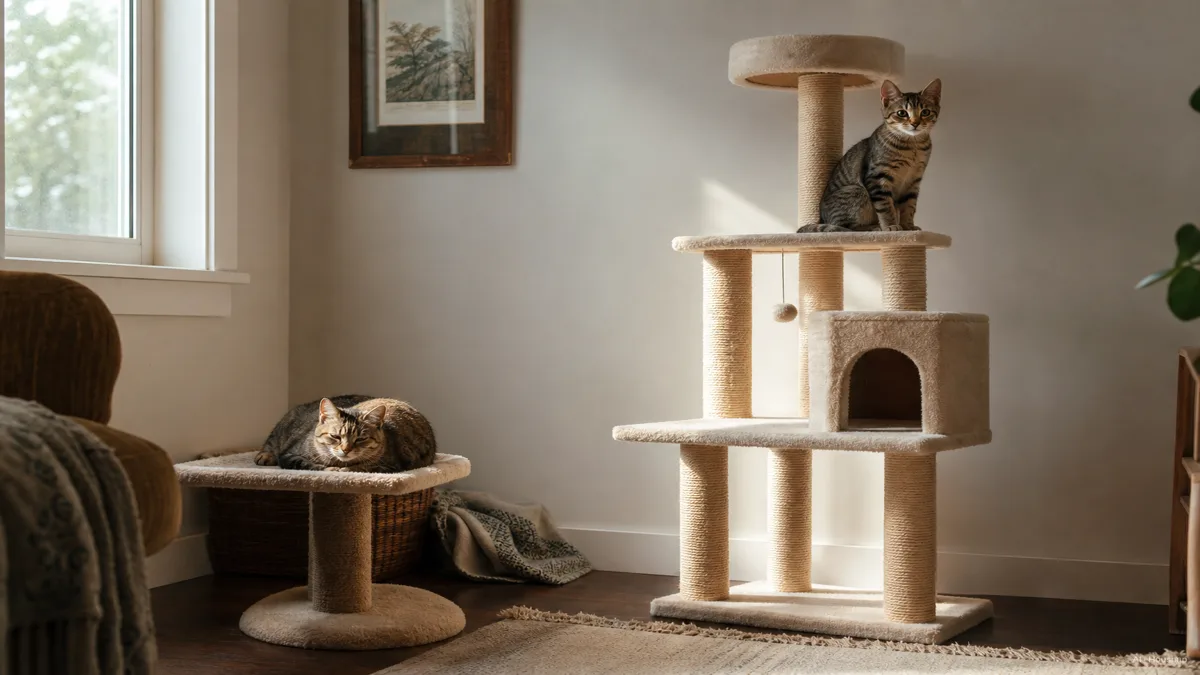
If a sheltered retreat is the immediate need, an open carrier can also provide a safe place (FelineVMA). If you also need one for travel, compare soft-sided and hard-sided carriers before choosing a tower mainly for its enclosed box.
Check usable space and installation, not just total height
Write down the floor space available, your cat’s weight and the space they occupy when resting. Then ask for the dimensions that let you compare candidates:
- Resting surfaces: the usable platform area, excluding posts and raised edges, plus the enclosed bed’s internal dimensions and opening.
- Floor space: both the base dimensions and any projecting platforms. Mark that outline where the tree will stand.
- Load limits: what the manufacturer’s rating covers, including any separate platform or hammock limit. The tree’s own weight is not its carrying capacity.
Armarkat’s A8104 specifications list base dimensions, overall dimensions, product weight and holding capacity separately. Treat missing measurements as questions for the seller, not blanks to fill from a photograph. Armarkat also notes that base stability matters even within the stated weight limit.
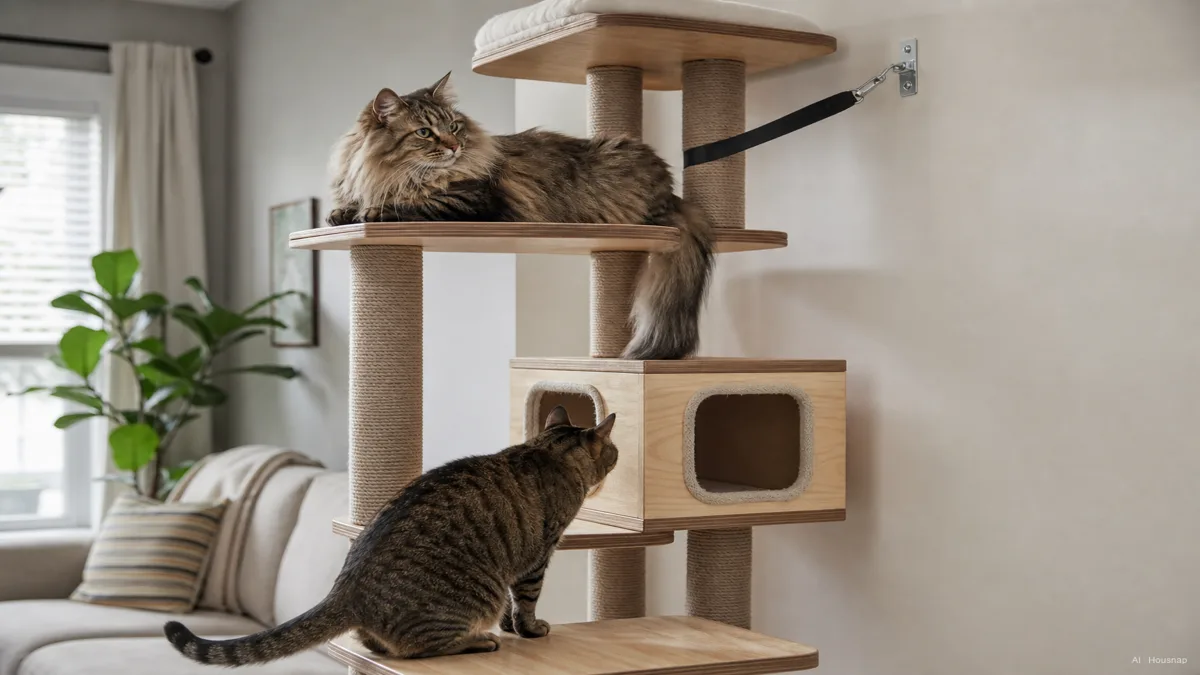
For several cats, count separate retreats, not just platforms on one tower. Provide at least one safe place per cat in separate locations; a retreat with two exits helps avoid another cat blocking the way out (FelineVMA).
Check anchoring requirements before buying. Armarkat lists a wall-anchoring safety strap for the A8104, but that does not establish the installation method for another model. Ask for the instructions for your chosen tree. If you cannot complete its required installation, remove it from your shortlist.
Match the scratching surface and check what can be cleaned
Observe both the texture and the direction your cat already scratches. Cornell recommends matching those preferences; carpet is not automatically the wrong choice, and sisal is not a guarantee that every cat will use a post (Cornell Feline Health Center).
For upright scratching, look for a stable post with enough uninterrupted height for a full stretch. A cat that scratches horizontally may still need a separate suitable surface even when the tree has posts (Cats Protection).
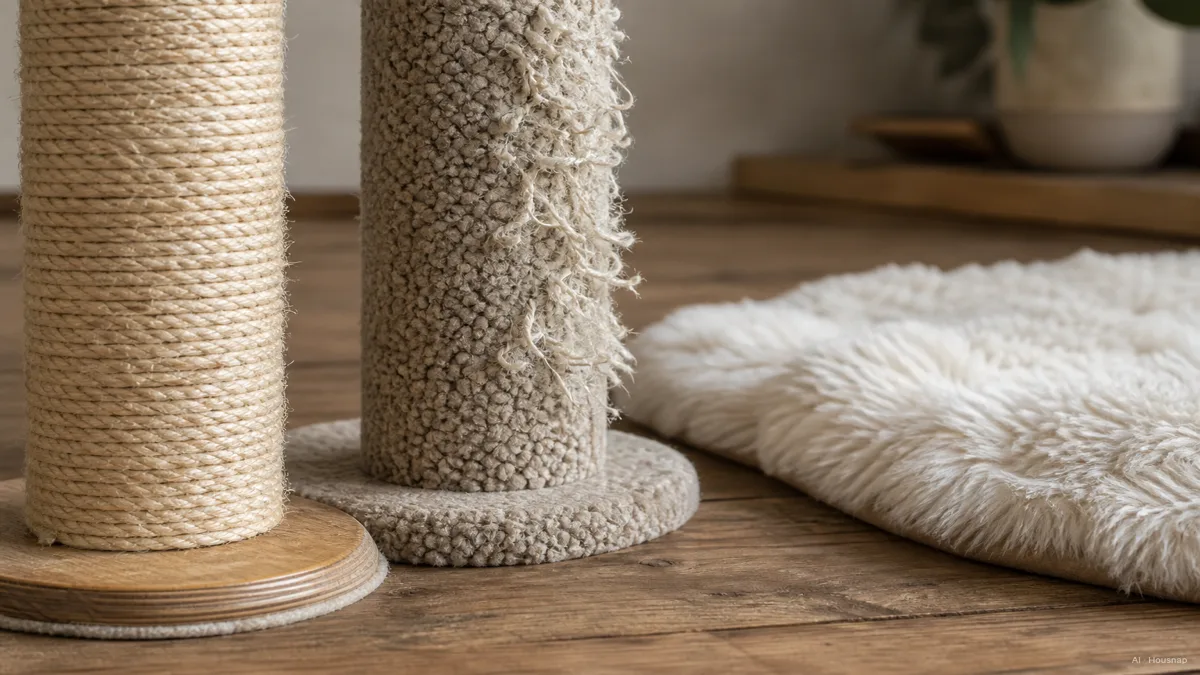
Compare the sleeping cover separately from the scratching material. Ask which pieces detach, how each is cleaned and whether worn parts can be replaced. For example, Catit specifies hand-washing detachable Vesper fabrics but cleaning its scratching posts and mats without washing them in water. That is a product-specific distinction, not permission to wash every plush-covered tree (Catit cleaning guide).
Turn those checks into a shortlist
Compare cat trees only after you have identified the required access route, resting dimensions and installation conditions.
- Keep: candidates with confirmed usable dimensions, appropriate stated load limits, suitable access and installation you can complete.
- Ask first: candidates missing platform measurements, clear capacity information or cleaning instructions.
- Pass: candidates whose required fixing cannot be installed, or whose layout leaves the intended sleeping place inaccessible to your cat.
Between candidates that meet those checks, use removable covers or replaceable wear parts as practical tie-breakers. Extra platforms should earn their place by giving your cat somewhere usable to go.
Make the first introduction easy
Check the parts against the instructions before assembly; Catit’s assembly guidance also suggests assembling away from the cat if the noise is unsettling. Complete the specified installation before use.
Let your cat investigate voluntarily. Reward scratching you want to encourage, and do not take their paws and move them along the post (Cats Protection).
Sources
- FelineVMA, environmental needs
- International Cat Care, adapting the home for mobility problems
- Cornell Feline Health Center, scratching preferences
- Cats Protection, scratching-post selection
Model-specific construction, assembly and cleaning sources are linked beside the relevant checks.
Comment ce guide a été conçu
Written by Housnap AI using feline-environment guidance from FelineVMA, International Cat Care, Cornell and Cats Protection, alongside manufacturer specifications and instructions. The selection checklist is an editorial synthesis for first-time buyers; it does not report hands-on product testing.