High-Protein, Grain-Free Cat Food, How to Choose Your First Bag
You went looking for the best cat food and the shelf answered with two words on almost every bag. Grain-free. High-protein. They sound like the same good thing, and the prices say they should be the smart choice. So you reach for one, and a small doubt follows you to the checkout. Is this actually better, or does it just sound better? Here is the part the front of the bag will not tell you. Grain-free and high-protein are not the same promise. One is about a label your cat does not care about. The other is about how your cat's body is actually built. Cats are obligate carnivores. Their metabolism runs on animal protein in a way that is genuinely different from dogs and from us. So protein is the real question. Grain is mostly a marketing one. Once you separate those two, a high-protein grain-free bag stops being a slogan and turns into something you can check. You just need to know which three lines on the package are doing the honest work.

Disponibles actuellement chez une boutique
Ces produits ne sont proposés pour l’instant que par une seule boutique chacun. La comparaison de prix s’ouvrira avec plus de boutiques.
Why Cats Need High Protein: The Obligate Carnivore Case
Start with the one fact that the whole category is built on. A cat is an obligate carnivore, which means its metabolism is wired to use protein as a primary energy source rather than carbohydrate. That is not a preference or a trend. It is a built-in requirement, and it sets cats apart from most other mammals, dogs included, as the review of amino acid nutrition in cats and dogs lays out.
That biology shows up in the numbers. AAFCO sets a minimum of 26 percent protein on a dry matter basis for adult cats and 30 percent for kittens, and that is a floor, not a target. A protein-forward food sits comfortably above it, which is the honest reason high-protein matters for a cat in a way it simply does not for a dog.
There is one amino acid that turns this from a preference into a hard rule. Taurine. Cats cannot make enough of it on their own, and a shortage leads to serious problems, including a heart condition called dilated cardiomyopathy and retinal degeneration that can take a cat's sight. The study on amino acid metabolism in cats is blunt about why this matters. So any good high-protein or grain-free cat food lists supplemented taurine right there in the ingredients. If you cannot find it, that is reason enough to put the bag back.
Here is the practical takeaway before we even touch the grain question. For a cat, more real animal protein is genuinely the right direction, as long as taurine is on the label. That is the part of the high-protein promise that is actually about your cat.

Grain-Free vs. Grain-Inclusive: What the Label Actually Means
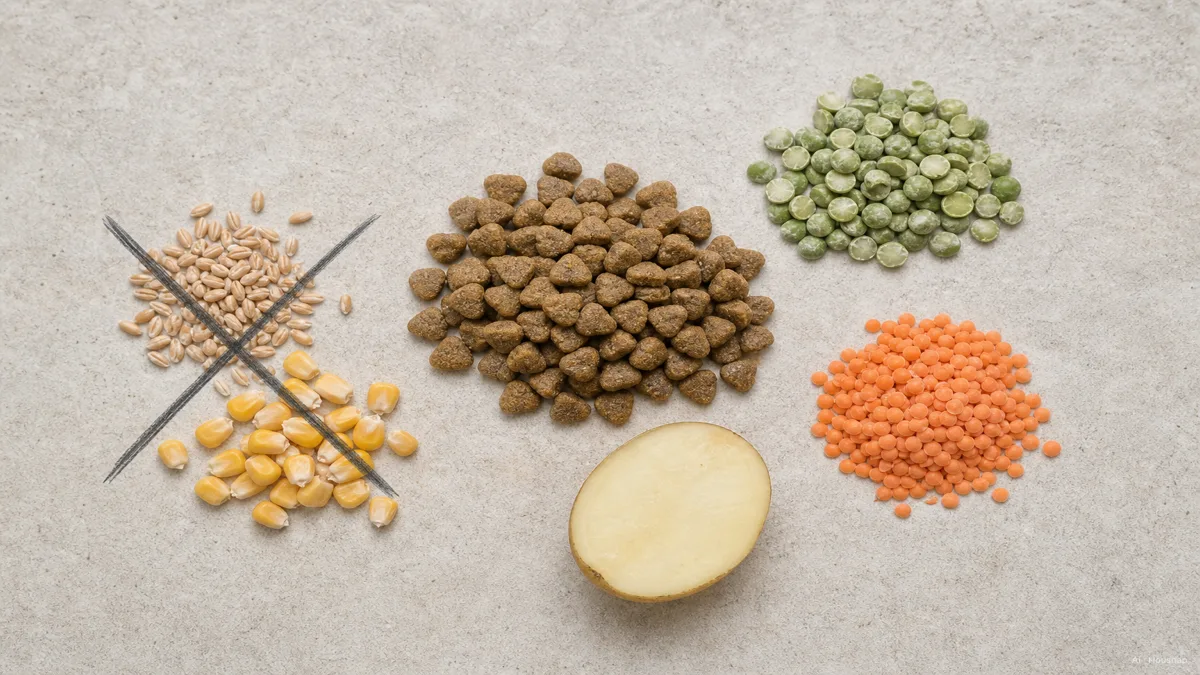
Now the word that does most of the marketing. Grain-free simply means no wheat, corn, oats, rice, or barley. That is the whole definition, and it is narrower than it sounds.
The catch is that grain-free is not carbohydrate-free. Dry kibble physically cannot exist without a starch to bind it and hold its shape, so a grain-free formula just swaps the grain for something else, usually legumes like peas, lentils, and chickpeas, or potato. Hill's explanation of grain-free cat food makes this plain: take out the corn, put in the peas, and the carbohydrate is still there. So the useful question is not whether a food is grain-free. It is how much total starch is in the bowl, whatever its source.
It is also worth deflating the fear that usually drives the grain-free purchase. True grain allergies in cats are rare, and PetMD's look at grain-free and gluten-free cat food points out that most cats do perfectly well with grain in the diet. If your cat has a confirmed sensitivity, grain-free is a real tool. If you are buying it just in case, you are mostly buying a label.
And the headline worry, the one linking grain-free diets to heart disease, deserves a calm look. A 2026 updated review of grain-free diets for dogs and cats found no established causal link between grain-free food and dilated cardiomyopathy in healthy cats. The concern has been far more significant in dogs and in poorly formulated foods that skimped on taurine, which loops right back to the previous section. Pick a grain-free food that supplements taurine and the scary headline mostly stops applying to you.

How to Read a Cat Food Label, Protein Percent, Dry Matter Basis, and AAFCO
This is where a first-time buyer gets quietly misled, so slow down here. The protein percentage on the front of the bag is almost never a fair number to compare across foods, because of water.
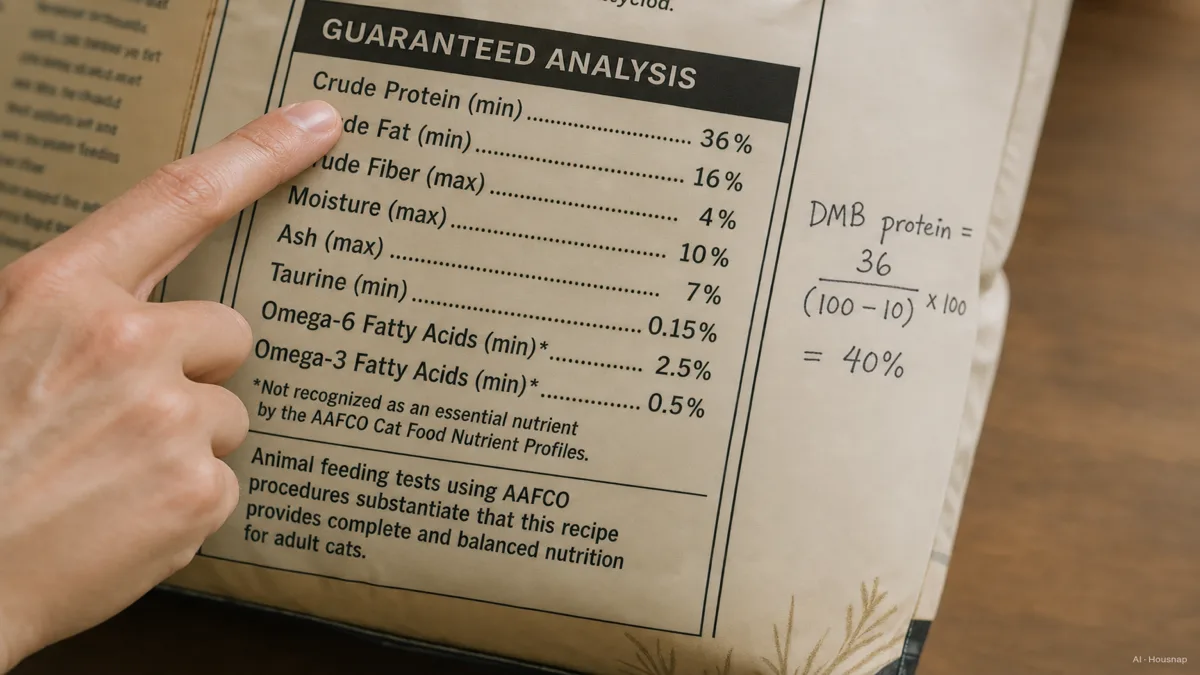
Dry food holds around 10 percent moisture and wet food holds 75 to 78 percent, so their labels live on completely different scales. To compare them honestly you convert to a dry matter basis, which sounds technical but is one short step: take the as-fed protein percent, divide it by 100 minus the moisture percent, then multiply by 100. A wet food showing a modest 10 percent protein at 80 percent moisture actually lands near 50 percent protein on a dry matter basis. Cats.com walks through this conversion, and once you have done it twice it becomes automatic. Without it, you will underrate every can and overrate every bag.
The second line that settles a lot is the AAFCO nutritional adequacy statement. You are looking for a sentence saying the food is complete and balanced, either formulated to meet AAFCO nutrient profiles or tested using AAFCO feeding procedures, for a named life stage. VCA's guide to grain-free and designer cat diets explains why this statement is the difference between a complete diet and a topper. A bag without it should not be your cat's main food, however impressive the rest of the label looks.
Put those two together and a confusing label gets simple. Convert protein to a dry matter basis so you are comparing like with like, then confirm the AAFCO statement matches your cat's life stage. Two lines, and most of the marketing noise falls away.

Top Ingredients to Look For, and the Red Flags to Avoid
The ingredient list is the most honest signal on the whole package, because ingredients are listed by weight. So the first three are where you spend your attention.
What you want to see is named animal proteins leading the list. Chicken, salmon, turkey, named and specific. Catster's roundup of grain-free cat foods and Cats.com's high-protein picks both keep coming back to this same point: the quality of a cat food is mostly decided in those first few lines.
Now the red flags. If pea protein, a meat meal, or a vague byproduct term shows up as the first ingredient, be careful. Pea protein in particular is the trick behind a lot of impressive-looking numbers, because it inflates the total protein percentage without bringing the animal-quality amino acid profile a cat actually needs. A 40 percent protein food can look identical to another on the front of the bag while one leans on chicken and the other leans on peas. The ingredient order is what tells them apart.
This is also where the strong brands earn their reputation rather than just their price. Names that come up repeatedly for genuine animal-first formulas include Orijen, with a very high share of animal ingredients, ACANA, Instinct, Open Farm, Solid Gold, and Purina ONE's grain-free line. You do not need to memorize a winner. You need the habit of checking that animal protein, not a legume, is leading the list, and then letting the comparison sort the rest.
A small bonus axis most first-time buyers miss: if your cat lives indoors, a formula that also includes a fiber source like psyllium or beet pulp can quietly help with hairballs and digestion, without giving up the protein-forward profile.
Switching Foods Safely, the 7 to 10 Day Transition Guide
One last thing, because the best bag in the world can still upset your cat if you rush it. Cats are sensitive to abrupt diet changes, and switching cold turkey is a reliable way to cause vomiting or diarrhea.
The fix is slow and boring and it works. Over seven to ten days, mix the new food into the old. Start with about 25 percent new and 75 percent old for the first two to three days, move to a 50/50 split, then 75 percent new, then the full switch. Cats.com's feeding guidance describes this same gentle ramp, and the whole trick really is just patience.
There is one more thing that catches people moving to a high-protein grain-free food specifically. These formulas are usually more calorie-dense than a standard food, so feeding the same volume your cat ate before can quietly add weight. Recalibrate the portion using the new bag's feeding guide, not your old muscle memory. And because cats have a low thirst drive and are prone to urinary and kidney issues, many vets suggest pairing a protein-forward diet with wet food or mixed feeding for the extra moisture.
So the finish line is concrete. Confirm taurine and the AAFCO statement, read the first three ingredients, convert the protein to a dry matter basis, and then ease into it over a week and a half. From here the useful next move is to line up high-protein grain-free options side by side, see how the leading animal-first brands price the same food across stores, and check that the bag you are leaning toward actually puts meat at the top of its list. You'll find products from the names that show up most in this category, so the comparison stays concrete rather than hypothetical.
Sources
- Grain-Free Diets for Dogs and Cats: An Updated Review — PMC/NCBI; no established causal link between grain-free diets and dilated cardiomyopathy in healthy cats, and where the real concern sits
- Amino Acid Nutrition and Metabolism in Domestic Cats and Dogs — PMC/NCBI; cats as obligate carnivores, higher protein requirement, and why taurine is essential
- The Best Grain-Free Cat Foods — Cats.com; dry matter basis conversion, calorie density, and the 7 to 10 day transition
- Best Grain-Free Cat Foods — Catster; named animal proteins as first ingredients and pea-protein red flags
- What's in My Cat's Food: Designer and Grain-Free Diets — VCA Animal Hospitals; the AAFCO nutritional adequacy statement
- Grain-Free and Gluten-Free Cat Food — PetMD; grain-free is not carbohydrate-free, and true grain allergies are rare
- Grain-Free Cat Food: What You Need to Know — Hill's Pet; legume and potato substitutes and total starch
- 8 Best High Protein Cat Foods — Catster; high-protein brand landscape and ingredient-list quality
Comment ce guide a été conçu
This topic opens the cat-food cluster for Housnap, and it is built around the doubt most first-time cat owners carry to the checkout: a bag says grain-free and high-protein, and you cannot tell whether that is real or just packaging. The spine is that grain-free and high-protein are two different promises, and only protein is genuinely about an obligate carnivore. We anchored the obligate-carnivore biology, the protein minimums, and why taurine is non-negotiable on the PMC review of amino acid metabolism in cats and dogs, and took the calm reading of the grain-free heart-disease worry from the 2026 PMC updated review, which found no established causal link in healthy cats. The label mechanics, dry matter basis conversion, calorie density, and the 7 to 10 day transition, come from Cats.com; the grain-free-is-not-carb-free point from Hill's and PetMD; the AAFCO statement from VCA; and the ingredient-order and brand landscape from Catster. Housnap covers Pet Supplies and stocks the leading animal-first brands across its retail partners, so the framing reflects products the catalog is built to compare, though offer depth is still being confirmed and the recommendations stay hedged.